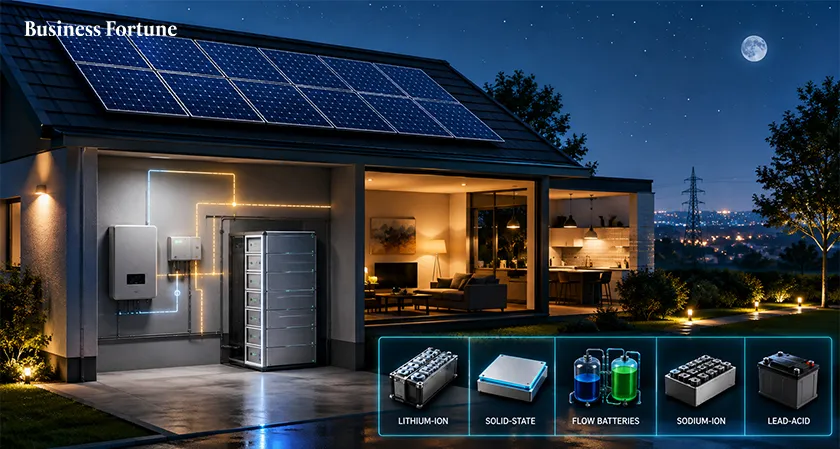
Discover the Best Battery Storage Technologies for solar power, from proven lithium iron phosphate batteries to emerging sodium-ion and flow battery systems.
The best battery storage technologies are really changing what solar power can do when the sun is not out. A solar system on your roof makes a lot of electricity around the middle of the day. Most homes use the most electricity in the evening. So what happens is that, without a way to store the electricity you have to send it to the grid when you are not using it during the day. Then you have to buy electricity from the grid when you need it at night.
But if you get the right kind of battery you can use the sunshine from the afternoon to have lights on in the evening or to keep your food cold at night. You can even use it as power when the electricity from the grid is not working. Solar power and battery storage technologies are really useful. That simple idea is driving a much bigger shift in the energy world. Storage makes it possible for solar power to be used whenever it is needed, not just when the sun is shining.
The U.S. Department of Energy says storage is a way to collect energy when there is a lot of it and use it when people need it the most. But here is the interesting thing: there is no best battery for all solar setups. The best option depends on how many times the battery will be charged and discharged, how much energy it needs to store, how much room is available, the weather in the area, safety rules and of course the money you have to spend.
Why Solar Needs a Battery in the First Place?
Picture your solar panels working hard at 1 p.m. Your family on the other hand is at work or school. The panels might be making more electricity than your house uses. Move ahead, to 7 p.m. The family is home. Lights are on. The television is running. Dinner is cooking. Perhaps an air conditioner or water heater is drawing substantial power. The solar panels are producing little or nothing. That is where battery storage for solar power becomes useful.
Instead of treating excess daytime generation as electricity that must immediately be consumed or exported, a storage system can hold some of it for later. This concept is commonly called solar plus storage. It can increase the usefulness of an existing solar installation while also providing backup capability, depending on the equipment and system design.
The basic battery itself is surprisingly simple. During charging electrical energy is turned into energy. During discharge that chemical energy is turned back into electricity. The chemistry inside the battery however has an impact.
- Lithium Iron Phosphate
If solar batteries were in a popularity contest lithium iron phosphate usually known as LFP or LiFePO4; would be hard to beat. LFP is part of the lithium-ion group. Its chemistry is different from other lithium-ion types like nickel-manganese-cobalt. It has become very popular for storage because it offers good performance along with a strong emphasis, on lasting strength and safety.
For homeowners looking at solar energy storage systems, LFP is often the starting point worth investigating. Why? It offers high usable energy, relatively strong cycle life and good efficiency, while lithium-ion manufacturing is already mature.For many residential and commercial installations, though; LFP currently offers one of the strongest combinations of practicality, performance and availability.
Best suited for: daily home cycling, backup power, commercial installations and many grid-connected systems.
- Lithium-Ion NMC
Another lithium-ion option is nickel-manganese-cobalt or NMC. NMC has historically been popular where energy density matters. That means more stored energy can fit into a relatively small and lightweight package. That advantage is particularly valuable in electric vehicles, portable electronics and situations where physical space is tight. A battery sitting in a garage or outdoor enclosure does not need to be carried around. This changes the calculation.
Best suited for: applications where space and energy density are especially important.
- Sodium-Ion
Lithium-ion batteries have been the choice for solar energy storage technology, for a long time but now sodium-ion batteries are becoming a real option. Sodium is everywhere so using it in batteries could help us get the things we need to make batteries from places and not have to rely so much on certain materials that are hard to find. If the battery is affordable, durable and safe, slightly lower energy density may be acceptable. Sodium-ion could therefore become an increasingly interesting option for stationary battery energy storage systems as manufacturing scales.
Best suited for: stationary storage, cold environments and applications where material availability and cost diversification matter.
- Flow Batteries
Flow batteries are really different from other batteries. They do not store all the energy inside the battery itself instead they use liquids that are stored in big tanks. These liquids are moved through a cell by pumps when the flow battery is being charged or used. This way of doing things gives flow batteries an advantage: they can store more energy if you make the tanks that hold the liquid bigger. It is a new way of thinking about batteries.
However they do not have a lot of renewable energy storage and they are not very powerful. In terms flow batteries are not trying to pack a lot of energy into a small space. They are more focused on being useful for a time and being able to be used many times. That makes them very interesting for solar farms commercial buildings and power grids where space is not a problem and being able to store energy for several hours is more important than being small.
Best for: installations storing energy for a long time and applications that need to be used many times.
- Lead-Acid
Before lithium batteries became really popular for storing energy lead-acid batteries were used all the time. They are cheap. People knew how to use them. They could also be recycled easily. For a time they had been used to power systems that need backup, vehicles and places that were not connected to the main power grid.
So why are they not the choice now? The problems with lead-acid batteries become clear when you need to use them every day. Lead-acid batteries do not store much energy as some other types of batteries and they do not last as long. Using them a lot can also shorten their life. If you leave them without charging for a time it can hurt how well they work forever. High temperatures are also a problem for lead-acid batteries.
Best suited for: budget-focused systems, occasional backup and some off-grid applications.
So, Which Are the Best Batteries for Solar?
The answer depends on the job. For a typical homeowner wanting a battery that charges during the day and powers the house later, LFP is currently one of the most compelling choices. For a large solar project where long-duration discharge and repeated cycling are priorities, flow batteries deserve serious consideration. For installations in very cold environments or projects looking toward emerging chemistry, sodium-ion is worth watching closely. Lead-acid remains an economical option where daily cycling is not required.
What Really Matters When Choosing a Battery?
Battery chemistry gets most of the attention, but shoppers should look beyond the chemistry label. Look at usable capacity and the manufacturer's recommended operating range. Power Rating Capacity tells you how much energy the battery can store. Power tells you how quickly it can deliver it. A large battery with a modest power rating may store plenty of electricity but struggle to run several high-demand appliances simultaneously. Every charge and discharge cycle contributes to battery degradation. If you plan to cycle your battery every day, cycle life becomes much more important than it would be for an emergency-only backup system. Round-trip efficiency generally means more of your generated electricity makes it to the final load. Batteries don't love extreme temperatures. The installation location, ventilation, thermal management and manufacturer's operating limits can all affect performance and longevity.
Warranty
A battery warranty can tell you a great deal about what the manufacturer expects from its product. Check not just the number of warranty years, but also cycle limits, retained-capacity guarantees and operating conditions. The Rise of Smarter Solar Storage Modern solar battery systems are becoming much more than boxes that store electricity. Energy-management software can monitor household consumption, solar production, battery state of charge and grid conditions. The system can then decide when to charge, discharge or preserve energy for backup. That intelligence matters. Suppose a storm is approaching and a power outage becomes more likely. A smart system may preserve some battery capacity rather than emptying the battery earlier in the day. The battery is still doing the physical work, but software increasingly determines when that work makes the most sense.
Beyond Batteries: The Bigger Storage Picture
Not every storage problem needs a battery. The energy industry is exploring pumped-storage hydropower, compressed-air storage, thermal storage and hydrogen alongside electrochemical technologies. A homeowner may need four to eight hours of backup. A utility may need to shift enormous amounts of solar energy into the evening. Another system may need electricity for several days.
Business Fortune believes the best battery storage technologies for power systems are not always the newest or the most expensive ones. They are the ones that match the needs of a solar system.
FAQs
What are the best battery storage technologies for power systems?
For homes and commercial installations lithium iron phosphate batteries are a good choice. Flow batteries and sodium-ion batteries can also be an option for specific applications. Lithium iron phosphate batteries are an all-around choice for solar power systems.
Is lithium iron phosphate better than lead-acid for power systems?
For use lithium iron phosphate batteries are generally better than lead-acid batteries because they last longer and work better.
Are sodium-ion batteries for solar storage?
Sodium-ion batteries are an option that has some good characteristics, especially in cold temperatures. However they do not store much energy as lithium-ion batteries.
Are flow batteries suitable for homes?
Flow batteries can be used for storage. They are big and do not store a lot of energy so they might not be practical for many homes.
How long should a solar battery last?
It depends on the type of battery, how it is used and how it is maintained. Always check the warranty of the battery of just looking at how long it is supposed to last. The lifespan of a battery depends on many factors including chemistry, operating temperature and maintenance.


.webp)





























Comments