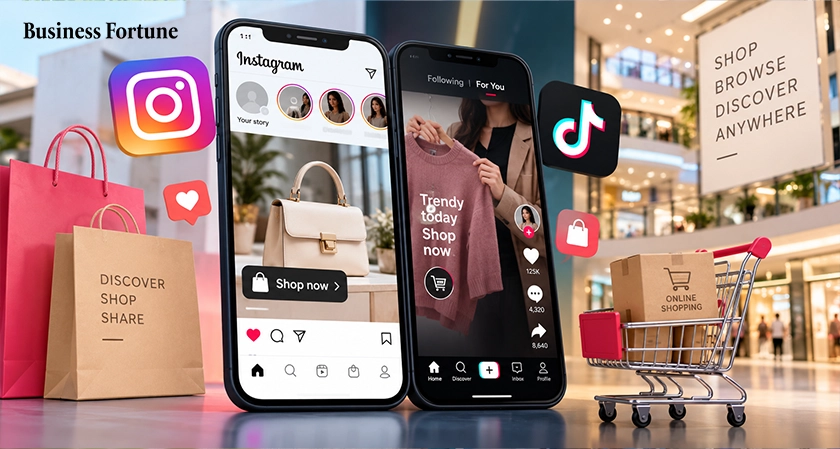
The Top social commerce trends of 2026 could revolutionize entertainers and buyers. For instance, we could turn a fashion video into a shop, a beauty influencer’s skincare routine into a recommendation and a live stream into a surprise shopping event.
The power of social commerce lies in its ability to engage the consumer at the decision making stage and shorten the sales funnel considerably.
Below are the top social commerce trends of 2026.
- Short-Form Video Is Becoming A Storefront
If there is any doorway to social shopping trends it is through short-form video. As we enter 2026, more and more consumers are using videos to discover content and by extension products. In particular, TikTok Shop and Instagram Reels users could leverage video to fuel their social commerce efforts in 2026. A 20-second video could serve as a buying prompt whereas longer videos could narrow down the search.
It is important to note that for brands the discovery via video has mixed results; on the one hand it is a powerful engagement and sales tool but as a discovery aid it has its limitations. After all, video needs to captivate the consumer to drive the sale.
Instagram Is Becoming An Investigation Tool
As one of the first visual commerce adopters, Instagram enables brands to harness the platform’s reach to drive traffic to products. Be it clothes, accessories, cosmetics or cuisine; nothing is beyond the investigation powers of Instagram for a brand’s goods and services.
Instagram Shopping Trends 2026: Authenticity Wins
As Instagram Shopping grows, so do consumer expectations. While product photography will continue to reign supreme on Instagram, the same cannot be said for product showcasing and investigation. In particular, as the social commerce trends of 2026 indicate, the demand for user-generated content (UGC) is on the rise. In effect, customers are relying on blogs and videos for honest opinions about brands; accordingly, companies should motivate their customers to post photos and videos about products that they are enthusiastic about. In 2026 authenticity is overtaking product photography because customers know they can trust other buyers.
- Creators Are Becoming Product Demonstrators
This social commerce trend is ideal for brands because it has the best of both worlds: On the one hand it drives traffic to the brand; on the other it entertains the influencer’s audience. By demonstrating and reviewing a product an influencer can serve as a buying companion to their audience.
- TikTok Shop Trends 2026: Entertainment Meets Commerce
While TikTok has blurred the lines between social media and commerce, the TikTok Shop trends suggest that it is shortening the distance between discovering and purchasing products. For TikTok users who want to find products, the TikTok Shop trends suggest that research and entertainment are converging. In other words, a TikTok user searching for products may stumble upon a product review, comedy skit, and cooking show all in one video.
In essence, TikTok’s shopping features enable TikTok’s creators to recommend products to their audience. Its live stream technology exploits TikTok’s entertainment value to facilitate a unique shopping experience called live stream selling. During a TikTok live stream selling event a creator could demonstrate and discuss products with their audience in real-time.
- AI Is Helping Make Recommendations Feel Personal
One of the most critical social commerce trends for 2026 is that artificial intelligence (AI) can make product recommendations feel personal.
When a consumer browses products on social media, they could encounter thousands of products. That is why product personalization is so important: by harnessing the power of AI brands can make product recommendations that are individualized to the consumer’s preference. For the consumer it means a more accessible and pleasant shopping experience, whereas for the brand it means higher sales due to the personalized product recommendations.
- Social Commerce Trends Are Becoming Conversational Commerce
Conversational commerce is fast becoming one of the most critical social commerce trends for 2026. By enabling a conversation with the brand, the consumer can ask questions and have them answered. Before purchasing a product, the consumer may have several questions ranging from what payment methods are available to the returns policy.
At the same time, social commerce trends suggest that brands can leverage conversational commerce to engage their audiences. In many ways, social commerce trends suggest that conversational commerce will follow omnichannel retailing, whereby brands can engage their audiences across multiple channels. In practice it can mean that a brand’s social commerce efforts can utilize conversational commerce to provide customer service to their audiences. By responding to comments and messages in a friendly and helpful manner brands can drive engagement and build relationships with their audiences.
- Small Creators Can Have A Surprisingly Big Impact
When it comes to social commerce, the adage states that the bigger the creator the better. After all, a creator with one million followers is exponentially better than someone with one thousand. Nevertheless, social commerce trends suggest that there is an alternative: a creator does not need to have many followers to be influential.
In fact, a creator with few followers can sometimes be much better for a brand: someone with five thousand followers can have a much better engagement rate than someone with 250,000.
- The Checkout Experience Is Vital For All
Ultimately no social commerce campaign is complete without optimizing the checkout experience. In many ways it is the ultimate litmus test for a brand: no matter how many views your product gets on social media, it will only sell as many as the number of people who can get through the checkout process. If someone is frustrated and put off by the experience, they will inevitably leave, annoyed and disappointed.
Therefore, it is vital to optimize the checkout process and make it as smooth as possible. By streamlining the experience and removing as many barriers as possible you can maximize the chances of a sale.
What It Means For Brands
A brand’s cardinal sin when it comes to social commerce is to think of Instagram and TikTok as marketing channels only. In 2026 they are much more: they are discovery engines. Therefore, brands need to think holistically about their social commerce efforts: they need to invest in visual appeal, product presentation, video creation, creator outreach, customer service and even checkout optimization to reap the rewards of social commerce.
Another crucial lesson for brands is multi-platform sales: while virality is a wonderful thing it is not a sure thing, which is why inventory management is so important. After all, a brand is only as strong as its weakest link and an excellent social commerce campaign cannot offset poor logistics.
The Hidden Trend: Social Commerce Is Becoming Omnichannel
One of the most critical social commerce trends for brands to realize is that social commerce is becoming omnichannel. In 2026 the most successful shopping experiences are those that employ multiple avenues and platforms to facilitate a purchase.
A consumer may discover a product on TikTok, investigate it on Instagram, look at the website and purchase on the mobile site. In other words, as social commerce becomes mainstream the lines between various platforms and traditional e-commerce will begin to blur.
What Products Work Particularly Well?
Certain categories are better suited to social commerce due to their visual, demonstrable or easily explained nature.
Fashion is an obvious example, due to the way consumers can see items being styled in different ways and take inspiration from creators.
Beauty lends itself to social commerce due to tutorials, before-and-after demonstrations and routines – all of which can be demonstrated in video form.
The same goes for home décor, fitness, tech, food and lifestyle products: all of which can be effectively showcased and reviewed in the right type of content.
The common link is not necessarily the category, but a compelling narrative around the product.
What Should Brands Measure?
Likes and followers are nice, but they’re ultimately vanity metrics.
Brands should be measuring conversion rate, click-through rate, average order value, engagement rate and return on ad spend; metrics which demonstrate a link between social commerce activity and revenue.
A video viewed by 100,000 people with no purchases has less value than a video viewed by 10,000 people which drove sales.
The smartest brands will use such metrics to balance out views with an emphasis on commercial value.
What Comes Next?
The next evolution of social commerce will be more personalised, interactive and integrated than ever before.
AI will continue to drive recommendations, while creators act as trusted voices for specific categories of product. Video will dominate, but increasingly so will live content and formats which enable in-the-moment interaction with brands, other consumers and products.
However, technology will only get brands so far – it’s trust which will determine which retailers thrive within social commerce.
Consumers have a very short attention span, meaning they’re likely to dismiss a marketing message in favour of something which entertains, engages, informs or provides value. That is the crux of social commerce: harnessing that attention for product discovery, inspiration and purchase all in one place.
The Top social commerce trends represent a new kind of retail experience which blends entertainment, discovery and transaction in one environment. Instagram and TikTok are no longer simply channels for brands to market products – they have evolved into destinations where consumers search, discover, research, engage, shop and increasingly purchase.
For brands, success in social commerce will be dictated not just by the ability to encourage a purchase, but to create content which consumers will want to engage with. That means building trust through credible recommendations, engaging content formats and removing barriers to purchase as well as ensuring the infrastructure which fulfils the order is fit for purpose.
Business Fortune believes that the brands which understand the balance between entertainment and education will have the most success in social commerce. Because when it comes to the next evolution of online retail, the most compelling stores won’t appear as ‘stores’ at all; they’ll be found in a short-form video someone decided to stop and watch.


.webp)































Comments