
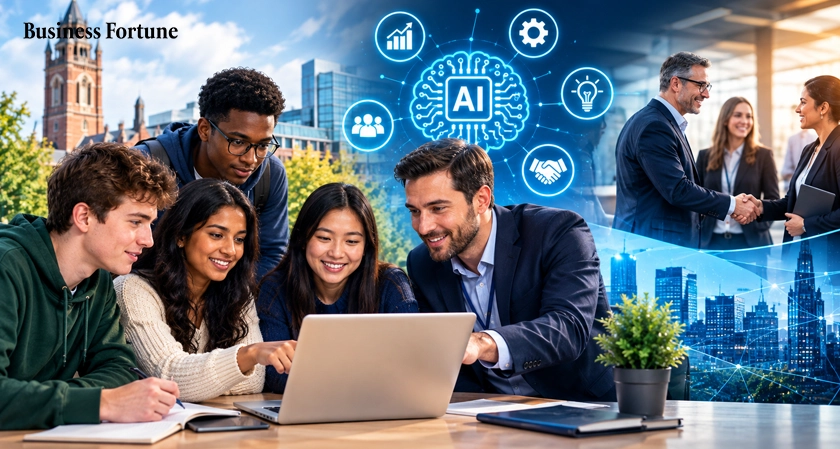
AI is moving beyond basic digital classrooms, with smarter tutoring, adaptive assessments and real-time insights creating new questions about the future of education.
Best EdTech companies are changing how students learn by using artificial intelligence to make lessons more responsive, accessible and useful. Instead of presenting the same information at the same rate to all learners, education technologies can analyze their performance and personalize content, exercises, feedback and support. It is evident from the search made by Business Fortune about why this change is significant because AI is changing from a laboratory-based concept to a practical one in the fields of tutoring, evaluation, administrative work and even workforce learning.
According to the University Canada West 2026, 86% of educational organizations have adopted AI in their operations, but according to a research conducted by the Digital Education Council and cited by the university, 86% of the students apply AI in their education processes. Privacy, biases, academic integrity, teachers’ readiness and inequality remain among the challenges. The most productive EdTech companies come up with systems that analyze students' performance and assist teachers in making sound decisions.
What is AI-powered personalized learning?
AI-powered personalized learning uses AI to adapt learning experiences to an individual learner. A system can analyze performance, rate, interests and problems and recommend proper lessons, activities, instructions, or actions. In contrast to the predefined courses, the learning track can vary as the skills and weaknesses of the learner vary.
How does AI personalize learning for students?
The use of AI can come into play in the area of personalized learning by gathering data like test scores, answers, finished tasks and progress. They may increase the difficulty of the questions, suggest additional sessions, give instant feedback or promote the student to another level.
Why does AI matter in modern education?
AI is important due to the fact that traditional, one-size-fits-all teaching is hard to scale. AI will be able to automate routine tasks, help students after class hours, improve accessibility and find gaps in knowledge. UCW suggests that AI is able to provide assistance in translation, transcription, adaptability and analysis.
What are the Best EdTech companies using AI?
There is no single universal ranking because platforms serve different needs. Some focus on K-12 classrooms, while others specialize in adaptive learning or student support. Based on current industry coverage and documented capabilities, five notable names are:
-
SchoolAI: SchoolAI targets AI-based learning and teaching support in areas such as adaptive tutoring, lesson variants and performance data. As per Master of Code’s report for 2026, SchoolAI is employed in over one million classrooms around 150 countries and works with Google Classroom, Canvas and PowerSchool.
-
ai: MagicSchool.ai framework revolves around teaching productivity and assistance for students. The platform delivers AI solutions for lesson planning, assessment, difference, communication and professional growth. The solution is relevant for schools looking for ready-made tools that can reduce their routine work and help teachers design diverse lessons.
-
Adaptemy: Adaptemy is renowned for its advanced adaptive learning solutions for teachers. Adaptemy works within the Learning Management Systems such as Canvas, Moodle and Blackboard. The company provides services including adaptive courseware provision, performance tracking, personalized placement, assessment and content creation via artificial intelligence.
-
Area9 Lyceum: Area9 Lyceum is a well-established adaptive learning solution. The Rhapsode platform adapts learning to the needs of the learner, incorporating elements of cognitive science, data analysis and artificial intelligence. According to Master of Code, the platform serves over 30 million users in 185 countries.
-
ai: LearnWise.ai is concentrated on AI-powered assistance for learning organizations that communicate with the learning management systems like Canvas, Blackboard, Moodle and Brightspace. It delivers personalized assistance, tutoring, assessment and automated helpdesk throughout the entire cycle from enrollment to graduation.
What are adaptive learning platforms?
Adaptive learning platforms are E-learning systems that adjust educational content according to a learner’s performance. In case the student does not understand the model, the system can provide further explanations or more practice. If the student understands the concept, the system can increase the difficulty level or move on to a different concept altogether. GeeksForGeeks offers the example of Dreambox and Knewton as an adaptive system.
The effective adaptive system always uses the feedback received to determine the path for the next learning exercise, thereby making the path dynamic and not the same for every individual.
Why is AI important for personalized education?
Personalized learning requires the use of artificial intelligence in processing data about the learner that would not be possible to be done by a single teacher manually. The system is capable of identifying patterns, recommending resources and generating practice activities, including learners that may require further assistance. According to UCW, AI will offer constant assessment and analysis used by educators.
Personalization should not do away with teachers since they know how to handle aspects that algorithms have problems with such as motivation, context, emotions and circumstances. The best approach is one where AI is combined with teachers' insights and guidance.
What are the benefits of AI personalized learning?
When designed well, personalized systems can provide:
-
Faster feedback, helping learners recognize mistakes while concepts are still fresh.
-
Targeted practice, allowing work on weak areas without repeating mastered topics.
-
Flexible pacing, so students spend more time where they need it and progress when ready.
-
Better accessibility through text-to-speech, speech-to-text, translation and flexible content.
-
Earlier intervention, because analytics can highlight patterns suggesting a student is falling behind.
-
Greater teacher efficiency, as automation can reduce repetitive planning, grading and administrative work.
The Udemy Business platform also emphasizes on the practical use of AI enabled personalization in workforce development through adaptive delivery of content, skills gap analysis, embedded learning, simulation and prediction interventions.
Which EdTech companies specialize in AI-powered learning?
The answer is to be made based on the nature of learning required by the institute. SchoolAI and MagicSchool.ai concentrate more on schools and teachers. AdaptEmy and Area9 Lyceum are known for their adaptability learning. LearnWise.ai deals with institutional support and personalized help. Some other organizations currently discussed in industry studies are IBL.ai, Aristek Systems and Raccoon Gang.
The difference between preassembled platforms and custom developers is an important aspect to note. Preassembled platforms provide fast deployment while custom-developed software provides better integration capabilities and control over data. Organizations must consider their requirements when choosing the right firm.
How can AI-powered education improve accessibility?
AI-powered education can make learning easier to access for students with different needs. Tools can include options such as speech-to-text, text-to-speech, automatic captioning, translation, navigation and other flexible tools. The AI applications for learning review by Hostinger highlights object recognition, customizable display and language assistance as important features in inclusive learning.
Access goes beyond software. Access to appropriate devices, internet access and accessible platform design are all required for the students. It is possible that AI will increase educational disparities if access to technology is confined to wealthy organizations only.
What should schools consider before adopting AI?
Schools and educational institutions must look into data protection and privacy, data accuracy, teacher training, integration, costs and equity before implementing AI. There may be the need for AI in education to collect data that might be confidential for the students and so there needs to be a clear policy on collection, storage, authorization and retention of data.
A responsible adoption plan should include:
-
Clear learning objectives rather than adopting AI simply because it is popular.
-
Teacher training so educators understand capabilities and limitations.
-
Human review of AI-generated educational content.
-
Privacy and security controls appropriate to student data.
-
Regular evaluation using learning outcomes, not only usage statistics.
-
Backup processes for technology failures.
Without oversight, AI can produce inaccurate content, reinforce biases, or encourage excessive dependence.
What is the future of AI-powered personalized learning?
Future developments will probably be away from recommendation engines and into systems that link assessment, content, skills, feedback and application in the real world. Udemy Business talks of a system whereby AI makes constant assessments of comprehension, adapts learning and links learning recommendations with work environment. This can happen within educational institutions too, creating more adaptive study paths and giving teachers better information about students’ progress.
Business Fortune believes what is coming up is an era where the success of any platform would not depend on the amount of AI in it but on its ability to improve the learning outcomes of users. It would involve the incorporation of elements such as pedagogy, good data practices, accessibility, analytics and human instruction. However, while AI would play a big role in education, it would only have value if students stayed engaged.
The top EdTech firms are now moving into an era when personalization might become part of E-learning routine instead of being a high-end solution. With the help of better performance and content adaptation, learners will have the opportunity to get relevant information and teachers will get the chance to teach more. According to Business Fortune, the successful players will be those that combine innovations with precision, privacy, accessibility and human judgment. AI technology will complement human-led learning in the future.


.webp)

























Comments