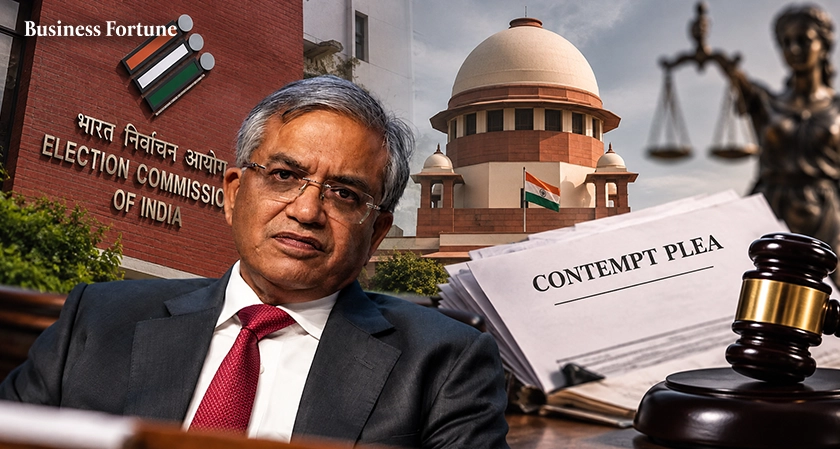
A legal plea against Gyanesh Kumar raises fresh questions over ECI decisions, voter data access and disagreements among election commissioners.
A fresh legal challenge has put the spotlight on the internal functioning of the Election Commission of India (ECI), with Supreme Court advocate Brajesh Singh seeking the Attorney General for India’s consent to initiate criminal contempt proceedings against Chief Election Commissioner Gyanesh Kumar.
In a letter written on September 24 to the attorney general R Venkataramani, Singh cited certain sections of the Contempt of Courts Act, 1971, saying that the CEC had consciously flouted Supreme Court judgments regarding the working of the three-member panel for conducting elections.
The decision was made a day after an Indian Express report indicated that the two election commissioners, Sukhbir Singh Sandhu and Vivek Joshi, have voiced their objection at least 14 times over the past 10 months on issues that they believed have been done without their consent or knowledge.
The disagreements, which were stated, involved the modifications on Form 6, addition and subtraction of voters and access to the electoral roll database. According to the two Commissioners, some decisions that had been made by the Commission were unauthorised and even illegal.
Why has a contempt plea been filed against CEC Gyanesh Kumar?
Singh’s central argument relies on the Supreme Court’s ruling in T.N. Seshan v. Union of India, which established that the Election Commission functions as a multi-member body and that the Chief Election Commissioner is primus inter pares, or first among equals.
It is pointed out that the decision made without involving the other Election Commissioners may violate the above-mentioned principle. The plea also mentions the decision of the Supreme Court in the case Anoop Baranwal v. Union of India, 2023 where the issue of the importance of having an independent Election Commission was raised.
As per Singh, accepting such decisions that are purportedly made without all members as being valid will be equivalent to a deliberate violation of the supreme law as declared by the Supreme Court under Article 141 of the Constitution.
What did Election Commissioners object to and what does the ECI say?
The objections apparently centered on the management of electoral roll data and changes in voter registration process rules. According to an Indian Express report, the problem was the increasingly centralized nature of the database and limitations of access for the official electoral bodies.
However, ECI dismissed the claim of any possible division within the Commission. It contended that the issues highlighted in the report were just operational issues or the input and suggestions received while framing the document and the decisions taken by the Commission were unanimous. Singh contends that the apparent differences are actually indicative of a wider constitutional issue regarding group decision-making in the ECI.
Moreover, this progress also comes shortly after the Supreme Court has referred the issues related to the 2023 act regarding the appointment of the Chief Election Commissioner and Election Commissioners to a bigger bench. Justice Dipankar Datta, in his own opinion, raised prima facie doubts about the independence of the current appointment process.
Subject to the Attorney General's consent, the case for contempt might be brought before the Supreme Court, which could subject the ECI's decision-making process to increased judicial oversight.
Thus, Business Fortune believes that the contempt plea could intensify scrutiny over collective decision-making and institutional independence within India’s Election Commission.


.webp)





























Comments