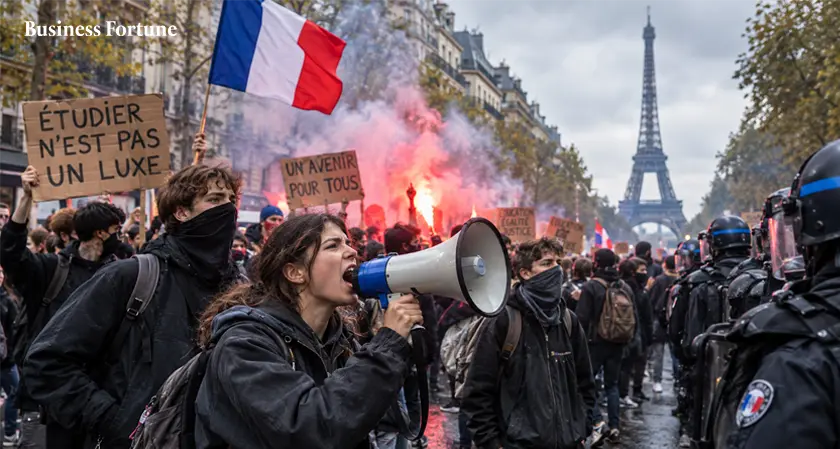
Student protests in France are getting more intense, with school fires and growing unrest. So, what’s really making students take to the streets?
Student protests in France have spread from the Paris region to cities across the country, with students demanding better school conditions, more teachers, smaller classes and improved facilities. What began as school blockades has now developed into clashes, arrests and disruptions affecting hundreds of educational institutions.
Nationwide Student Protests
Police said about 900 demonstrations, blockades and related incidents were taking place outside high schools, while more than 160 schools had been shut. Around 30 university campuses were also affected. The protests involve mainly lycée students aged 15 to 18, although university students have now joined the action. The causes of student protests in France are that overcrowded classrooms, exhausting timetables, teacher shortages, ageing school buildings and poor facilities. Students have also raised concerns about extreme temperatures inside classrooms during earlier heatwaves.
In Strasbourg, one 17-year-old student described classrooms with about 35 pupils, leaking rooms, limited toilets and an undersized cafeteria. “The building is falling apart, the cafeteria is too small. There’s zero budget, zero resources,” he said.
Why has the government called a crisis meeting?
Prime Minister Sébastien Lecornu held a crisis cabinet meeting as the demonstrations spread. His office said the rise in violence was making it difficult to maintain public education safely. Education Minister Édouard Geffray was also due to meet pupil representatives.
The situation has become increasingly tense. Fires have been reported near schools, while vandalism and clashes with police have disrupted public transport in some cities. Authorities said nearly 3,000 lycée students had been detained since the protests began, with more than 300 police officers and others injured.
Teachers have taken different sides, where some have reported threats or attacks, while others have joined blockades to support students. The situation has also entered political debate. The government has accused La France Insoumise of encouraging the demonstrations, while the party has rejected the characterization and said it supports non-violent protest. These competing claims have added another layer to the dispute.
With further action planned by the lycée students’ union, attention is now turning to whether dialogue can address the problems raised by students while preventing more disruption and violence. As Business Fortune observes, the longer-term outcome could depend on investment in schools, staffing levels and whether authorities and student representatives can find practical solutions.
FAQs
Why are students protesting in France?
Students are mainly demanding better school facilities, more teachers, less overcrowding and improved learning conditions.
Where did the protests begin?
The demonstrations began in and around Paris before spreading to cities including Strasbourg, Marseille, Lille, Lyon and Nantes.
Have universities joined the protests?
Yes. Around 30 university campuses were reported to have restricted access as university students joined the wider demonstrations.
What has the French government done?
Prime Minister Sébastien Lecornu called a crisis cabinet meeting, while education officials planned discussions with student representatives.
What could happen next?
Further demonstrations are expected, but the longer-term direction will depend on negotiations, school investment and efforts to restore normal education while addressing students’ concerns.
SOURCES: https://www.bbc.co.uk/newsround/articles/cvgl7ln5j1n7o https://www.bbc.com/news/articles/c6d080d1e3l4o https://www.theguardian.com/world/2026/oct/01/france-school-protests-escalate-pm-crisis-cabinet-meeting


.webp)































Comments