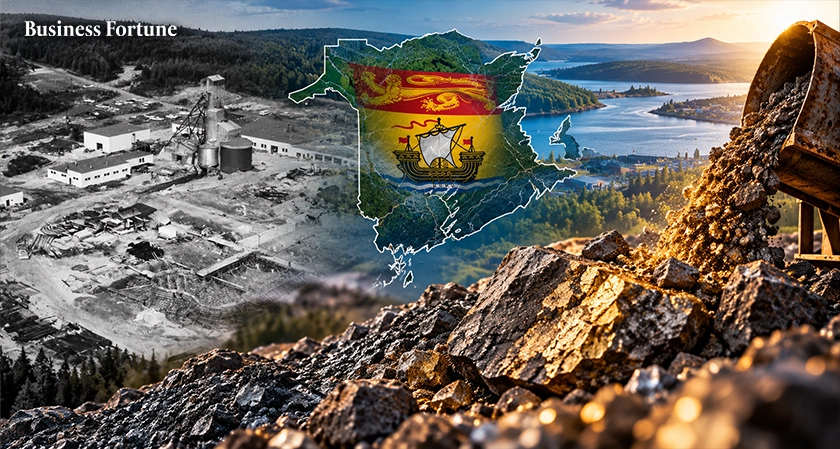
New Brunswick hopes to turn old mine waste into valuable minerals. Find out how this Brunswick mine waste project could clean up the site, create jobs, and save public money.
New Brunswick is investigating the possibility of turning an old mine site into a source of precious materials. In a recent deal with Regeneration Enterprises based in the United States, New Brunswick mine waste will extract critical minerals from the old Nigadoo mine located near Bathurst, Canada.
It yielded copper, lead, zinc, and silver until it shut down permanently in 1977. Even after nearly half a century, the waste deposited by the mine could still contain precious metals which can now be extracted using advanced technologies.
The provincial government revealed the exploration deal on Monday in Fredericton as part of its efforts to revitalize the mining industry and enhance Canada’s own mineral supplies.
Old Mining Waste Could Become a New Economic Opportunity
Regeneration Enterprises intends to conduct tests on the tailings of the mine, the residual products of the previous mining activities, to find out if there are any profitable metals left to be mined. The metals that can be recovered include zinc, copper, cobalt, germanium, gallium, indium, and silver.
The company estimates that the site represents a $35 million liability for the province. Its proposal is to use revenue from recovered metals to pay for restoration instead of relying on taxpayers.
“The recovery of the metals, the critical minerals, whatever they might be, are then used to fund the restoration, as opposed to the public having to pay for it,” said Michael McPhie, the company's managing director.
The company says it is not seeking provincial funding for the exploration phase. However, the government has not ruled out possible public investment in the future.
Natural Resources Minister John Herron said the initiative could unlock mineral wealth while supporting environmental remediation and land restoration.
Could the Project Clean Up the Site Without Creating New Risks?
The proposal has been cautiously welcomed by environmental activists because there are advantages to restoring a damaged site rather than exposing new land to the ravages of mining.
However, there are still some concerns about the potential environmental impact of disturbing the older tailings. As stated by Beverly Gingras, the executive director of the Conservation Council of New Brunswick, reprocessing can disturb the already settled heavy metals and can affect the watersheds surrounding the region.
Regeneration is collaborating with the Oinpegitjoig (Pabineau) First Nation under a memorandum of understanding signed in August 2026 for cooperation regarding possible mineral extraction and site remediation. Chief Terry Richardson stated that this collaboration is meant to ensure that environmental conservation goes hand in hand with economic benefit.
What Happens Next?
Testing will decide whether the project will proceed commercially. It is expected that regeneration will prove itself financially viable in one year, whereas the whole exploration program will take about three years. In case the project proves to be viable and all the required approvals are obtained, processing will start within two to three years.
As Business Fortune observes, the results can be used by New Brunswick as an example of how to extract resources from old mines and avoid environmental problems in the long run. The success of this project will help supply critical minerals for manufacturing, defense, and clean energy in the future, as long as mining is profitable and environmentally safe.
Sources: https://globalnews.ca/news/12121765/nigadoo-mine-waste-new-brunswick/ https://www.gnb.ca/en/news/n-b.2026.10.exploration-agreement-signed-for-former-nigadoo-mine-sites.html https://ca.finance.yahoo.com/news/commences-environmental-regeneration-zone-183900912.html


.webp)































Comments