The global search for critical minerals is beginning to reveal something more interesting than the size of the deposits being discovered. Increasingly, it's the particular elements within those deposits—and the technologies that depend on them—that are attracting attention.
That distinction matters as governments and manufacturers seek alternatives to China's dominant position in rare earth processing and high-performance magnet production.
Electric vehicles, industrial robotics, aerospace systems, semiconductor equipment, and advanced electronics all depend on specialized materials whose availability can influence manufacturing decisions thousands of miles from the mines where they originate.
And Brazil, already recognized for its substantial mineral resources, is becoming an important place to investigate what those future supplies might look like.
Recent exploration results suggest the country's opportunity may extend beyond the rare earth elements that have traditionally dominated industry headlines.
The Value of What's Inside the Deposit
Rare earth projects are often introduced through impressive resource estimates, measured in hundreds of millions or even billions of tonnes.
Those figures convey geological scale. But for manufacturers and potential development partners, a deposit's composition can matter just as much.
Neodymium and praseodymium are essential ingredients in many high-performance permanent magnets. Dysprosium and terbium help certain magnets maintain their performance at elevated temperatures, making them particularly valuable in demanding industrial applications.
Yttrium serves a different range of purposes, including advanced ceramics, lasers, aerospace components, and specialized semiconductor manufacturing equipment.
Together, these materials illustrate why the rare earth industry cannot be understood through resource tonnage alone. The presence, concentration, recoverability, and eventual marketability of individual elements can all influence a project's development potential.
That makes continued geological investigation especially important, even after a substantial resource has already been identified.
New Findings Add Another Dimension at Itarantim
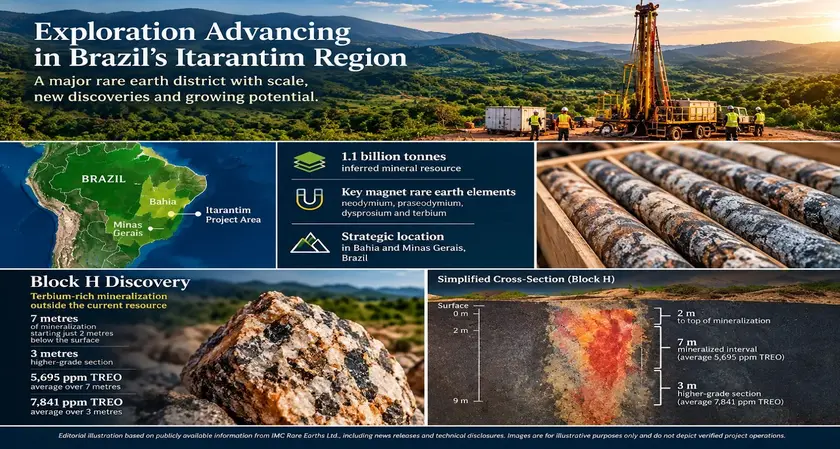
One example is IMC Rare Earths Ltd. (NYSE American: IMC), which is advancing its Itarantim rare earth project across portions of Bahia and Minas Gerais in Brazil.
The project hosts a reported 1.1-billion-tonne inferred mineral resource containing the four principal magnet rare earth elements: neodymium, praseodymium, dysprosium, and terbium.
Earlier exploration established a substantial geological foundation, while more recent drilling has begun revealing additional mineralized zones outside the existing resource boundaries.
On October 8, IMC announced a terbium-rich discovery at Block H, where drilling encountered seven meters of mineralization beginning just two meters below the surface.
But subsequent analysis has added another dimension to that finding.
On October 29, the company reported elevated yttrium concentrations at both Block H and Block D, identifying some of the strongest yttrium grades recorded in its exploration database of more than 870 drill holes.
At Block H, drilling returned a seven-meter interval averaging 2,052 parts per million yttrium oxide, including a higher-grade three-meter section averaging 2,836 parts per million.
At Block D, a separate hole identified 13 meters averaging 1,287 parts per million yttrium oxide, with mineralization continuing when drilling stopped.
The findings are particularly interesting because yttrium represented approximately 36% of total rare earth oxides in the Block H interval and 26% at Block D, compared with roughly 10% across the broader drilling database.
That difference suggests these newly investigated zones may have a mineral composition distinct from much of the material previously examined at Itarantim.
And for a project still being evaluated, understanding those differences could influence the direction of future exploration and processing studies.
Why Yttrium Adds to the Conversation
Yttrium's significance extends beyond its classification as a rare earth element.
It plays a role in technologies that demand specialized material performance, including certain semiconductor manufacturing applications, lasers, aerospace components, and advanced ceramics.
As the semiconductor and advanced manufacturing industries evaluate supply-chain vulnerabilities, dependable access to specialized minerals is becoming an increasingly important consideration.
Recent reporting involving Taiwan Semiconductor Manufacturing Company, for example, has highlighted efforts to investigate manufacturing equipment with reduced dependence on Chinese rare earth components.
That development does not establish a direct commercial connection to IMC or its yttrium discoveries. It does, however, illustrate the broader industrial environment in which new sources of specialized materials are being investigated.
For Brazil, the opportunity is not limited to identifying large deposits. It also involves determining which valuable elements those deposits contain and whether they can eventually be recovered in forms suitable for industrial use.
The latest findings at Itarantim add another area for researchers to investigate.
Recovery Technology Remains Central
Finding elevated concentrations of valuable minerals is encouraging, but the commercial equation depends heavily on extraction and processing.
IMC has already reported laboratory results involving other rare earth elements at Itarantim, including terbium recoveries reaching 95.2% under specific testing conditions.
Separate research undertaken at the University of Brighton in the United Kingdom demonstrated 73% recovery of total rare earth elements, excluding cerium, using a different laboratory protocol.
The company has also successfully produced a mixed rare earth carbonate, an intermediate material that can undergo further processing.
Those results have helped establish a technical foundation for continued investigation of potential recovery methods.
The newly identified yttrium-rich zones, however, introduce additional questions.
In its October 29 announcement, IMC explained that some yttrium concentrations in recovered laboratory solutions exceeded the analytical equipment's upper measurement limit. As a result, certain preliminary extraction percentages were estimated using the recovery behavior of other heavy rare earth elements rather than direct yttrium measurements.
Further testing will be needed to establish reliable yttrium recovery performance.
IMC has indicated that representative material will undergo additional metallurgical work through ANSTO Minerals in Australia. At the same time, follow-up drilling at Blocks H and D will investigate the extent and continuity of the newly identified mineralization.
The distinction is important. Encouraging exploration results may identify new opportunities, but confirming how effectively those minerals can be recovered is what helps determine whether those opportunities can advance toward development.
A Larger Opportunity for Brazil's Mineral Industry
Brazil's rare earth ambitions are growing as international manufacturers and governments place greater emphasis on supply-chain diversification.
Major industry transactions involving Brazilian rare earth assets have already demonstrated substantial international interest in the country's geological resources.
But the longer-term opportunity may depend on something more fundamental than the number of projects being explored.
Developing new mineral supplies requires geological expertise, reliable resource estimates, metallurgical testing, processing infrastructure, investment, and relationships with potential industrial customers.
It also requires understanding how individual mineral deposits might fit the needs of different industries.
At Itarantim, IMC's latest findings illustrate how that understanding can evolve. What began as an exploration story centered on magnet rare earth elements is now generating additional questions about yttrium and its potential contribution to the project's future product mix.
The company must still establish the scale of the newly identified zones, confirm extraction performance, and complete the technical and economic work necessary to evaluate potential development.
Yet those investigations are part of a broader process taking shape across Brazil, where exploration companies are working to understand not simply how much rare earth material exists, but which elements could eventually support new industrial supply chains.
For manufacturers seeking dependable sources of specialized minerals, those distinctions may become increasingly important.
And for Brazil, they point toward a larger opportunity: transforming geological knowledge into the technical and industrial capabilities needed to serve tomorrow's markets.
The next important discovery may not be another enormous deposit. It may be a better understanding of the valuable materials already waiting to be found within one.
Sources & References: IMC Rare Earths Ltd., SEC-filed Itarantim Technical Report Summary, 2026; IMC Rare Earths Ltd., High-Grade Terbium Recoveries of Up to 95.2% at Itarantim Project, September 10, 2026; IMC Rare Earths Ltd., 73% In-Situ Rare Earth Recovery at Itarantim, September 22, 2026; IMC Rare Earths Ltd., New High-Grade, Near-Surface Terbium Discovery at Block H, October 8, 2026; IMC Rare Earths Ltd., High-Grade Yttrium Discoveries at Blocks H and D, October 29, 2026; Reuters, TSMC Seeks Factory-Equipment Alternatives to Thwart China's Rare Earths Grip, October 22, 2026; USA Rare Earth Inc., Serra Verde Acquisition Announcement, April 20, 2026, and Completion Announcement, September 4, 2026; Reuters, Lynas Rare Earths–Meteoric Resources Acquisition Report, September 30, 2026.


.webp)




























Comments