
The global search for critical minerals is opening doors for companies that might once have struggled to command the attention of major industries and international markets. And in Brazil, where substantial rare earth deposits are attracting growing interest, some of the most intriguing developments are coming from exploration companies working to uncover resources that could help reshape tomorrow's supply chains.
Behind that opportunity is a fundamental shift in how governments and manufacturers view access to critical materials. Rare earth elements are essential to advanced defense systems, aerospace technologies, electric vehicles, and high-performance magnets, yet much of the world's processing and magnet manufacturing remains concentrated in China. With geopolitical tensions and trade restrictions exposing the risks of that dependence, developing alternative sources has become a strategic priority.
For smaller exploration companies, this changing market creates an opening. While major mining corporations command enormous financial and operational resources, geological discovery is not exclusively the domain of industry giants. Smaller companies can identify promising deposits, advance technical understanding, and establish the foundations for projects that may ultimately contribute to a more diversified global mineral supply.
And Brazil is becoming an increasingly important place to pursue those opportunities.
A Big Opportunity for Smaller Explorers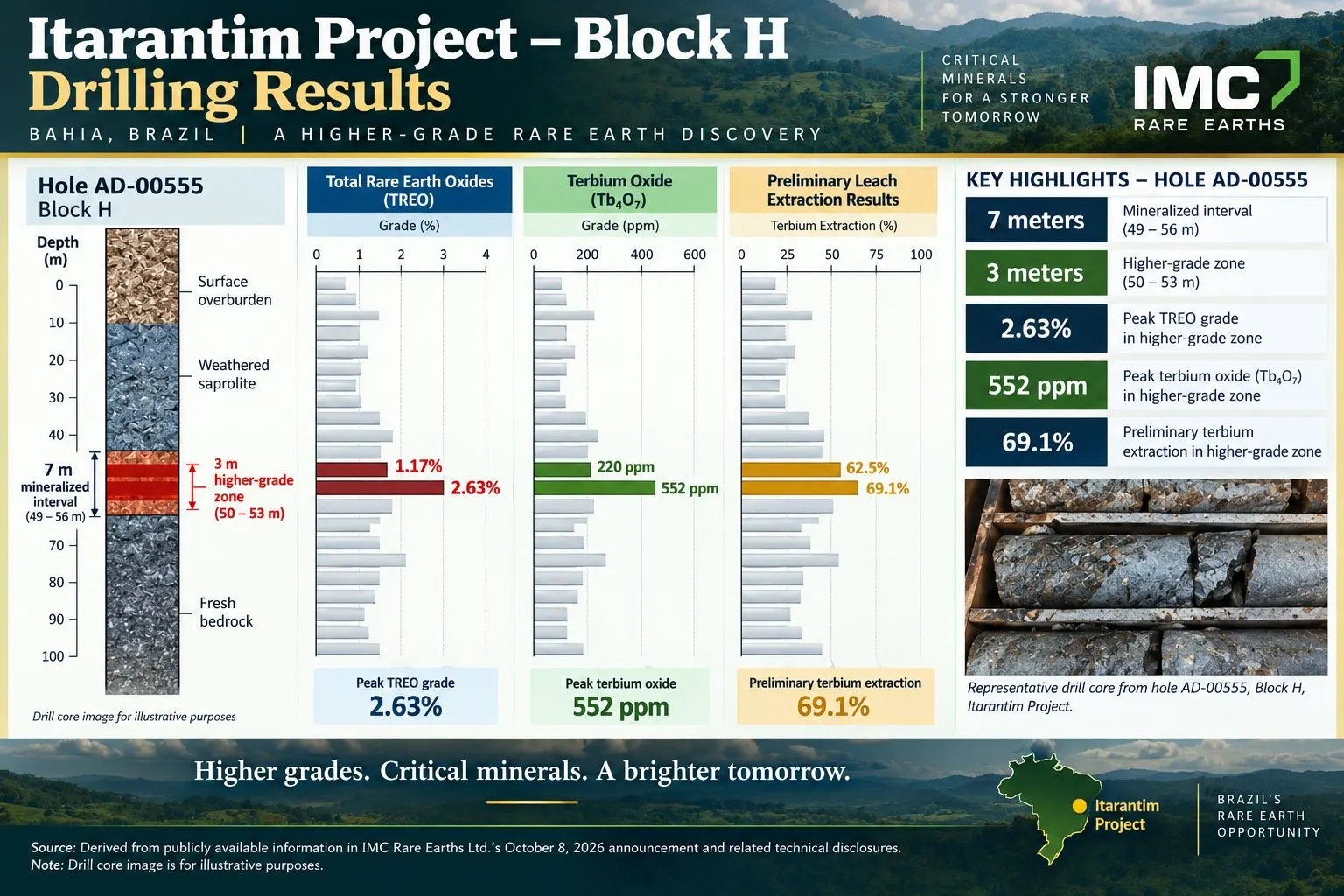
Brazil's substantial rare earth resources are attracting attention as governments and manufacturers look beyond established suppliers. Its geological potential creates opportunities for exploration companies capable of identifying deposits and advancing the technical work needed to evaluate their commercial possibilities.
One example is IMC Rare Earths Ltd. (NYSE American: IMC), an exploration and development company advancing its Itarantim rare earth project in the Brazilian states of Bahia and Minas Gerais.
IMC's project already contains a reported 1.1-billion-tonne inferred mineral resource, providing a substantial geological foundation for continued exploration. But recent developments suggest that the areas already incorporated into that resource may represent only part of the project's broader mineral potential.
That possibility gained new relevance on October 8, when IMC announced the discovery of a high-grade, terbium-rich mineralized zone at Block H, outside the boundaries of its existing resource. According to the company, mineralization begins just two meters below the surface, with drilling identifying a seven-meter interval averaging 5,695 parts per million total rare earth oxides, including a higher-grade three-meter section averaging 7,841 parts per million.
The discovery introduces another area for investigation beyond an already substantial defined resource. Additional drilling will be needed to establish the extent and continuity of the mineralization, but the findings create new possibilities for understanding the project's overall geological potential.
Why Terbium Is Drawing Strategic Interest
What makes these findings particularly relevant is the role terbium plays in some of today's most demanding technologies.
Terbium is a specialized rare earth element used to improve the performance of certain high-strength permanent magnets, particularly under elevated temperatures. These magnets are important in applications where reliability is essential, including electric vehicle motors, aerospace equipment, defense systems, and advanced industrial machinery.
For manufacturers, the challenge extends beyond obtaining rare earth minerals. It involves securing dependable access to the specialized materials and processing capabilities needed to transform them into usable industrial products.
That reliance makes discoveries involving terbium particularly relevant to the global effort to diversify rare earth supplies. For emerging exploration companies, identifying deposits containing these valuable elements creates an opportunity to participate in a market increasingly shaped by supply security and industrial demand.
From Geological Discovery to Recovery Potential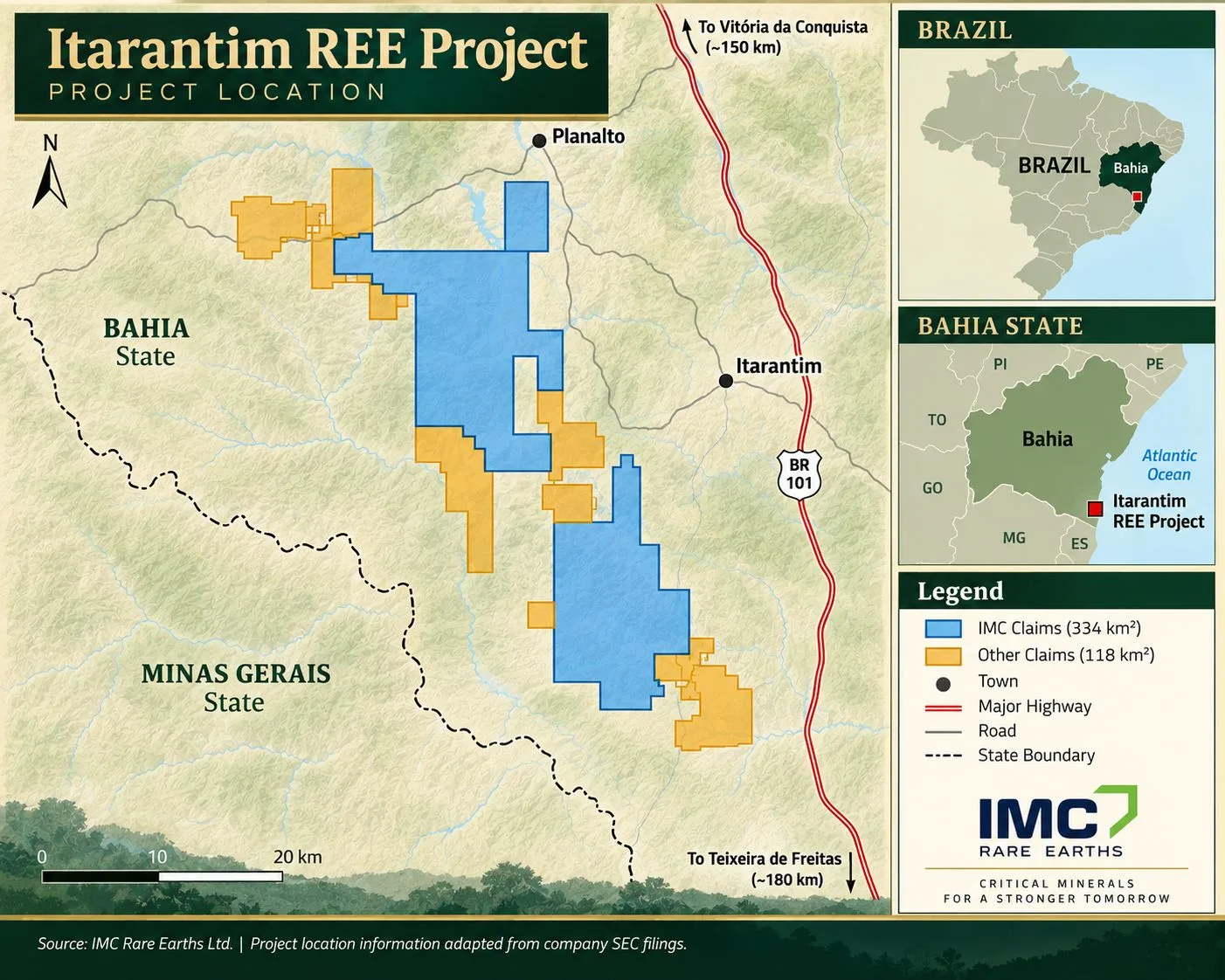
Discovering valuable minerals is only part of the exploration equation. Understanding how effectively they can be recovered is another, particularly for rare earth-bearing clay deposits, where mineral composition and extraction methods can significantly influence development potential.
IMC has been advancing metallurgical testing alongside its exploration program at Itarantim. September laboratory testing reported terbium recoveries reaching 95.2% in the best-performing composite, with an average recovery of 81.1% across the composites. The company also successfully produced a mixed rare earth carbonate, an intermediate product that can undergo further processing into separated rare earth materials.
Separate University of Brighton testing demonstrated 73% recovery of total rare earth elements, excluding cerium, under a different laboratory protocol. The work also reported recovery of approximately 71% for terbium and dysprosium, two strategically important heavy rare earth elements.
These findings support further evaluation of in-situ recovery, a method that could potentially use injection and recovery wells rather than extensive excavation. If proven effective at commercial scale, such an approach could offer advantages in capital requirements, land disturbance, and the handling of mined material.
Another encouraging finding involved the composition of the recovered solutions. In the University of Brighton tests, uranium and thorium remained below detection limits in the leachate. Additional mineralogical work reported negligible deleterious elements in tested leached solutions, potentially reducing certain processing and waste-management complications.
The near-total absence of detectable uranium and thorium in the tested leachate solutions, together with reported negligible deleterious elements, could prove particularly meaningful as the project advances through further metallurgical evaluation. For potential development partners, regulators, and other stakeholders, such characteristics may offer important advantages when assessing processing requirements, environmental considerations, and the project's longer-term commercial potential.
The October 8 discovery introduced another dimension, with preliminary terbium extraction results ranging from 64% to 83% from the upper three meters of the newly identified Block H mineralization.
Together, the results illustrate progress across several areas: geological scale, new exploration targets, and the technical understanding of how valuable rare earth elements may be recovered. For smaller exploration companies, that combination helps transform geological potential into a more detailed technical proposition that can guide future development decisions.
Brazil's Emerging Role in a Global Supply Shift
The growing strategic importance of Brazilian rare earth assets is becoming increasingly evident through major industry transactions.
In September, USA Rare Earth completed its combination with Serra Verde, a Brazilian rare earth producer, following an agreement initially valued at approximately $2.8 billion. The transaction brought an operating Brazilian rare earth business into a broader international platform focused on developing mineral supply, processing, and magnet manufacturing outside Asia.
Another significant development came when Australia's Lynas Rare Earths announced an approximately $672 million all-share agreement to acquire Meteoric Resources, gaining access to its Caldeira rare earth project in Brazil, subject to completion of the proposed transaction.
Together, the transactions represent approximately $3.5 billion in announced deal values, although their structures, development stages, and financial terms differ. More importantly, they demonstrate the scale of international interest in Brazil's rare earth resources and the strategic importance of securing new sources of critical minerals.
The comparison also brings attention to the geological scale of Itarantim. IMC's reported 1.1-billion-tonne inferred resource is approximately 20% larger by tonnage than the historically cited 911-million-tonne resource at Serra Verde's Pela Ema deposit. Although the figures are drawn from different reporting periods and resource tonnage alone cannot establish economic value, the comparison offers another perspective on the scale of IMC's Brazilian asset.
For emerging exploration companies such as IMC, these developments provide a compelling backdrop. With its substantial resource, encouraging metallurgical results, and new discoveries beyond established boundaries, the company is advancing Itarantim in a country attracting considerable international investment and strategic attention.
There is also an interesting connection through geological expertise. Alexandre Rocha da Rocha, a director of IMC and a geologist involved in its technical work, has been credited with contributing to the discovery of several significant Brazilian ionic adsorption clay deposits, including Serra Verde's Pela Ema project. That experience adds another dimension to IMC's technical capabilities as it continues evaluating Itarantim.
The Next Opportunity: Turning Exploration Progress Into Development
For IMC, the next stages involve further resource definition, continued validation of recovery methods and potential upstream processing infrastructure, and the identification of industrial, corporate, or government partners capable of supporting future development.
These priorities are particularly important for smaller companies operating in a capital-intensive industry. IMC completed a $20 million initial public offering in July, providing gross proceeds intended to support working capital, exploration, development, licensing, and permitting activities.
The company's progress also illustrates why technical results matter when evaluating how exploration capital is being deployed. With new discoveries beyond established resource boundaries, encouraging laboratory recovery results, and continued work on potential extraction methods, IMC is checking several important boxes in the early exploration process.
The next phase includes additional drilling at Blocks H and D, further metallurgical studies, and evaluation of potential processing approaches. IMC has also engaged ANSTO Minerals in Australia to advance quantitative testing and help refine its understanding of recovery performance and intermediate rare earth products.
These efforts are producing information that can help guide subsequent development decisions, while potentially strengthening the project's appeal to industrial and strategic partners seeking new sources of critical minerals.
Opportunity Isn't Reserved for the Industry's Giants
For those following the rare earth sector, the strategic importance of new mineral sources is becoming increasingly difficult to ignore. Major transactions and expanding international supply-chain initiatives are bringing greater attention to projects capable of contributing to the industry's future.
Yet opportunity is not limited to companies already operating commercial mines. Smaller explorers can play an important role by identifying mineral resources, advancing recovery technologies, and developing projects that may eventually contribute to a more resilient international supply chain.
IMC Rare Earths' latest results at Itarantim provide one example of that process taking shape in Brazil, where a substantial existing resource, promising laboratory results, and new mineralization beyond established boundaries are creating additional avenues for exploration.
As the world searches for dependable new sources of critical minerals, the companies capable of identifying tomorrow's resources may not necessarily be the industry's largest.
Sometimes, the biggest opportunities begin with the explorers willing to look where others haven't.


.webp)






























Comments