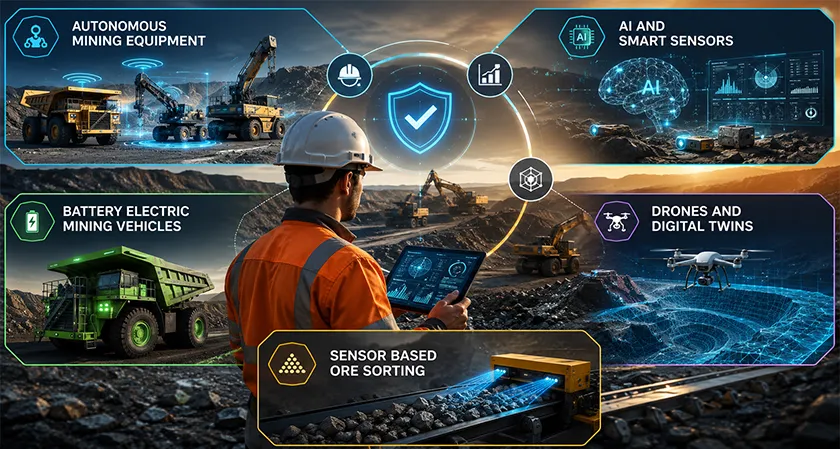
The Best Mining Technologies in 2026 are changing how mines operate, combining automation, AI, digital twins, drones and electrification to improve safety, productivity and efficiency.
The Best Mining Technologies are no longer futuristic concepts hidden inside research labs. In 2026, autonomous machines, intelligent sensors, drones, digital twins and electrified equipment remain steadily changing what happens above and below the ground. These modern, digital mining solutions are becoming a place where machines can detect danger on its own. A transformation appears being driven by a simple challenge; mining companies need to extract more value while exposing fewer people to dangerous conditions and controlling costs.
But among all these innovations, five stand out for their ability to make mining both safer and more efficient.
- Autonomous Mining Equipment
Picture a truck carrying a lot of ore through a mine without any person driving it. That is no longer something people imagine. Autonomous trucks, drills and other big machines are now a part of how mining is done today. These advanced mining technologies like GPS, sensors and machine learning move around mine areas and do tasks that are the same over and over or that are dangerous. This is where mining automation becomes more than a way to get more work done. Automation can also help machines work for times. Machines do not need to take breaks like people do. Their work can be watched all the time. The outcome is time spent in risky places, more regular work and possibly more work done.
- AI and Smart Sensors
Mining creates a lot of information. We get data from surveys, drill results, equipment readings, satellite images and records of what is happening every day. This can be too much for people to handle. Artificial intelligence is helping to change this. AI systems can look at a lot of data. Find patterns that people might not see for a long time. When we are looking for places to mine, machine learning models can combine information about the earth and physics to help us find good areas to look at more closely. AI is not just helpful for finding new places to mine, smart sensors can watch equipment, see if there are any changes in how it is working like if it is getting too hot or vibrating too much. If something strange happens, the people who fix the equipment can check it out before it becomes a problem. This is what is happening with mining technology. It is helping us make good decisions from all the data we have. The safety part of this is also very important. Sensors can watch where vehicles are moving, where workers are and what is happening in the environment. For example systems that help prevent accidents can tell operators where other vehicles and equipments are so they can be more careful. The mine is, like a place that is always learning. It can see things before people do. AI and smart sensors are making mining safer and more efficient.
- Battery Electric Mining Vehicles
Underground mines have an unusual problem; every diesel engine operating underground adds to the ventilation burden. That makes electrification particularly attractive. Battery electric vehicles seem increasingly being introduced for underground applications, including loaders, trucks and drilling equipment. Unlike diesel powered machines, electric vehicles produce no direct exhaust emissions while operating. That can mean cleaner underground air and potentially lower ventilation requirements. It can also reduce exposure to diesel particulate matter. The benefits go beyond environmental headlines. Electric equipment can offer lower energy and maintenance costs in certain applications, although this economics depend heavily on mine design, charging infrastructure, equipment utilisation and electricity prices. The bigger picture is that electrification is becoming one of this most important mining safety technology developments because healthier underground working conditions can complement the industry's push for lower emissions. However, electrification is not as simple as swapping a diesel truck for a battery powered one. Mines need charging stations, battery management systems, trained technicians and carefully planned operating schedules. The technology works best when this entire mining system seems designed around it.
- Drones and Digital Twins
Some mining jobs are dangerous simply because someone has to physically go there. Drones are changing that. Equipped with cameras, LiDAR and other sensors, drones can survey large areas, measure stockpiles, inspect infrastructure and monitor slopes. Tasks that previously required survey crews to spend hours or days in the field can increasingly be completed remotely. A digital twin seems essentially a virtual representation of a physical asset or operation. It can combine sensor readings, geological information and operational data to help engineers understand what appears happening in that real mine, like having a virtual mine on a computer screen.
- Sensor Based Ore Sorting
Traditional mining can involve moving enormous quantities of rock from the mine to a processing plant. The problem is that not every piece contains valuable minerals. Advanced sensor based sorting systems can identify differences between valuable ore and waste material before everything enters the processing circuit. Technologies such as X-ray transmission, near infrared sensing and laser based analysis can be used to identify and separate materials. The advantage is straightforward. If waste can be removed earlier, a processing plant has less material to crush, grind and treat. That can reduce energy and water consumption while improving this quality of material entering downstream processing. This is where mining efficiency technology becomes particularly interesting. Instead of simply making a machine work faster, technology asks a smarter question; why process material that doesn't need to be processed at all?
Why These Technologies Work Better Together
This real excitement isn't necessarily any single machine. It is what happens when this technologies connect. An autonomous truck can generate operational data. Sensors can monitor its health. AI can analyse that information. A remote operations centre can respond to problems. A digital twin can simulate changes. Drones can provide an updated view of the surrounding mine. Suddenly, a collection of individual technologies becomes an interconnected mining ecosystem. The biggest opportunity may therefore come from integration rather than isolation. “A Safety Revolution Is Happening Quietly”.
Mining safety is often associated with helmets, protective clothing and strict procedures. Those things remain essential. But technology seems adding another layer of protection. Collision avoidance systems can warn operators about nearby vehicles. Remote controls can move workers away from dangerous zones. Drones can inspect hazardous structures without putting surveyors directly in harm's way. Monitoring systems can identify ground movement or equipment problems earlier. The goal isn't to replace human judgement. It appears to give people better information before they have to produce a decision.
What About the Workers?
One common misconception is that smarter mines automatically mean fewer people. The reality appears more complicated. As machines become more autonomous, mining companies need people with different skills: automation specialists, data analysts, software engineers, remote operators, robotics technicians, cybersecurity professionals and advanced maintenance teams. The job may move from sitting inside a truck to sitting inside a control room. That shift means training will become increasingly important. A technologically advanced mine still depends on people who understand both mining operations and the digital systems running them.
What Mining Could Look Like Next?
That next stage of mining technology is likely to be defined by connectivity. Imagine a mine where equipment communicates continuously, geological models update as new information arrives and AI systems flag potential problems before operators notice them. Drones could regularly map changing terrain, while autonomous machines adjust their activities based on live operational conditions. That vision is already emerging in pieces. Meanwhile, advanced monitoring systems are making it possible to collect more detailed information about mine slopes, machinery and working environments. That interesting part appears that these systems don't necessarily need to arrive all at once. A mine can begin with fleet tracking, add predictive maintenance, introduce autonomous equipment and eventually build a fully connected operational environment.
The Biggest Challenge: Making Smart Technology
Actually work technology alone doesn't guarantee success. Mining environments are harsh. Dust, vibration, extreme temperatures, remote locations and unreliable connectivity can generate sophisticated systems difficult to deploy. There remains also the question of cybersecurity. As more mine equipment becomes connected, protecting operational networks becomes increasingly vital. Then there seems cost. Autonomous vehicles, sensors, drones and digital platforms require substantial investment. Companies need to prove that the benefits justify this expense. Finally, there appears the human factor. Workers need training, management teams need to understand new workflows and organisations need to be willing to change established processes. A best technology in the world is useless if nobody knows how to leverage it properly.
Why 2026 Could Be a Turning Point?
Mining is under pressure from several directions at once. The world needs more minerals for batteries, power networks, electronics, renewable energy systems and infrastructure. At the same time, mining companies face pressure to reduce costs, improve safety and minimise environmental impacts. That combination makes technology increasingly difficult to ignore. The Best Mining Technologies appear therefore not simply about making mines look futuristic. Their real value lies in solving practical problems: keeping workers away from danger, reducing unnecessary material movement, preventing equipment failures, improving ore quality and giving decision makers better information.
Business Fortune believes the industry remains moving from machines that simply perform tasks to systems that can sense, analyse, predict and respond.
The five Best Mining Technologies shaping 2026; autonomous equipment, AI and sensors, battery electric vehicles, drones and digital twins and advanced ore sorting show how quickly mining remains evolving. That most vital change isn't that machines seem becoming smarter. It seems that the entire mine appears becoming more connected. A safer truck, a smarter sensor or a faster drone may deliver value on its own. But when those technologies communicate and work together, they can transform how an entire operation functions. Mining will always involve challenging environments and demanding work. Technology cannot eliminate every risk. It can assist companies generate better decisions, reduce unnecessary exposure to hazards and extract resources with greater precision. This mine of a future may look particularly different from that mine of that past. And in 2026, that future is no longer somewhere on this horizon. It is already being built.
FAQs
What are the Best Mining Technologies in 2026?
The leading technologies include autonomous mining equipment, artificial intelligence, connected sensors, battery electric vehicles, drones, digital twins and sensor based ore sorting.
How does technology make mining safer?
Technology can make mining safer by reducing the time workers spend in areas through automation and remote work. It also uses sensors monitoring systems and collision avoidance tools to spot dangers sooner.
How is artificial intelligence used in mining?
Artificial intelligence can look at information, find places to explore check how machines are working help with fixing machines before they break and make mining and processing better.
Are electric vehicles useful in underground mines?
Yes. Battery electric vehicles can reduce direct exhaust emissions underground and may lower ventilation requirements, while also supporting mining companies' emissions reduction goals.
Will mining become fully automated?
Some mining activities can become highly automated, but people will remain essential. Future mines are likely to need more specialists in automation, software, data, robotics, maintenance and remote operations.


.webp)




























Comments