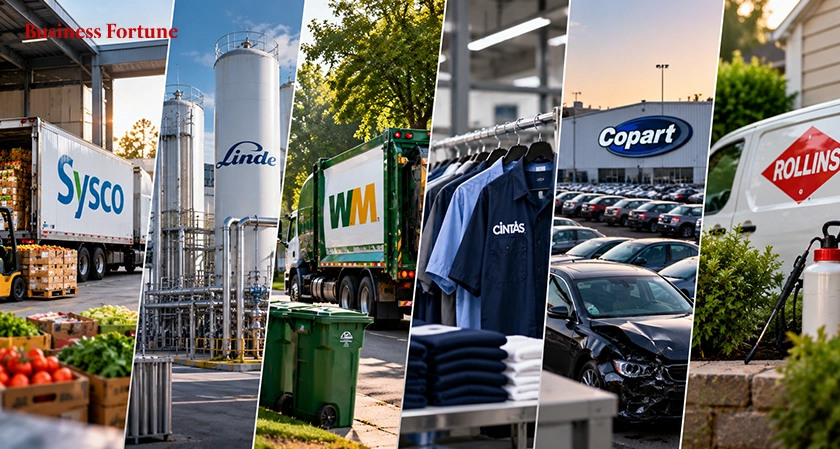
Invisible billion dollar industries, from uniform rental to food distribution, reached billions by owning routes and pricing power. See the data on six business-to-business giants and what could stall them.
Cintas, a uniform and towel business that leases its goods to other firms, made $11.3 billion in revenue in its fiscal year ended 31 May 2026. Sysco, which supplies food to restaurants, healthcare facilities and schools, reported $84.6 billion for the year ended 27 June 2026. None of the names would win a dinner-party guessing game, nevertheless. Both are part of a class of invisible billion dollar industries that lie underneath almost every workplace that one has walked into. The piece analyses six of them and their starts and what their filings say about the compounding of dull work.
What makes an industry invisible?
Three traits, mostly.
The customer is another company, so that ordinary shoppers never meet the brand.
The product is a chore: laundering, hauling, exterminating, restocking.
And the work repeats on a schedule, which turns a single sale into a route.
These are the B2B outfits clearing billions whilst almost nobody outside of procurement can name them. Most are quiet industries with modest starts and the starts matter, as the section on origins shows.
How big are these industries, in numbers?
Six examples, each on its latest full fiscal year, sorted by revenue:
Revenue is not profit and fiscal years end on different dates. WM's change is calculated from its reported $25.2 billion and $22.1 billion and includes acquired revenue from Stericycle.
Linde's is reported to the nearest whole percent.
How boring industries become multi billion dollar markets?
Not through glamour. Four mechanics recur across these filings.
Route density
Linde says its 24.2% return on capital reflects, among other things, "exceptional network density."
Cintas is betting on the same logic. It agreed to buy rival UniFirst for about $5.5 billion, estimating roughly $375 million of operating cost synergies from combining processing capacity, route networks and service infrastructure.
In plain terms, a truck serving more doors on the same street costs little more to run.
Price does the heavy lifting
Volume in these markets barely moves, so price carries growth.
WM's 2026 outlook assumes core price of 5.4% to 5.8% against volume growth of 0.2% to 0.6%.
Linde's 2025 sales rose 3%: 2% from price, 1% from bolt-on acquisitions, with volumes stable. Linde shows how far this can run: its adjusted operating margin rose 30 basis points to 29.8% in 2025 with volumes stable.
Switching suppliers means re-tendering a service that already works, and few buyers relish that.
Acquisitions fill in the map
Rollins grew revenue 11.0% in 2025: 6.9% organic, 4.1% from acquisitions.
Cintas grew 8.9% in fiscal 2026, of which 8.3% was organic and 0.6% acquired.
A competitor's routes can be quicker to buy than to win stop by stop. Cintas needed three attempts to land UniFirst, after bids in 2022 and early 2025 fell through.
Big is not the same as rich
Sysco sold $84.6 billion of food and related products and earned $3.1 billion in operating income, a GAAP operating margin of 3.66%.
Sysco's sales grew 3.9% while its operating income rose just 0.2%. Both Sysco and Linde are dull; their economics are opposites.
Linde's adjusted operating margin was 29.8%.
Nor is dull a guarantee.
Copart's fiscal 2026 revenue rose 0.4% to $4.7 billion, and net income attributable to Copart fell 4.4% to $1.48 billion.
Excluding the Hurricane Helene and Milton revenue booked in fiscal 2025, revenue grew 2.4%.
Quiet industries and overlooked start
Look at the overlooked beginnings and the pattern is almost embarrassing.
Cintas began in 1929, when Doc and Amelia Farmer, former circus performers, started collecting discarded factory rags, laundering them and selling them back. When Doc's grandson Dick joined in 1957, the family firm had 12 employees. By 1959 he was running it and pushing into uniform rental. The name Cintas arrived in 1972. Fiscal 2026 revenue: $11.3 billion.
Shipping tells the same story on a bigger stage. On 26 April 1956 the converted tanker Ideal-X left Newark for Houston carrying 58 containers. Loading cost 16 cents a ton, against $5.86 for hand-loading, according to figures widely cited from Malcom McLean's operation.
One caveat: that figure covers loading, not the full journey from factory to buyer.
Neither founder invented a product. Each standardised a nuisance and sold it as a service, which is the pattern behind most of the invisible billion dollar industries in this piece: someone finds the messiest step in a customer's day, fixes it the same way every time and bills for it on repeat.
Why does nobody notice them?
Three reasons, none mysterious.
The buyer is a procurement desk, not a crowd, so these firms have little reason to advertise to the public.
The service is built to disappear: a clean towel, an empty bin, a pest-free kitchen are results, not products.
And the sums are made of small increments, prices up a few percent and a competitor bought here and there, which make dull headlines and large totals. That is how dull services scale into multibillion-dollar markets.
What do the filings show that the headlines skip?
Read the capital lines and the industries stop looking alike.
Linde invested $5.3 billion in capital expenditures in 2025 on sales of $34.0 billion, roughly 16% .
Cintas spent $395.1 million in fiscal 2026, 3.5% of revenue.
Sysco's net capital expenditures, after equipment sales, were $524 million on $84.6 billion of sales, about 0.6%.
Same label, three different businesses.
Linde builds plants and earns a wide margin on them.
Sysco runs 333 distribution centers on a margin in single digits and is leaning on AI-assisted routing and back-office automation to squeeze more from it.
What could stall these businesses?
Three pressure points appear in the same documents.
Costs bite first. Sysco's product-cost inflation ran at 3.0% in fiscal 2026, and its gross margin moved only 10 basis points, to 18.5%. On margins that thin, a bad quarter of inflation is a story.
Permission comes second. Consolidation is the growth plan for several of these firms and it needs regulators to agree. The UniFirst agreement includes a reverse termination fee that protects UniFirst if regulators block the merger.
Third, one-off tailwinds fade. Copart's prior-year hurricane revenue made fiscal 2026 look flat. Strip it out and the picture improves, but the lesson stands. Steady compounding in dull industries is usually steadier in hindsight than in the moment.
How can you tell whether a dull industry is worth watching?
Four questions, offered as a working checklist rather than a formula.
Does the work repeat on a schedule? Recurring service beats one-off sales.
Is skipping it hard? Rollins pitches commercial pest control as a way for businesses to stay compliant with industry standards. Spending that keeps an inspection clean is harder to cut.
Does each new customer make the network cheaper to run? That is density at work.
Who is buying whom? Consolidators signal a fragmented market and routes worth owning.
Then check price against volume and organic against acquired growth before trusting any headline number. An unglamorous start tells you where to look, not what you will find.
More to Know
Rollins' 2025 was its 24th consecutive year of revenue growth. It serves more than 2.8 million customers from more than 850 locations.
Cintas will pay $310 per share in cash and stock for UniFirst. UniFirst shareholders approved the deal on 12 June 2026 and closing is expected in the second half of calendar 2026, subject to regulatory approvals.
Sysco's next moves. Its fiscal 2027 guidance includes about $100 million of savings tied to AI-driven and other cost-out efforts. It also has a pending deal to acquire Jetro Restaurant Depot.
Copart agreed to acquire ACV, a primarily digital automotive marketplace, in an all-cash deal expected to close by the end of the calendar year.
The lesson is not that dull is good. It is that dull work with a schedule, a route and a pricing habit can compound for decades while attention goes elsewhere.
The road from a rag route to $11.3 billion took nearly a century and Copart's flat year shows it is never guaranteed.
Business Fortune asks readers to watch density, price and who is buying whom, and the next set of B2B industries nobody notices making billions may look a lot less mysterious.
Sources
Cintas 10-K FY2026 . Cintas–UniFirst announcement . ASI on the UniFirst deal . Sysco FY2026 results . Rollins 10-K FY2025 . Rollins FY2025 release . Copart FY2026 results . Copart Q4 call highlights . WM FY2025 results (Waste Today) . WM 2025 release . Linde FY2025 results . Linde annual report . Cintas history (Wikipedia) . Cintas timeline . Cintas company history . Malcom McLean (Wikipedia) . Make Tech Easier on the Ideal X


.webp)































Comments