Discover the Global Clean Energy companies leading the shift towards a cleaner future. Explore 15 industry leaders, their latest innovations, and the market trends shaping clean energy in 2026.
Clean energy is bringing new ways of producing and consuming electrical energy. Solar cells, wind generators, storage technology and energy grids become key elements of energy strategies. The transformation does not concern energy providers only but also concerns companies that produce devices, store electricity and control energy grids.
This Business Fortune article analyzes15 leading Global Clean Energy Companies that will change the industry in 2026 and examine the technologies, business strategies, and trends that may affect their future development. This list is not based on revenues or market capitalization.
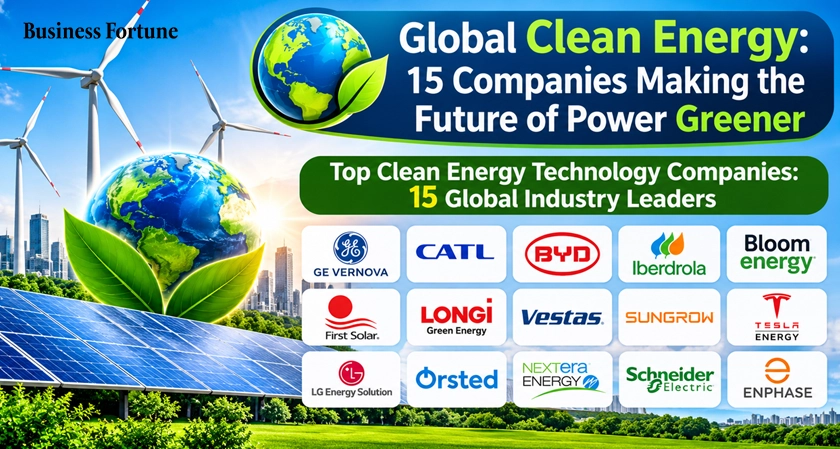
Top Clean Energy Technology Companies: 15 Global Industry Leaders
The companies span solar, wind, batteries, grid equipment and renewable power projects.
-
GE Vernova
US-based GE Vernova supplies wind systems, power generation equipment and grid technology. Not every product is renewable, but its wind and grid businesses help power systems connect and manage growing amounts of clean electricity.
-
CATL
CATL of China is a well-known battery manufacturing company providing services for electric vehicles as well as stationary power storage. Bigger batteries store energy for future use to stabilize supply.
-
BYD
China’s BYD operates across electric vehicles, batteries and energy storage. Its products serve vehicles and larger installations connected to buildings or power networks, giving the company a role in several parts of the energy transition.
-
Iberdrola
Spain’s Iberdrola develops wind, solar and hydropower projects and operates electricity networks. Its mix of power generation and grid services helps connect renewable projects to homes and businesses.
-
Bloom Energy
A solid oxide fuel cell system is produced by Bloom Energy in the US. This technology converts energy and emits gases depending on the kind of fuel utilized, such as natural gas, hydrogen or biogas.
-
First Solar
First Solar is an American company which uses cadmium telluride technology to produce thin-film photovoltaic modules. Its manufacturing base outside China gives large solar project buyers another supply option.
-
LONGi Green Energy
China’s LONGi makes solar wafers, cells and modules. It invests in high-efficiency cell technology, while facing the price pressure and excess supply affecting solar manufacturers.
-
Vestas
Denmark’s Vestas designs, manufactures and services turbines for onshore and offshore wind farms. Performance, reliability and maintenance shape the cost and output of wind power.
-
Sungrow
China-based Sungrow makes solar inverters and energy storage systems. Its inverters convert panel output into electricity used by buildings and grids. S&P Global named it a 2026 Tier 1 supplier in both categories.
-
Tesla Energy
Tesla Energy supplies battery storage for homes, businesses and power networks. Its systems store electricity for later use, helping manage solar supply that peaks during the day.
-
LG Energy Solution
South Korea’s LG Energy Solution makes rechargeable battery cells for electric vehicles and stationary storage. Its research focuses on safety, battery life, energy density and cost.
-
Ørsted
Denmark’s Ørsted develops and operates offshore wind farms, alongside interests in onshore wind, solar and storage. Offshore projects offer large power output but need major investment and reliable grid links.
-
NextEra Energy
US company NextEra Energy operates wind, solar and battery projects alongside regulated electricity services. Its business shows how established power providers can combine utility operations with clean generation.
-
Schneider Electric
French company Schneider Electric produces switchgear and energy management systems. These devices do not produce renewable energy, but enable efficient usage of electricity.
-
Enphase Energy
US-based Enphase Energy makes solar microinverters that manage output at individual panel level. It also offers home batteries and energy management products for households.
From the consumer’s perspective, the decision will vary according to location, power requirements, and project size. The residential user will find value in a rooftop solution with a battery back-up, while the utility will require large wind farms and grid batteries. This diversity is what makes Clean Energy Companies 2026 impossible to assess based on one single metric.
What Makes Global Clean Energy Companies Important?
Clean energy means much more than having panels and turbines. To make use of clean energy, you also need the machines themselves, the batteries to store the energy, and the grid to distribute the energy. Not matter how efficient your solar panels or turbines are, you still need money, space, permits, etc.
The leaders within the industry will be judged according to their growth, consistency, cost management, and R&D achievement. The 2026 Clean Edge 100 consists of clean energy firms, transport firms, water and grid firms. The technique used takes into account the market value, revenues, operating profit with respect to clean technology.
The market conditions for Renewable Energy Technology Companies also differ. The solar companies have to cope with price competition and trade regulations. The wind companies have to consider construction costs and delays. The battery companies have to react to the demands for batteries from electric vehicles, data centers, and electricity grids.
Clean Energy Market Outlook 2026: Growth and Challenges
The long-term prospects are excellent, though growth may fluctuate from year to year. The International Energy Agency predicts that renewable electricity capacity worldwide will rise by nearly 4,800 gigawatts from 2026 to 2031, an increase of 57% compared with the preceding six years. Solar photovoltaic power is expected to account for more than three-quarters of this increase.
Moreover, the IEA expects an 85 percent increase in the capacity for renewable electricity from 2025 to 2031. The capacity for onshore wind will experience more than a 70 percent increase. It is projected that India will be the second largest growth market, after China, while Southeast Asia, Middle East, and Africa will play a bigger role.
There is an upside as well. Certain regions might have inadequate grid capacities; certain ventures may experience delays because of permits, land, logistics, and financing issues. Reductions in solar panel prices may be favorable to customers, yet lower manufacturing margins for producers. There will also be material and construction expenses for wind energy ventures. Producers of battery storage should resolve concerns around minerals availability, recycling, and safety.
Thus, apart from the production volume expansion, Solar Energy Companies and Wind Energy Technology Companies should work on their efficiency, cost management, and supply chain that will be able to withstand policy changes and international trade dynamics. Moreover, government policies, auctions, and investments in grid capacities will influence the demand. Companies which manage to adjust to local regulatory requirements and customer demands will probably prosper.
Energy Storage Companies: Why Batteries Matter
Electricity must be available when people need it, not only when the sun shines or wind blows. Batteries store extra power and release it when demand rises or renewable output falls. They can also support grid stability.
Storage is therefore an important market to watch in 2026. S&P Global’s 2026 Tier 1 list identifies suppliers of battery cells and complete storage systems. However, projects still depend on cost, safety standards, grid connections and access to materials.
Clean Energy Innovations Shaping the Next Stage
Innovations are occurring everywhere in the energy industry. There is an improvement of efficiency in cells for solar manufacturers. Innovations are being done for wind turbines concerning the blades, controls and maintenance. Batteries need to become more efficient in terms of material usage and safety.
The other area of emphasis would be the connection between renewable generation capacity and electricity demand. Power needs are increasing in data centers, industrial activities, homes, and transport. Coupling of renewable energy projects with energy storage solutions and flexible electricity demand could address such an issue. Hydrogen energy and fuel cells are meant for some selected applications where it is hard to electrify directly.
What Should Readers Watch Beyond 2026?
The next step relies on implementation. Project developments need to be made, financial strength is required for manufacturers, and the grid needs to integrate new generation capacity. The customer will desire a reliable system that reduces energy prices without sacrificing reliability.
For readers following Global Clean Energy, the critical thing to understand is that there is no one solution that is going to be the answer for everyone in the transition. Solar, wind, batteries, grid hardware, and flexible power need to play together. Businesses that marry good technology with reliable delivery and sustainable supply chains may have staying power.
FAQs
What does clean energy technology include?
It includes technologies that produce, store, move or manage energy with lower environmental impact. Examples include solar panels, wind turbines, batteries, fuel cells, smart grids and energy management systems.
Which clean energy technology is growing fastest?
Solar photovoltaic power is expected to account for the largest share of renewable capacity growth through 2031. Battery storage is also gaining attention as power systems need more flexibility.
Why are batteries important for renewable energy?
Solar and wind output changes with weather and time of day. Batteries store electricity when supply is high and release it when needed, making renewable power more useful and reliable.
Are clean energy companies the same as renewable energy companies?
Not exactly. Renewable energy companies mainly develop or supply power from sunlight, wind and water. Clean energy technology companies can also make batteries, grid equipment, fuel cells and energy management software.
What could affect the clean energy market after 2026?
Government policies, electricity demand, grid investment, interest rates, material costs, trade rules and technology improvements will influence growth. Building projects on time will matter as much as new inventions.
















































































































































.webp)




Comments