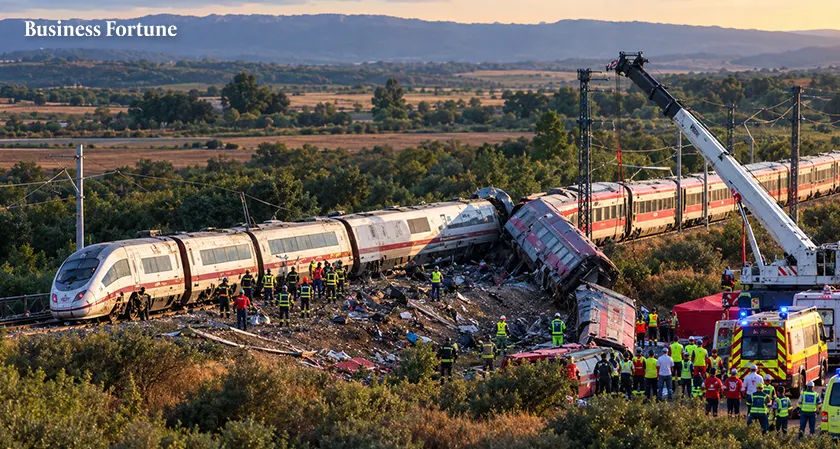
Read how the Spain train crash killed 68 people, what may have caused the tragedy, and why the disaster is raising fresh questions about railway safety and the future of high-speed travel in Spain.
Spain is mourning for three days following the tragic Spain train crash that left at least 68 dead and many others injured. The train crash occurred yesterday as a Renfe train collided with the back of an Iryo train that was parked in Urda, a town south of Madrid. This unfortunate incident has created fears of rail safety following another train accident earlier in the year.
The rescue efforts went on throughout the night looking for victims trapped in the damaged trains. Some trains fell off the embankment due to the impact of the crash. It took heavy machinery to shift the bent metals to get access to those stranded in there. The families are waiting to hear back on their loved ones who are missing, while efforts are being made to identify those who died.
A Possible Error at the Railway Control Centre
Spain’s transport minister, Óscar Puente, said the Iryo train had stopped because of a technical problem. The investigation is currently under way to discover why the Renfe train was permitted to proceed even though there was another train on that same stretch of track. Both the trains struck each other at about 8:53 am local time. The officials are analyzing the railways signals and the control center’s decision-making process.
According to the prime minister, Mr. Pedro Sánchez, “All of Spain is mourning.” He further promised serious action in case of any carelessness within the railway safety system. However, the exact cause of the crash has not yet been confirmed.
Why Is Spain Facing Fresh Railway Safety Questions?
This is the second major high-speed train disaster in Spain this year. In January, another collision near Adamuz in Andalusia killed 46 people and injured dozens. While there may be different reasons behind these two accidents, the latest one has raised doubts about whether enough is being done to ensure the safety of railway passengers.
Leader of the opposition in Spain, Alberto Núñez Feijóo, has demanded an independent investigation into the rail system of the country. Other political parties have suspended their election campaigns out of respect for the victims. On the other hand, train drivers are preparing to strike in order to improve their safety. There have been protests in Madrid as well, where some protesters demanded the resignation of top-level officials.
Families Continue Searching for Missing Relatives
Authorities have opened support centres in Madrid, Toledo, Córdoba and Seville to help families report missing passengers and provide DNA samples for identification. Red Cross teams are supporting relatives as they deal with the loss and uncertainty. The European Union has also shown its support, with flags lowered at half-mast in Brussels during Spain’s mourning period.
What Could Change After the Spain Train Crash?
The investigation could lead to changes in railway rules, better monitoring systems and stricter checks on safety equipment. Officials will need to explain what went wrong and take steps to prevent similar accidents. As Business Fortune observes, the coming weeks for Spain will be important. Finding the cause of the crash is only the first step. The bigger challenge will be making passengers feel safe on trains again.
FAQs
What happened in the Spain train crash?
A Renfe train crashed into the back of a stationary Iryo train near Urda, south of Madrid, killing at least 68 people and injuring dozens.
What caused the Spain train crash?
The cause is still being investigated. Officials are examining a possible error at the railway control centre and other safety issues.
Which railway companies were involved in the crash?
The trains were operated by Renfe, Spain’s state-owned railway company, and Iryo, a private rail operator.
Why has the accident raised concerns about railway safety?
Spain suffered another deadly train collision in January, when 46 people died. The two accidents have increased calls for stronger safety checks.
What could Spain do to prevent similar accidents?
Spain could review its railway signals, improve communication between train drivers and control centres, strengthen safety systems and carry out independent inspections of its rail network.
Sources: https://www.theguardian.com/world/2026/oct/29/spain-mourning-period-deadly-train-crash https://www.ft.com/content/3500a00d-d676-4460-83f8-8ea2bfce1049?syn-25a6b1a6=1 https://www.bbc.com/news/articles/cmqxnl312v34o


.webp)




























Comments