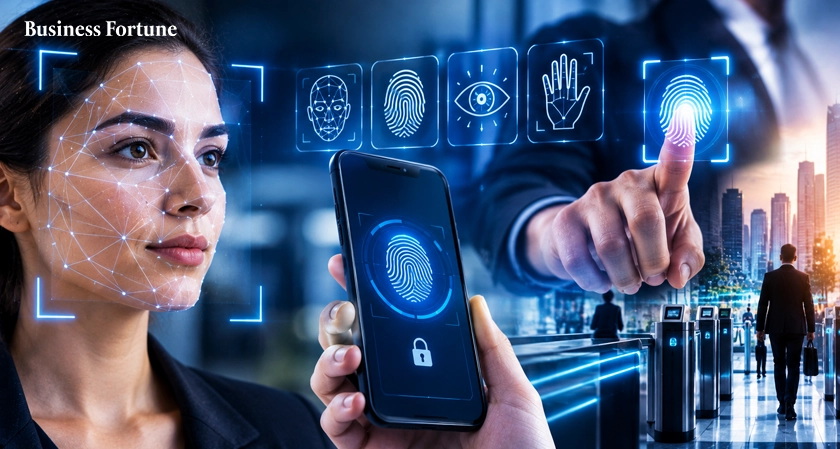
A look at the companies leading biometric authentication innovation from iris orbs to voice fraud detection and why the arms race with deepfakes is reshaping the industry.
Who's Leading Biometric Authentication Innovation in 2026?
Five billion passkeys are now in active use worldwide and companies leading biometric authentication innovation are simultaneously fighting off a surge in AI-generated deepfake attacks that grew over 1,000% in a single year. That paradox; mass adoption alongside mounting attack sophistication defines the industry right now. The password is dying faster than anyone predicted five years ago, but the thing replacing it, your face, your voice, your fingerprint, is now itself a target.
This report looks at who's actually pushing the field forward, what's changed technically and where the real vulnerabilities sit heading into next year.
At a Glance
Global passkey use has hit 5 billion, per the FIDO Alliance's State of Passkeys 2026 report, with 90% consumer awareness worldwide.
Government and enterprise identity leaders IDEMIA, NEC, Thales and Fujitsu continue to dominate large-scale deployments: border control, national ID, banking.
Injection attacks using deepfakes surged 1,151% in the second half of 2025 alone, according to iProov data reported by Biometric Update.
Worldcoin (rebranded World) has issued more than 12 million iris-based World IDs despite regulatory pushback in at least five countries.
Voice biometrics providers like Pindrop are racing to stay ahead of synthetic voice fraud, which rose 149% against banks in 2024.
Which Companies Are Actually Leading Biometric Security Trends 2026?
No single company owns this space; it splits into distinct tiers and conflating them is where a lot of "top 10" lists go wrong.
Government and large-scale identity infrastructure
IDEMIA and NEC Corporation sit at the top here.
IDEMIA, headquartered in France, runs multimodal face, fingerprint and iris systems across more than 180 countries, supporting national ID programs and border control.
NEC, a Japanese conglomerate founded in 1899, built its reputation on the NeoFace facial recognition engine used at airports and in public safety systems globally.
Thales and Fujitsu round out this tier.
Consumer hardware
Apple and the Android ecosystem control how most people actually experience biometrics day to day. Apple's Face ID remains its primary phone authentication method, while Touch ID persists on iPads and some Macs; the company also built Optic ID, an iris-based system, for the Vision Pro headset.
Google and Samsung have leaned harder into under-display fingerprint sensors across their Android lineups.
Identity verification and fraud platforms
This is the fastest-moving tier.
Socure, Persona, ID.me, iProov, GBG, Entrust and newer entrants like Didit build the software layer that verifies a selfie against a government ID, checks for liveness and screens for injection attacks in real time.
Voice-specific players.
Pindrop stands out here, alongside Nuance (now part of Microsoft since its $19.7 billion acquisition). Pindrop's own research, drawn from more than 1.2 billion analyzed calls, found synthetic voice attacks against banks rose 149% in 2024, with a fraud attempt now hitting the average U.S. contact center roughly every 46 seconds.
How Does Biometric Authentication Actually Work?
At its core, the process is simple even when the underlying math isn't. A sensor captures a physical or behavioral trait: a face, a fingerprint ridge pattern, an iris texture, a voice's acoustic signature and converts it into a mathematical template, not a stored photo or recording. That template gets compared against a previously enrolled one using a matching algorithm, which returns a similarity score. Cross a confidence threshold and you're authenticated.
The part most explainers skip is liveness detection and it's become the whole ballgame. A matching algorithm alone can't tell a live face from a printed photo or a screen replay; liveness checks: analyzing micro-movements, blood-flow patterns, 3D depth or asking for a spontaneous blink, confirm a real, present human generated the sample. Modern systems increasingly run passive liveness detection, meaning the check happens without asking users to blink, nod or speak on cue.
Why Is Facial Recognition Technology Still the Dominant Modality?
Cameras are already everywhere: phones, laptops, airport gates, ATMs so facial recognition technology requires no extra hardware to deploy at scale, unlike fingerprint sensors or iris scanners, which typically need purpose-built equipment. That's the main reason it dominates.
NEC's NeoFace system and IDEMIA's facial matching engines both power large national and airport-scale deployments precisely because they can bolt onto existing camera infrastructure.
The tradeoff is exposure. A face is public by nature: visible in photos, video calls and social media in a way a fingerprint or iris pattern isn't, which makes it a richer target for deepfake generation. That's precisely why so much of the current innovation in this modality is defensive: 3D depth sensing, near-infrared imaging and multi-frame liveness analysis, all aimed at making it harder to fool a camera with synthetic footage rather than making the underlying match itself more accurate.
Is Fingerprint Authentication Technology Falling Behind?
Not falling behind, exactly, but the story's more layered than "face vs. fingerprint." Fingerprint authentication technology remains the most widely deployed biometric modality globally by raw volume: cheap sensors, decades of field-tested accuracy and near-universal familiarity keep it entrenched in smartphones, laptops and access-control systems.
What's changed is where the sensor sits.
Under-display optical and ultrasonic fingerprint sensors, now standard across most Android flagships, have made the technology nearly invisible to the user, embedded directly into the screen rather than occupying a separate button or panel.
Apple's own relationship with fingerprint tech has been public and unresolved for years; Touch ID disappeared from flagship iPhones after Face ID's 2017 debut, though it persists on iPads and budget iPhone models and the company continues to file patents on under-screen fingerprint sensing. Whatever Apple eventually ships, the broader industry has already settled the debate: fingerprint and facial matching now typically run alongside each other as complementary factors, not competing ones.
What does the Future of Biometric Authentication Look Like?
Three shifts stand out and none of them are speculative; they're already underway.
Multimodal is becoming the default, not the premium option.
Layering face, fingerprint, voice and behavioral signals into a single risk score is now standard practice among serious identity platforms, precisely because deepfakes and injection attacks have made any single check individually unreliable.
Didit, for instance, now combines PAD-certified liveness checks with over 200 separate fraud signals per verification session and is a good example for AI-powered biometric authentication.
Injection attack detection is overtaking presentation attack detection as the priority. A presentation attack holds a fake in front of a real camera; an injection attack skips the camera entirely and feeds synthetic video directly into the software pipeline using virtual-camera tools.
Proof-of-personhood is emerging as its own category, separate from conventional authentication.
Worldcoin's iris-scanning Orb network, now rebranded simply as World, has issued over 12 million verified World IDs globally, explicitly built to answer a newer question: not "is this the account owner," but "is this a real human at all," in a web increasingly populated by AI agents and bots. The approach has drawn regulatory friction in Kenya, Spain, Portugal, Hong Kong and Germany over biometric data handling, underscoring that this frontier is as much a policy fight as a technical one.
How Companies are Improving Biometric Security Against AI Threats?
The honest answer is that the industry is playing catch-up and most companies would admit it off the record. The defensive playbook that's emerging has a few consistent pieces: independently certified liveness testing (ISO/IEC 30107-3 is becoming the reference standard), device and session integrity checks that can flag virtual camera software, layered risk scoring instead of pass/fail matching, and increasingly treating a single biometric check as one signal among many rather than a standalone gatekeeper.
iProov and Ingenium Biometric Laboratories have both pushed publicly for independently verified performance benchmarks rather than vendor-reported accuracy claims, a sign the industry recognizes its own marketing has gotten ahead of its testing rigor.
Where Does Iris Recognition Technology Fit In?
Iris recognition technology occupies a narrower but growing niche. It's harder to spoof at a distance than a face and produces a more stable biometric template over a person's lifetime, which is exactly why Worldcoin bet its entire identity model on it rather than facial matching. Iris scanning also remains central to high-assurance government use cases. UAE border control and India's Aadhaar system both rely on it alongside fingerprint data, but the hardware requirement keeps it from spreading into everyday consumer devices the way cameras and fingerprint sensors have.
Is Voice Biometric Authentication Still Trustworthy?
This is the modality under the most pressure.
Voice biometric authentication was, for years, considered a convenient behavioral layer for call centers and banking apps. AI voice cloning has undercut that trust fast; tools can now clone a voice from just seconds of sample audio.
Top Biometric Authentication Companies: Comparison
|
Company |
Primary Focus |
Key Modality |
Notable Scale/Metric |
|
IDEMIA |
Government & enterprise ID |
Face, fingerprint, iris |
Operates in 180+ countries |
|
NEC Corporation |
Public safety, border control |
Facial recognition (NeoFace) |
Founded 1899; global airport deployments |
|
Apple |
Consumer devices |
Face ID, Touch ID, Optic ID |
Optic ID powers Vision Pro headset |
|
Worldcoin (World) |
Proof of personhood |
Iris scanning |
12M+ verified World IDs issued |
|
Pindrop |
Voice fraud detection |
Voice biometrics |
1.2B+ calls analyzed |
|
Socure / Persona / ID.me |
Digital identity verification |
Multimodal + liveness |
Top-ranked in Seedtable's 2026 startup index |
|
iProov |
Liveness & injection detection |
Facial liveness |
Reported 1,151% injection-attack surge (H2 2025) |
Business Fortune summarises, the companies driving the development of biometric authentication technology and ecosystems are no longer the same, with different firms dominating the government, consumer and enterprise markets.
At the same time, the technology itself is witnessing an arms race, with injection attacks dominating the threat landscape and liveness detection and injection countermeasures promising to close the security gap before deepfake tools become cheap and widely available.
FAQs
What companies are leading the innovation in the field of biometric authentication?
IDEMIA, NEC Corporation, Apple, Worldcoin, Pindrop, Socure, iProov
How biometric authentication works?
The process always involves capturing a biometric sample with a sensor and then turning it into a mathematical representation, which is compared to a reference sample using a matching algorithm.
What is the biggest threat to biometric security currently?
The biggest threat is injection attacks, bypassing biometric authentication mechanisms by tricking the software into accepting a deepfake video or audio instead of a real sample.
Are fingerprint or facial recognition technologies more secure?
Neither of them is secure on its own, but when used in conjunction with other measures, including liveness detection, behavioral biometrics and other factors, they can provide an acceptable level of security.
How many people are using passkeys versus traditional passwords?
According to the FIDO Alliance’s State of Passkeys 2026 report, there are approximately 5 billion passkeys in active use globally and 75% of consumers have at least one passkey-enabled account.
Sources
FIDO Alliance . MarketsandMarkets . Verified Market Research . Seedtable . Biometric Update . Didit . Matellio . Interface.ai . MobileIDWorld . Ryder.id . Grand View Research


.webp)




























Comments