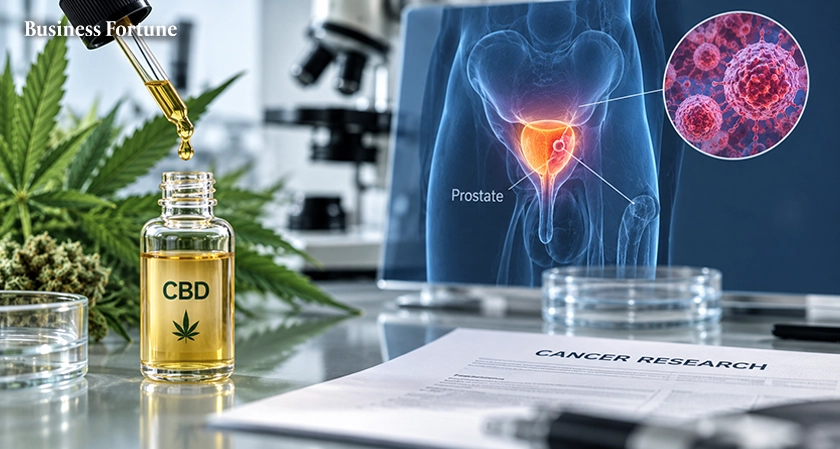
Could cannabidiol make prostate cancer drugs more effective? New lab research reveals surprising changes in cancer cells and hints at a potential treatment combination.
Cannabidiol (CBD) may not only be able to affect the endocannabinoid system in the body but could fight prostate cancer. New research conducted in a lab has shown that it could influence gene activity in prostate cancer cells and even increase the effect of cancer treatment drugs.
The researchers at University College Dublin and University College Cork studied the effects of CBD on three cell lines of prostate cancer: hormone-dependent LNCaP cells and hormone-independent PC3 and DU145 cells. This study was published in the journal 'Biomedicine & Pharmacotherapy' and involved studying the effects of CBD on epigenome.
CBD changed thousands of genes in cancer cells
The strongest DNA methylation changes appeared in LNCaP cells. Researchers also found changes in gene activity across all three cell lines, affecting 353 genes in DU145 cells, 3,337 in PC3 cells and 5,468 in LNCaP cells.
Several genes linked to DNA replication, cell division and the cell cycle were suppressed. Important cell-cycle regulators, including CDK1 and CDK2, were also reduced.
CBD decreased the level of EZH2, a protein involved in epigenetic regulator and prostate cancer promoter, in all three types of cells. In hormone-dependent cells, CBD also decreased the activity of androgen receptor-regulated genes such as KLK3, KLK2, and TMPRSS2.
Could CBD make cancer drugs work better?
The most notable results came when CBD was combined with existing treatments. CBD plus the EZH2 inhibitor GSK126 reduced PC3 cell viability by an additional 16.35% compared with GSK126 alone. In DU145 cells with a BRCA1 mutation, CBD added to the PARP inhibitor talazoparib produced a further 24% reduction.
The biggest effect involved enzalutamide. A combination of 9.79 micromolar CBD and 14.02 micromolar enzalutamide reduced LNCaP cell viability to about 23% of untreated levels, a 54% reduction compared with enzalutamide alone. The researchers described the interaction as synergistic.
“These findings provide a basis for further investigation of CBD as a potential treatment combination,” the study authors concluded, while stressing that the work remains preclinical.
What about Parkinson’s-related pain?
A separate mouse study published August 31 also found potentially interesting results. Higher doses of CBD and THC reduced cold sensitivity in mice with Parkinsonian features. Higher-dose CBD increased withdrawal time from 18.5 to 46.75 seconds, while higher-dose THC increased it to 57.75 seconds.
Some treatments also improved markers linked to oxidative stress. However, the researchers said the findings do not prove CBD or THC can treat Parkinson’s disease pain.
The human evidence is still missing
All of these results have been gathered from laboratory and animal studies and not from human clinical trials. CBD may react with other medication because it undergoes liver metabolism, which may cause problems when used in combination with certain cancer drugs. Currently, there is evidence that CBD will be used in the future as a combination therapy instead of cancer treatment on its own.
As Business Fortune observes, animal models and carefully designed human trials will be needed to determine whether the laboratory signals can transform into safer and more effective treatments.


.webp)





























Comments