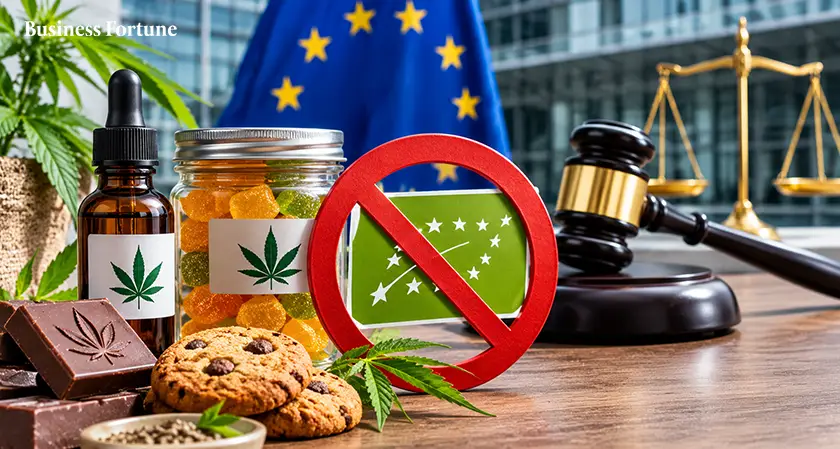
The EU Court of Justice has ruled that organic CBD foods need market authorisation before they can be certified.
The Court of Justice of the European Union ruled on the 5th October 2026 that no organic food products containing CBD will be able to be certified as organic.
Key facts
Judgment Date – 5th October 2026 (Case C-495/25)
Parties Involved – Syndicat professionnel du chanvre (French hemp industry group), INAO (French food quality institute) and French Council of State (referred the matter to the EU Court).
Ruling by the EU Court
The judges in Luxemburg ruled that CBD will not be able to be certified as organic until it has been approved for sale. This applies for goods which are not approved for sale within the EU. This includes goods to be sold in third countries as it may affect the credibility of the certification.
Why was the case referred to Luxemburg?
The case began in France. INAO informed organic certification bodies on the 2nd June 2021 that hemp flowers and leaves and CBD cannot be certified as organic or used within organic food products. The 17th August 2021 reiterated this ruling for CBD based products.
The Hemp Trade Association took this matter to the French Council of State who referred the case to the EU court. The question asked was whether CBD extracted from an agricultural product could be considered as a processed agricultural product for food purposes.
Judges’ reasoning
The judges decided to look at this in two parts. The Organic Rules apply to any product which is or may be eaten by humans. This includes novel foods whether they are approved or not. This means CBD should qualify.
However, being certified as organic gives a product a “positive image of quality and approval” from consumers. This cannot be separated from marketing rules.
Finally, the safety of the product was considered. For novel foods to be approved there must be evidence to show that they are safe for human consumption, not misleading to consumers and not nutritionally inferior. The Court found that to certify a product which is not approved may affect consumer safety.
What happens next for CBD producers?
CBD is classed by the European Commission as a novel food. This means that it has not been approved to be sold within the EU as a food product. Until this changes, CBD products will not be able to be labelled as organic.
Further Information
-
C-495/25 – Reference for a preliminary ruling from the French Council of State.
-
Opinion by Advocate General Rantos – 11th June 2026.
-
The Organic Rules are included within Regulation (EU) 2018/848.
-
Novel Foods are covered within Regulation (EU) 2015/2283.
-
Cannabinoids from hemp (including CBD) were added to the EU Novel Food Catalogue in January 2019.
-
Hemp oil which was not enriched with CBD was excluded by the INAO.
Business Fortune believes this ruling connects two areas which are often viewed as separate, organic labelling and novel food approval. At present, CBD products will need to be approved for sale within the EU to be labelled as organic. The Court has noted this also applies to exports.
FAQs
Can CBD food products be labelled as organic?
No unless they have been approved for sale within the EU.
Which court made the ruling?
Court of Justice of the European Union – 5th October 2026.
Is CBD a novel food?
Yes. It is classed as such by the Commission and has not been approved as a food.
Does this ruling apply to CBD food products outside of the EU?
Yes.
Who brought the case?
The French hemp trade association – Syndicat professionnel du chanvre.
Sources
Eunews · Advocate General's opinion, C-495/25 · Hemp Industry Daily















































































































































.webp)



Comments