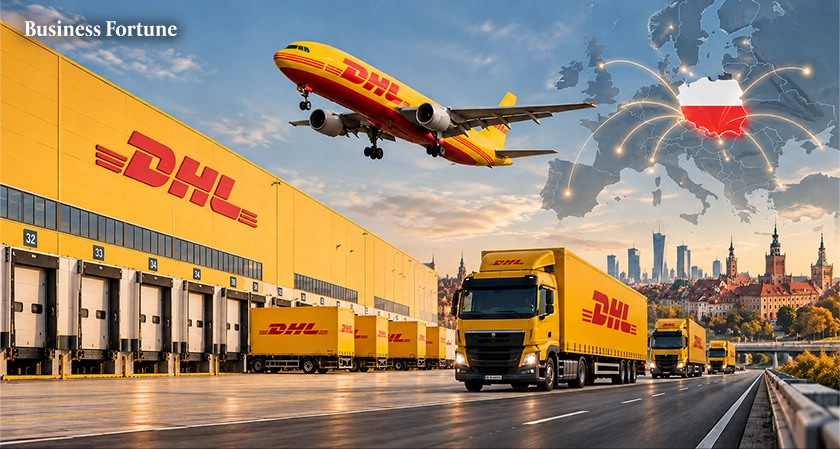
DHL plans major logistics upgrades across Poland, aiming to improve cross-border connectivity, strengthen supply chain resilience, and capture growing European trade opportunities.
DHL Group investment in Poland is set to exceed €400 million (US$447.8 million) by 2030 as the logistics company strengthens its presence across Central and Eastern Europe. The investment will help enhance warehouse facilities, transportation, distribution channels and logistics technologies. The strategy will contribute to making the supply chain more resilient and facilitate international business.
Central and Eastern Europe Gains Trade Importance
Central and Eastern Europe is turning into an increasingly important region for manufacturing, logistics and nearshoring due to the need for a dependable way to enter the European market. Political instability and climatic problems are prompting companies to diversify their logistical networks closer to their clients.
According to Supply Chain Digital, Poland has emerged as a key European manufacturing and logistics hub. Between 2016 and 2025, its goods trade grew 2.1 times faster than global trade and 2.7 times faster than European Union trade.
Poland’s goods trade is also forecast to grow 28% faster than global trade and 91% faster than EU trade between 2026 and 2029. Its location between Western and Eastern Europe makes it attractive for companies expanding their regional operations.
Hendrik Venter, CEO of DHL Supply Chain, said the company’s investments would help customers manage supply chain complexity, respond quickly to market changes and explore new growth opportunities.
DHL Expands Logistics Infrastructure
DHL has already made significant investments in Poland. In 2024, the group opened a €180 million International Logistics Centre in Poznań, connecting Polish operations with European and international markets. The facility supports DHL eCommerce, DHL Freight and Post & Parcel Germany.
The company plans additional investments in warehousing and logistics via DHL Supply Chain, DHL Freight, DHL eCommerce and DHL Global Forwarding. There is also an intention to construct a DHL Express air terminal at Katowice to cater for increased air freight services.
These developments will enhance connectivity in logistics across borders and aid businesses to manage their inventories and deliveries.
The Chief Executive Officer of DHL E commerce, Pablo Ciano, mentioned the contribution of the organization to the financial growth of Poland. In addition to that, he emphasized the investments made by the company in fulfillment centres and OOH parcel lockers.
Workforce Development Supports Long-Term Growth
Apart from this infrastructure investment, DHL is also focusing on enhancing its workforce capabilities. Poland is one of the top ten largest markets in the world for DHL in terms of employment, with more than 10,000 employees in the country.
This growth comes amid DHL’s overall strategy to assist firms that are expanding internationally by developing regional logistics networks. The use of technology, efficient distribution channels and skilled labor will be vital for navigating new trade routes.
In line with the increasing significance of Central and Eastern Europe in world business, DHL’s expenditure will make Poland an even more important connection between European production hubs and world markets.
Thus, Business Fortune believes that DHL’s investment will strengthen Poland’s logistics position, improve supply chain resilience, and support long-term European trade growth.
Sources: https://supplychaindigital.com/news/dhl-group-invests-400m-in-european-supply-chain-resilience https://group.dhl.com/en/media-relations/press-releases/2026/dhl-group-plans-more-than-eur-400-million-investment.html


.webp)






























Comments