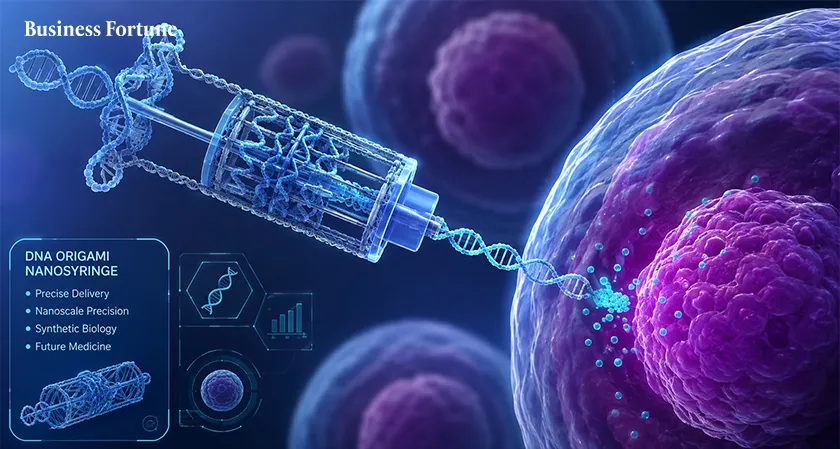
The DNA Origami Nanosyringe is a programmable molecular device that can pierce synthetic cell membranes, deliver cargo and retract to allow membranes to reseal.
The DNA Origami Nanosyringe is giving scientists a new way to deliver molecular cargo through membranes without permanently damaging them. Developed by a team led by Na Liu at the University of Stuttgart and the Max Planck Institute for Solid State Research, the synthetic device uses precisely folded DNA structures to mimic aspects of natural bacterial injection systems.
A Tiny Syringe Built From DNA
The device is made from two DNA origami bundles connected through a tiny gold nanoparticle that functions as a hinge. One bundle anchors to a lipid membrane using cholesterol linked DNA strands, while the other functions as a movable needle.
Short DNA fuel strands control the movement through a process known as Toehold Mediated Strand Displacement. Each fuel driven step moves the needle approximately 14 nanometres, allowing the researchers to control how far it penetrates the membrane. Experiments showed that the device can create conductive pores in artificial lipid membranes. Importantly, the researchers could also reverse the movement, pulling the needle back and allowing the membrane to recover.
Piercing Membranes Without Leaving Them Permanently Open
The researchers tested the nanosyringe on giant unilamellar vesicles, which are cell sized artificial lipid compartments. Fluorescent dyes entered the vesicles much more effectively after the nanosyringe was activated.
The experiments also showed size and charge selectivity. Smaller molecules passed more readily, while larger or more negatively charged molecules experienced reduced transport. This suggests that the designed channels, rather than uncontrolled membrane damage, were responsible for much of the molecular movement. When the needle was retracted, membrane currents moved back toward baseline and dye entry decreased.
Turning Chemistry On From the Outside
The nanosyringe does more than transport molecules. Researchers used it to initiate biochemical reactions inside synthetic cells.
In one experiment, DNA strands delivered through the device triggered a hybridisation chain reaction, producing a DNA structure along the inner membrane. In another, the researchers used the system to introduce sequences capable of activating gene expression, resulting in production of fluorescent Spinach RNA aptamers.
The team also demonstrated RNA cleavage using 10–23 DNAzymes delivered into the vesicles. These experiments suggest that the nanosyringe could eventually provide a way to control when and where molecular processes begin inside artificial cellular compartments. As the researchers noted, “These results demonstrate a strategy for constructing dynamic DNA devices that operate at membrane interfaces and coordinate mechanical actuation with biochemical function.”
What Makes the Discovery Significant?
The work offers a striking example of DNA being used not simply as genetic material, but as an engineering material capable of mechanical movement and molecular control.
However, the technology remains at the synthetic cell stage. The experiments were conducted using lipid membranes and giant vesicles rather than living organisms. Membrane stiffness also affects penetration efficiency, while current cargo designs work most naturally with molecules that can be connected to DNA.
Business Fortune asks if future improvements could involve different attachment systems, more sophisticated actuation mechanisms and testing in increasingly complex membrane environments.
A Programmable Door for Synthetic Cells
The DNA Origami Nanosyringe could eventually help scientists build more sophisticated artificial cells in which molecular reactions are triggered precisely when required.
Its ability to anchor, penetrate, deliver cargo and retract represents a significant step toward programmable membrane interfaces. Rather than treating a membrane as an impenetrable wall or destroying it to gain access; the technology suggests a different possibility: a nanoscale door that can open, deliver a molecular message and close again.
FAQs
What is a DNA Origami nanosyringe?
It is a synthetic molecular device built from DNA origami that can attach to lipid membranes, mechanically penetrate them and deliver molecular cargo.
How does the DNA Origami Nanosyringe move?
Short DNA fuel strands trigger toehold mediated strand displacement, moving the nanosyringe in controlled steps of roughly 14 nanometres.
Can the nanosyringe close after delivering cargo?
Yes. Researchers demonstrated reverse movement that retracts the needle and reduces membrane leakage and molecular transport.
What can the nanosyringe deliver?
Experiments demonstrated transport or delivery involving fluorescent dyes, DNA strands, gene expression activators and DNAzymes.
Can the DNA Origami Nanosyringe currently be used in living humans?
Not yet. The reported experiments were conducted with artificial lipid membranes and giant unilamellar vesicles. Further research is needed before applications in living biological systems could be considered.


.webp)






























Comments