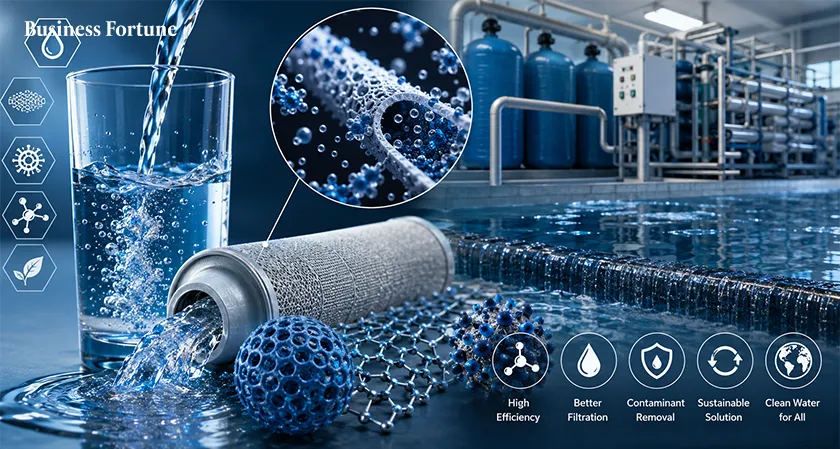
What if the future of clean water is smaller than you think? Explore 5 nanotechnology advancements transforming water purification in 2026. From graphene membranes to AI-designed nanomaterials, discover the tiny technologies that could change how we purify water.
Clean water appears to be one of those issues that should have been solved long ago by the humans. However, the water must survive many contaminants that include such things as industrial byproducts, heavy metals, bacteria, drugs, pesticides, salt and other pollutants that may not get filtered out by normal methods. This is where we need the best nanotechnology for water purification.
Nanomaterials measured in terms of thousands of times smaller than the diameter of a human hair tend to operate in ways entirely different from that of regular materials Nanomaterials offer huge surface area for trapping contaminants, act as highly selective filters, assist in decomposition of difficult-to-degrade chemicals and enable easy detection of contaminations. By 2026, the field is moving beyond the idea of simply putting nanoparticles into water-treatment systems. Researchers are developing membranes, adsorbents, catalysts, antimicrobial materials, sensors, and hybrid systems that can perform several jobs at once
A 2026 review published in Trends in Environmental Analytical Chemistry, for example, highlights filtration, adsorption, photocatalysis, and sensing as major areas of advancement. The goal is to get cleaner water, fewer chemicals and treatment systems that can work more efficiently in the real world.
So, what does the future of water purification actually look like? In this Business Fortune article, we explore five of the most promising nanotech advancements in 2026.
Five Best Nanotechnologies for Water Purification in 2026
- 2D nanomaterial membranes
Think about a water filter so incredibly small that some of its best characteristics will be measured in nanometers. That is the idea of latest version of 2D nanomaterial membrane filters. The use of materials like graphene oxide, MXenes, and other 2D nanomaterials is growing in popularity due to their ability to produce very small and controlled channels for water passage. In addition, their surface chemistry can be modified to react differently with various contaminants. This allows for selectivity in nanomaterial water filtration.
A 2026 review in Desalination describes 2D nanomaterials as excellent membrane materials owing to their properties such as high surface area, selective charges, anti-fouling characteristics, cleaning capacity, and molecular sieving efficiency. Their use is being investigated in applications such as desalination, heavy metal removal, antibiotics, organic contaminants, oil-water separation, and even microplastics.
Graphene oxide is particularly interesting. Its structure contains oxygen-containing groups that can interact with water and pollutants, while nanoscale spaces between layers can influence what passes through.
Biomass-derived nanofibers add another interesting angle. Cellulose and other renewable materials can be converted into nanoscale fibers and combined with advanced membrane materials. The result is an attempt to bring together high filtration performance with more sustainable raw materials.
This matters because a great membrane is not enough. It must also be durable, cost-effective, resistant to fouling and easy to manufacture in large quantities. Scientists continue to make progress in regard to fouling of membranes, cost of manufacturing, energy consumption, stability over time, and their ecological footprint.
Could nanotech make desalination less demanding?
Potentially, yes. The process of desalination usually involves high levels of pressure and energy input, especially in reverse osmosis. Research is currently ongoing into the use of nanostructured membranes for facilitating improved flow while still retaining high salt rejection. This does not imply that nanotechnology-based desalination has already become an alternative to conventional reverse osmosis in 2026. This has not happened. Most of the research is still ongoing. However, the trend is towards membranes that facilitate faster flow while being highly selective.
- Advanced nano-adsorbents
It may not always be required to force the contaminants through a filter, in such cases, the best way to clean the water may be to absorb the contaminants. This is the basic concept of adsorption. Nanoadsorbents refer to materials that have been manufactured to have a high surface area, coupled with specially-designed chemical sites where the pollutants attach when the contaminated water makes contact with them.
The materials under consideration include graphene derivatives, carbon nanomaterials, metal-organic frameworks (MOFs), zeolites, metal oxides, nanomaterials from biochar, and hybrid materials. These materials are meant to filter out pollutants such as heavy metals, dyes, pesticides, pharmaceuticals, and other organic pollutants. According to reviews carried out in 2025 and 2026 on nanomaterials for water purification, one of the major uses of nanomaterials in water purification is adsorption.
The material can be designed to have more affinity for some pollutants than others based on their surface chemistry. This will prove beneficial for treating industrial wastewater, which may have an array of pollutants.
What happens after the pollutant is captured?
This is an important to know because nano-adsorbent, which is effective only once but turns into hazardous waste after the first use, might not always make a good solution for treating water.
The scientists now concentrate more on the possibility to regenerate and reuse the substance. It will add significant value to the material from both economic and environmental perspectives if it is possible to recover the pollutants adsorbed by it and to reuse it. Nano-materials produced from biowastes have also become the objects of interest. According to the review from 2026, the waste materials can be used to produce nano-activated carbons and hybrid nanocomposites for water treatment. So, the waste of yesterday can turn out to be the filter of tomorrow.
- Nanophotocatalysts are turning light into a pollution-fighting tool
What if the treatment system not only adsorbed the contaminant but also helped break it down?
This is where nanophotocatalysis helps. A photocatalyst is a substance that becomes reactive upon exposure to an appropriate type of light. When such substances exist on a nanoscale, materials like titanium dioxide and zinc oxide will break down certain organic pollutants.
The basic process looks surprisingly simple:
Light + nanocatalyst + polluted water = chemical reactions that break down pollutants.
This method is currently being studied for the degradation of substances like dyes, pesticides, pharmaceuticals, and other organic contaminants that are hard to remove from water. This could prove useful due to the large surface area provided by nanomaterials. However, the exciting new direction is the use of visible light and sunlight rather than solely ultraviolet sources which are very energy-intensive.
This would be especially relevant for the use of solar-activated nanocatalysts in places with plenty of sunshine. Unfortunately, there is a drawback. It is not enough to simply break down the pollutant, whereas it needs to be established what products are formed by the process and whether they are really harmless.
Then there is the problem of separation of the catalyst after the purification process. Loose nanoparticles left freely floating in purified water are not exactly what one would hope for. So the future would probably include immobilized nanocatalysts and re-usable composite materials.
- Nanotechnology is taking on bacteria and biofilms
Clean water is not only about removing chemicals. It also has to be safe from harmful microorganisms. This is where nanotechnology for water disinfection is showing promise. Scientists are researching metal nanoparticles, metal oxide nanoparticles, carbon-based nanoparticles, antibacterial nanocomposites and many other nanostructures that could harm or inhibit microorganisms.
The problem with all this is biofouling. Once the bacteria have adhered to the water treatment membrane, they form a biofilm, which can obstruct the surface of the membrane and affect the efficiency of treatment. It is basically the filter equivalent of a bathroom drain slowly becoming clogged. A 2026 review in Discover Nano examines how nanotechnology can support both pathogen control and biofilm management, including mechanisms involving antimicrobial activity and interactions between nanomaterials and microorganisms.
Carbon nanotubes, or CNTs, are also being explored in advanced membrane systems. In some research directions, electrical stimulation is combined with conductive nanomaterials to discourage microbial attachment or damage microorganisms. The bigger idea is to build filters that do more than separate substances.
They could potentially filter, resist fouling, and help control microbes at the same time. Still, safety has to come first. Any antimicrobial material used in water treatment needs careful evaluation to make sure the treatment itself does not introduce harmful substances into the water.
- AI-designed and sustainable nanomaterials
Here is where two major trends meet, artificial intelligence and green nanotechnology.
Traditionally, developing a new nanomaterial can involve a lot of trial and error. Researchers change a material's structure, test it, measure performance, modify it, and repeat the process. But AI and machine learning could help narrow that search. Computational models may be utilized to analyze connections between structure, surface chemistry, pore size, charge, and performance of a particular nanomaterial. This may save researchers much time and effort in the development of promising materials before their fabrication and testing.
How to Choose the Right Nanotechnology for Water Purification
There is no universal solution. Technology which is brilliant for seawater could be a wrong choice for industrial wastewater. The substance used to eliminate lead could not be the right one for pharmaceuticals or microorganisms.
The first thing to do, thus, is to identify what is in the water.
In the case of heavy metals, nano-adsorbents and functionalized membranes are good candidates. As for salts, advanced membranes and nanotech desalination methods should be taken into account. For organic compounds, photocatalysis could be more effective. Bacteria and biofilms can be handled by antimicrobial nanomaterials.
Then comes the practical side.
Look at five things:
-
Target contaminants: What exactly needs to be removed?
-
Water quality: Laboratory water and real wastewater behave very differently. Natural organic matter and multiple contaminants can affect performance.
-
Energy requirements: A technology that consumes too much energy may not make economic sense.
-
Material safety: Nanomaterials must be contained, recovered or otherwise managed responsibly.
-
Total cost: Manufacturing, maintenance, regeneration, replacement, and disposal all matter.
This last point is crucial. A 2025 review of nanomaterial-based water treatment identifies cost, scalability, environmental risks, and long-term sustainability among the major challenges facing wider adoption.
Final Thoughts
Water purification is transforming where nanotechnology makes purification processes much more intelligent and efficient. Instead of focusing on a single technology, scientists are now using a combination of nanomaterials and methods to solve different water problems.
2D membranes will be able to purify water more selectively, while nano-adsorbents will be able to remove contaminants from water. Photocatalysts will be able to degrade persistent chemicals, while antimicrobial nanomaterials will help to control bacteria and biofilm formation. At the same time, AI will assist scientists in material design, while biomass-based nanomaterials will help to make water purification processes more sustainable.
All these trends will influence the development of advanced water purification technologies in the future. However, some issues including costs, safety, energy consumption, stability, and mass production need to be solved. Nanotechnology in water purification in 2026 is going to include filtration, disinfection, pollutant removal, monitoring and use of sustainable nanomaterials.
FAQs
Which nanomaterials are used for water purification?
Common examples include graphene and graphene oxide, carbon nanotubes, metal oxides such as titanium dioxide and zinc oxide, metal-organic frameworks, nano-activated carbon, and various nanocomposites.
Can nanotechnology remove heavy metals from water?
Yes. Nano-adsorbents, functionalized carbon materials, metal oxides, membranes, and other nanocomposites are being studied for removing metals such as lead, mercury, arsenic, and cadmium.
Can nanotechnology desalinate seawater?
Nanostructured membranes are being researched for desalination because their nanoscale structures can potentially improve water transport and salt separation. However, conventional reverse osmosis remains an established commercial technology, while many advanced nanomembranes are still being developed and tested.
Is nanotechnology water treatment safe?
It can be, but safety depends on the material and how it is used. Researchers need to consider nanoparticle release, toxicity, recovery, durability, and what happens to the material after treatment. These concerns remain important barriers to large-scale adoption.
What are the biggest water treatment innovations 2026?
Among the important directions are 2D nanomaterial membranes, high-capacity nano-adsorbents, photocatalytic nanomaterials, antimicrobial and antibiofouling systems, AI-assisted material design, biomass-derived nanomaterials, and nano-enabled sensing.


.webp)





























Comments