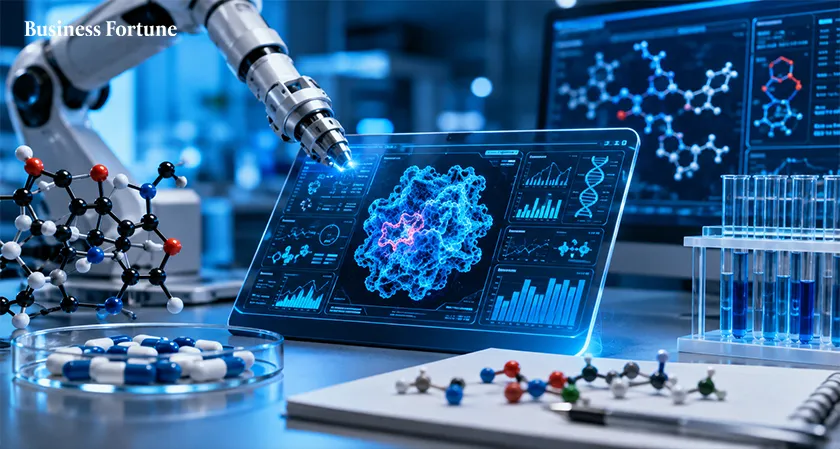
The Best AI applications in drug discovery are currently transforming drug design by helping researchers identify targets, screen molecules, design new compounds and prioritize drug candidates for laboratory investigation.
For years, drug discovery has been a numbers intensive endeavour - a search through millions of possible molecules to find a handful of viable drug candidates. Researchers may have a general sense of what to look for, but isolating a single effective molecule, testing its viability and ensuring its safety can require years of research.
That's where the Best AI applications in drug discovery come in. By analysing biological data, predicting protein structure, screening large chemical libraries, recommending new molecules for investigation and supporting other areas of research; computers are accelerating the search for new drugs. These technologies can't replace researchers. The much more interesting scenario is a scientist working alongside a powerful, tireless research assistant.
Why drug discovery needed a new approach?
Taking a drug from initial discovery to a doctor's office is a challenging endeavour. Molecules that look promising on paper may fail at various stages of testing.
The reason for these failures is biology; complex, variable, difficult to control and impossible to fully understand. A drug can have unexpected effects, interact with more proteins than targeted, vary in potency across different tissues and interact unpredictably with other drugs.
Researchers seeking new therapeutics must navigate this space carefully, considering formulation, administration, toxicology, metabolism and other factors. Meanwhile, AI drug Development computer can help find patterns in this sprawling dataset. Here are ten reasons why researchers should be excited about the Best AI applications in drug discovery in 2026:
- Discovering new drug targets
Before a drug can be designed, researchers need to identify a biological target; a protein, gene or other structure associated with a disease. That's not always easy. Most diseases are complex processes involving numerous proteins, genes and other factors. Computational methods can help identify disease associated patterns, link them to biological processes or structures and suggest potential therapeutic targets for further investigation.
This process may seem abstract, but it's often essential. Artificial Intelligence drug discovery can highlight relationships that might not be obvious from a researcher's perspective. On the other hand, any promising lead still has to be validated in the laboratory.
- Predicting protein structure
Some structures are more important than others, notably proteins. These complex molecules must take on specific shapes in order to perform their functions and drugs often work by attaching to these structures.
The latest developments in AI drug discovery platforms around increasingly accurate methods of predicting protein structure. This information can help scientists select promising targets and study their interactions with potential drugs. AlphaFold and similar programs have already made astounding advances in this field, but later innovations are also accelerating the process.
For researchers, that may make identifying promising interactions easier than ever.
- Virtual screening
Researchers looking for molecules that can act as drugs face an immense search space. A virtual screening can help narrow that space down to only the most promising candidates.
Computer scientists have already made remarkable strides in speeding up the screening process while maintaining accuracy. One method reviewed in detail in a 2026 article from Nature Protocols utilised an AI driven virtual screening platform, constructing a workflow consisting of multiple docking and scoring models. The system was able to screen 100,000 compounds in "approximately 30–45 min."
That "approximately" is crucial; the system doesn't identify 100,000 drugs in that time. However, this result demonstrates that an AI can drastically reduce the number of compounds requiring experimental follow up. That's a significant benefit, given the time required to evaluate every molecule.
- Designing new molecules that don't yet exist
So far, these methods have suggested existing molecules for further investigation. What about molecules that don't exist yet?
Many AI techniques can design novel drug molecules; typically by suggesting modifications to existing compounds. Scientists can specify their design criteria, then select from suggested structures or investigate the changes they recommend.
This type of AI application can support the search for compounds that bind most effectively to a particular protein, possess desirable traits beyond binding (e.g. solubility, permeability) or otherwise meet specific requirements. This is the realm of generative AI drug discovery, wherein programs can recommend new molecules under certain constraints. It's also the domain of generative chemistry more broadly.
Researchers can use various approaches to design new molecules with desired traits. Generative adversarial networks (GANs) allow two AI models to compete, with one designing molecules and the other evaluating them against specified criteria. Similarly, variational autoencoders can learn the patterns of existing drugs, then suggest new variants that fit a particular design framework.
- Optimizing lead compounds
A lead compound is a promising candidate for further development ideally, it possesses desirable traits while avoiding problematic effects. However, optimization is a crucial process. A researcher might pursue molecular modifications that improve potency, solubility or other desired traits. They might also seek ways to reduce undesirable effects.
Computational methods can help guide this process, analyzing a molecule's interactions and suggesting modifications to pursue or avoid. This sort of approach has tremendous value in medicinal chemistry. By rapidly identifying changes that confer particular benefits, AI can accelerate the path to candidate selection.
Furthermore, researchers can utilize models that estimate beneficial and harmful effects in silicon, reducing the number of modifications that require experimental follow up.
That's a particularly valuable advantage. Optimization is often a frustrating process. A predictive model can help scientists make more informed choices.
What are the Best AI applications in drug discovery good for?
The best applications tend to have something in common; they allow researchers to accomplish something they couldn't do before. More specifically, they tend to take advantage of the unique strengths of a computer.
There's value in speed, of course.
Some methods are valuable because they provide extremely rapid results. For instance, a system that can screen hundreds of thousands of molecules in just hours. That can make a major difference in drug discovery, where time is always of the essence.
However, speed isn't nearly as important as accuracy. A fast but faulty model is often worse than a slow but accurate one.
That principle applies to most aspects of AI pharmaceutical research. A promising model may be exciting, but it's only valuable if it results in better treatments.
What researchers should look for in an AI platform?
There's no single right answer, of course. Every team has to determine what matters most.
A group investigating protein folding will have very different priorities from a team working in phenotypic screening or generative chemistry.
That being said, there are some common considerations, most notably, the value of the information provided. Researchers should take a close look at what a particular AI application can accomplish, investigating its sources and limitations. Accuracy and validation are critically important, as is the ability to utilise the results effectively.
After all, a promising but time consuming technique offers little value to a team that needs rapid results. Similarly, speed alone doesn't overcome fundamental weaknesses in an approach.
Why 2026 could be an important year?
The phrase "AI drug discovery 2026" isn't just a catchy title. Researchers are already utilising AI to design new therapeutics and pharmaceutical companies are pursuing an increasing variety of promising approaches. A review of leading platforms in 2026 could well highlight similar trends, investigating the latest methods in generative chemistry, phenomics and physics informed molecular design. AI powered drug discovery is beginning to enter clinical development and the next few years will be crucial to determining their ultimate impact.
Meanwhile, researchers are also recognising the importance of these challenges. The field needs innovation, but incremental improvements without substantial progress will only lead to disappointment.
That's especially true for machine learning drug discovery in pharmaceutical research. After all, most promising projects ultimately fail.
The future of AI pharmaceutical research
The coming years will see a steady expansion of the concepts described in this article. Researchers are already utilising powerful tools to investigate biology at an unprecedented scale.
In the future, those tools will become faster, more versatile and more powerful.
A promising direction for AI drug discovery involves integrating diverse sources of information and utilising that knowledge to guide further investigations.
Rather than making predictions about single phenomena, an algorithm might utilise a greater variety of information to understand biological systems and recommend specific opportunities for investigation. This approach would have tremendous value in many areas of pharmaceutical research, spanning from basic discovery to clinical development.
That presents an exciting opportunity, but it also involves considerable risk. A more integrated, self sustaining system has tremendous potential, but it will require substantial validation before researchers can truly trust its results.
There's also the danger of false expectations. A researcher must still interpret an AI's suggestions and recommendations.
The drug discovery process has been fragmented for years, with investigators following a rigid pipeline wherein one stage leads to the next. AI can overcome these barriers, streamlining the process and accelerating development. However, efficiency isn't always synonymous with improvement. The next major innovation in pharmaceutical research may well come from investigators who embrace a different approach.
The Best AI applications in drug discovery are not about computers replacing labs. They are the ones providing researchers with a better guide through an incredibly complex terrain. From target discovery and protein structure prediction to virtual screening of large libraries of compounds, molecule design, lead optimisation, toxicity prediction, drug repurposing and clinical trial design, AI applications in drug discovery are numerous and compelling. The most interesting aspect of this technology is that its best applications have not been reached yet, which means that there is still a long way to go. This technology’s true breakthrough is not about generating molecules and making rankings of existing compounds but rather being able to consistently contribute to the development of therapeutics and bring new medicines to patients.
Business Fortune believes that the Best AI applications in drug discovery are not about computers replacing labs. They are the ones providing researchers with a better guide through an incredibly complex terrain.
FAQs
What are the Best AI applications in drug discovery?
The best applications are those that are used in target identification, protein structure prediction, virtual screening, molecule generation, lead optimisation, toxicity prediction, drug repurposing and clinical trial support.
Can AI discover a new drug?
AI can generate and rank potential candidates; however, laboratory and clinical studies are essential to evaluate if the prepared molecules are therapeutically active and generally safe for patients.
How can AI accelerate drug discovery?
AI can help tremendously at analysing large amounts of data and screening thousands of compounds to identify the most promising areas of research.
What are the main limitations of using AI in drug discovery?
The limitations of using AI in drug discovery are connected to data. Data quality, data biases, data accuracy and data incompletion, as well as translational and validity barriers.
Will AI replace pharmaceutical researchers?
The most plausible scenario states that pharmaceutical researchers will use AI to complement the existing approaches by harnessing the computing power of these systems.


.webp)





























Comments