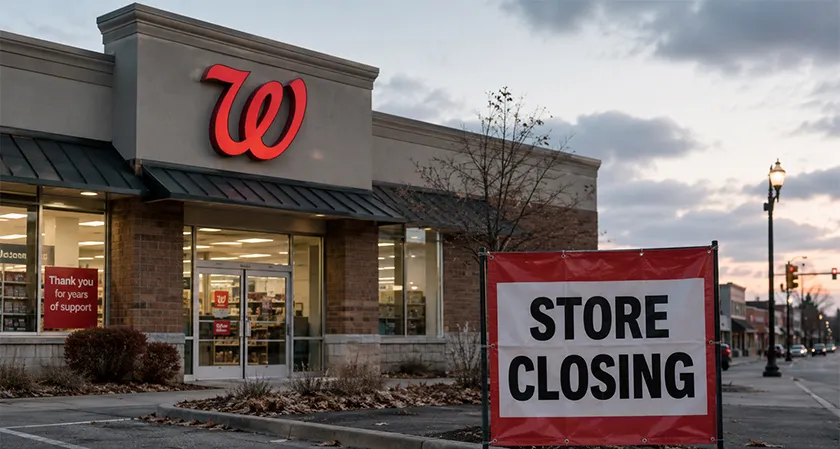
Walgreens is closing more stores in 2026 across the U.S. Find out why these locations are shutting down, what it means for customers, and what the company plans to do next.
Walgreens 2026 is becoming one of the biggest retail stories of the year as the pharmacy giant continues closing stores across multiple states while bringing some change to its business. Though Walgreens is closing stores, the company says it isn't stepping away from the pharmacy business. Instead, it's focusing on keeping its stronger-performing locations open and building a healthier business for the future.
Walgreens still has around 8,000 stores across the U.S. In 2024, the company announced plans to close about 1,200 underperforming stores over three years. But after private equity firm Sycamore Partners bought Walgreens in 2025, those plans changed. The company now expects to close fewer than 100 stores in 2026, much lower than what was first expected.
Every store has a different reason for closing
There isn't one single reason behind the closures. Some stores are shutting because their leases have ended, while others have struggled with low sales, rising operating costs, theft, or safety issues. Walgreens has also been cutting costs by consolidating some of its larger operations, including distribution centers.
Stores have already closed in several states, including California, Florida, Illinois, Missouri, New York, South Carolina, Texas, Virginia, Washington, Wisconsin, and Washington, D.C. Two more stores in New Jersey are also set to close.
"Decisions to close stores are never made lightly, and we are committed to making the transition as seamless as possible," a Walgreens spokesperson said. The company added that prescriptions will automatically be transferred to nearby Walgreens stores, and eligible customers will receive free prescription delivery for 90 days.
What does this mean for customers?
For many people, especially those who depend on a nearby pharmacy, these closures have raised concerns. In parts of Chicago, residents have criticized the shutdowns, saying they reduce access to important healthcare services in their neighborhoods. Walgreens says customers will still be able to get their medications through nearby stores, automatic prescription transfers, home delivery, and online pharmacy services.
While the company is reducing the number of stores it operates, it says the goal is to invest more in locations with better long-term potential. Walgreens believes this approach will help improve customer service while making the business stronger in the years ahead.
As Business Fortune observes, the retail pharmacy industry continues to change and Walgreens is expected to keep reviewing its store network. More closures could happen where stores are struggling, but the company is betting that a smaller, more efficient network will put it in a better position for the future.
FAQs
Why is Walgreens closing stores in 2026?
Walgreens is closing underperforming locations due to factors such as declining sales, expiring leases, theft, safety concerns, and a company-wide effort to improve profitability.
How many Walgreens stores are expected to close in 2026?
Current estimates indicate fewer than 100 stores will close during 2026, significantly fewer than earlier projections.
Will customers lose access to their prescriptions?
No. Walgreens says prescriptions from closed stores will automatically transfer to nearby locations, and some customers will qualify for temporary free prescription delivery.
Who owns Walgreens now?
Walgreens became a private company after being acquired by Sycamore Partners in 2025 as part of a multibillion-dollar buyout.
Is Walgreens shutting down completely?
No. Walgreens continues to operate thousands of stores across the U.S. The company says it is reducing its footprint while strengthening its core pharmacy business rather than leaving the market.


.webp)






























Comments