The human brain remains one of medicine's most extraordinary achievements and one of its most difficult challenges. Physicians have become remarkably skilled at identifying abnormal electrical activity, locating the sources of neurological disorders, and understanding how different regions of the brain communicate. Yet knowing where a problem begins is not always the same as being able to treat it, particularly when the affected tissue lies deep within the brain or involves nerves responsible for some of the body's most essential functions.
That challenge is helping shape the next chapter for NeuroOne Medical Technologies Corporation (NASDAQ: NMTC), a Minnesota-based medical technology company developing tools that could give physicians more precise ways to diagnose and treat neurological conditions.
NeuroOne's story began with an effort to improve the electrodes used to monitor electrical activity in the brain. Today, that technology has evolved into a portfolio of FDA-cleared devices capable of supporting neurological monitoring and targeted treatment, along with an emerging drug-delivery platform that could eventually extend the company's reach into additional areas of medicine.
It's a progression that has become particularly interesting in recent months, as new clinical findings, record purchase orders, and expanding research activity begin to demonstrate how the company's technology might serve a much broader purpose.
When Diagnosis and Treatment Come Together
Consider the challenges facing patients with drug-resistant epilepsy. For some, medications offer little relief, leaving physicians to investigate whether the seizures originate in a particular region of the brain that might be treated surgically. Finding that location often requires sophisticated monitoring, and treating it can involve additional procedures and specialized equipment.
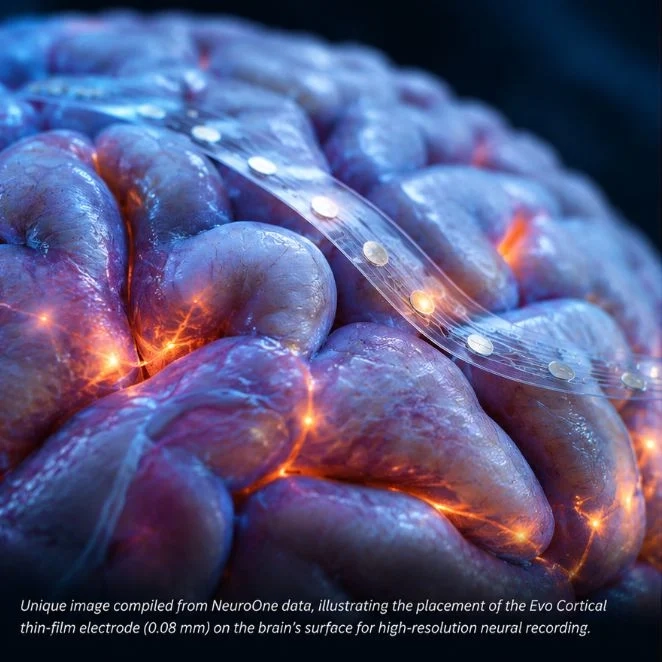
NeuroOne has developed technology intended to make portions of that process more efficient, beginning with the physical design of the electrodes themselves. Its Evo Cortical electrodes measure just 0.08 millimeters thick, approximately seven times thinner than conventional silicone electrodes. Among the thinnest designs in neurological monitoring, their flexibility and reduced dimensions are intended to support close contact with delicate tissue while potentially offering less invasive approaches to implantation.
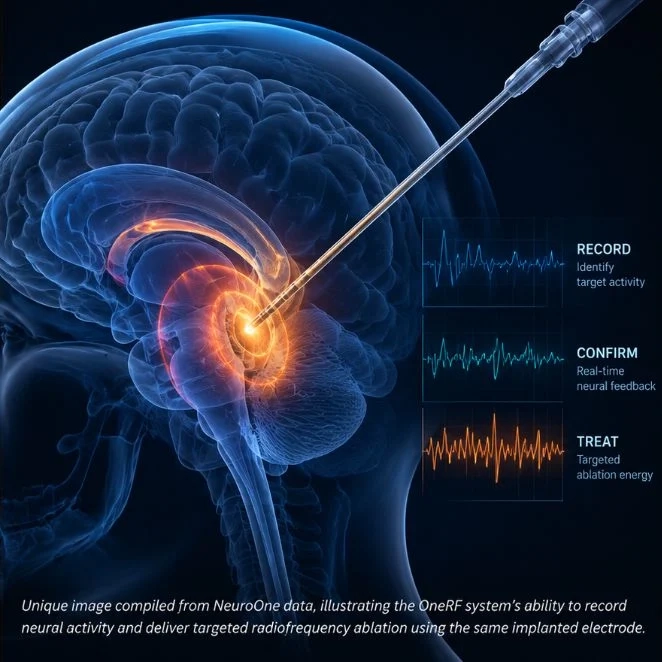
But thinness is only one part of the company's technological distinction. NeuroOne's OneRF Brain Ablation System is designed to allow compatible electrodes to perform both diagnostic recording and targeted radiofrequency ablation. For certain patients with drug-resistant epilepsy, those capabilities may allow physicians to identify abnormal brain tissue and subsequently treat it using the same implanted device, potentially avoiding a separate surgical procedure and allowing treatment during a single hospital admission.
For patients, the appeal is straightforward. The prospect of fewer interventions, less procedural disruption, and a more integrated approach to treatment can be just as meaningful as the sophistication of the technology itself.
The company now has four FDA-cleared devices, including its Evo Cortical and Evo sEEG electrode systems and its OneRF systems for brain and trigeminal nerve ablation. Through its commercial relationship with Zimmer Biomet, NeuroOne has access to an established medical-device distribution network, providing a pathway to hospitals and physicians without having to build an equivalent national sales organization entirely on its own.
Perhaps one of the clearest illustrations of the technology's potential comes from a condition that has little to do with epilepsy but can be equally devastating to those who experience it.
Trigeminal neuralgia causes sudden, severe facial pain that patients often describe as an electric shock. Something as ordinary as chewing, speaking, or brushing one's teeth can trigger an episode, turning routine daily activities into sources of anxiety and discomfort.
On October 29, NeuroOne announced the publication of peer-reviewed clinical findings involving 15 patients treated with its OneRF Trigeminal Nerve Ablation System. Fourteen experienced immediate freedom from pain, while the remaining patient became pain-free approximately one week later. At an average follow-up of six months, all 15 had achieved favorable clinical outcomes, although some continued taking medication.
The results are encouraging, especially given the system's ability to map and treat different nerve distributions without repeatedly repositioning its probe. The study was small and retrospective, and additional research will be needed to establish longer-term effectiveness. Still, the findings offer an early look at how NeuroOne's technology is being adapted to address a painful neurological condition with a substantial impact on quality of life.
Innovation Begins to Meet Commercial Opportunity
Developing sophisticated medical technology is one achievement. Bringing it into widespread clinical use is another, and that distinction is especially important for smaller medical-device companies trying to establish themselves in a market dominated by much larger competitors.
For NeuroOne, recent financial and commercial developments suggest that the transition from product development to broader commercialization is gaining traction.
In early October, the company reported preliminary fiscal fourth-quarter 2026 product revenue of approximately $3.8 million, an increase of 38.4% from the comparable period a year earlier. Preliminary full-year product revenue reached approximately $10.5 million, representing 15.6% annual growth and placing the company at the top of its previously announced guidance range.
Just as noteworthy was a $4.5 million purchase order received in September, the largest in NeuroOne's history. The company reported approximately $5.4 million in open purchase orders as of September 30, providing additional visibility into anticipated shipments as fiscal 2027 gets underway.
These figures do not eliminate the challenges associated with scaling a medical-device business. Manufacturing capacity, physician adoption, distribution, and working capital will continue to influence how quickly orders translate into revenue. As NeuroOne expands its commercial presence, managing resources and maintaining financial flexibility will remain important to supporting its growth.
Nevertheless, the growing order activity suggests that the company's established products are finding opportunities in the marketplace at the same time its research pipeline is opening additional possibilities.
CEO Dave Rosa has emphasized the importance of expanding commercialization, developing international markets, and advancing technologies that build upon the company's existing expertise. Rather than pursuing an entirely unrelated collection of medical devices, NeuroOne is seeking to apply its underlying electrode technology to a wider range of neurological needs.
That strategy becomes especially interesting when considering what the company is developing beyond its currently cleared products. And perhaps nowhere is that potential more intriguing than in NeuroOne's efforts to address one of neurological medicine's most persistent challenges: delivering treatments directly to the brain.
Beyond the Electrode: A New Approach to Drug Delivery
One of the longstanding obstacles in treating neurological disease is the blood-brain barrier, a natural protective system that helps keep harmful substances out of the brain but also makes it difficult for many medications to reach their intended targets.
For researchers working on conditions such as brain cancer and certain neurological disorders, finding ways to deliver therapeutic agents precisely where they are needed remains an important area of investigation.
NeuroOne's StereoCED platform is being developed with that challenge in mind. The investigational technology is designed to deliver therapeutic agents directly into targeted brain tissue while incorporating the company's expertise in neural recording and minimally invasive access.
The concept is a natural extension of the work NeuroOne has already undertaken. If electrodes can help physicians reach and monitor specific areas of the brain, the same technological foundation may offer opportunities to deliver therapies to those locations with greater precision.
The company has been advancing StereoCED through research initiatives involving medical and academic institutions, including work exploring applications in epilepsy and pediatric brain cancer. These programs remain at an early stage, and the technology has not established clinical effectiveness or received FDA clearance for commercial therapeutic use.
Even so, the research points toward a broader ambition that extends beyond the immediate market for neurological electrodes. It also creates opportunities for collaboration with pharmaceutical developers seeking new ways to investigate therapies that have historically been difficult to deliver into brain tissue.
A Broader Opportunity Begins to Take Shape
What makes NeuroOne's development worth following is not any single product or clinical announcement, but the way its different technologies are beginning to fit together.
The company's diagnostic electrodes established a foundation in neurological monitoring. Its OneRF systems extended that expertise into targeted treatment, while StereoCED represents an effort to explore what might be possible when precise access to neurological tissue is combined with localized drug delivery.
There is still considerable work ahead. New applications will require additional clinical evidence, commercial products must continue gaining acceptance among physicians, and the company will need to manage the financial demands that accompany growth.
But the combination of FDA-cleared devices, expanding product orders, and an increasingly diverse research pipeline suggests that NeuroOne is moving beyond its original identity as an electrode developer.
For patients facing neurological conditions that remain difficult to diagnose or treat, the larger significance lies in the possibility of giving physicians better tools and more options. And for NeuroOne, the opportunity is to build upon technology that is already being used in clinical settings while exploring how much further it might go.
The brain will never be a simple place to practice medicine. But as the tools used to understand it become more precise, the possibilities for treating it may continue to expand. And in a field where innovation isn't necessarily measured by the size of a company, some of the smallest players may ultimately make some of the biggest contributions.
Sources and References: NeuroOne Medical Technologies Corporation, company website and investor relations (nmtc1.com); Evo Cortical Electrode product specifications and technical white paper; Frontiers in Neuroscience (2022), published research on thin-film electrodes; October 29, 2026, peer-reviewed OneRF Trigeminal Nerve Ablation clinical findings; October 5, 2026, preliminary fiscal 2026 financial results and record purchase order; June 2026 Investor Presentation; SEC Form 10-Q, filed August 13, 2026; and NeuroOne corporate materials covering Evo electrodes, OneRF ablation systems, and the StereoCED drug-delivery platform.


.webp)






























Comments