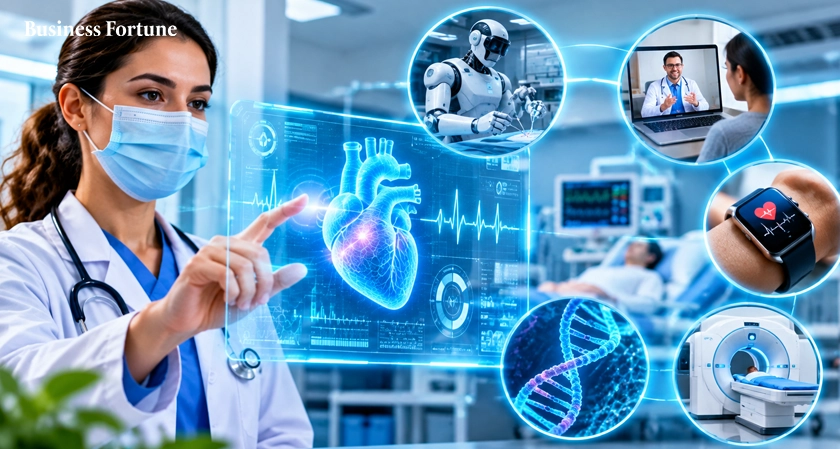
Key medical tech developments in 2027 aim to reduce administrative work, improve early disease detection and provide care in the community. Below outlines key medical technologies set to develop in 2027 and how to critically assess them.
Why medical technologies are important?
Due to an increase in elderly people and people with chronic diseases, medical technologies are being incorporated into healthcare systems to provide efficient care given high clinical workloads and limited resources.
The most effective medical technologies reduce inefficiencies in clinical practice. This may be reducing waiting times for results, reducing time spent on documentation and streamlining discharge.
Medical Technology Developments
Artificial intelligence (AI)
AI is being used to detect abnormalities in various imaging types and biopsies (X-rays, CT scans, retinal scans and histology). This allows for prioritisation of urgent cases. In main markets, diagnostic software is classed as medical devices. The highest quality products have been validated across multiple patient groups.
Voice recognition software
This reduces the amount of time taken to document. It does however mean more interaction with patients. Documentation is not finalised and needs reviewing by clinical staff.
Wearables
Wears such as smart wearables, continuous glucose monitors, smart BP machines and patches can be used to collect patient data between appointments. Over several weeks, patients with hypertension, diabetes or heart failure can be better assessed than in one appointment. In order to maximise benefit from this medical technology, alerts should be carefully selected to avoid overburdening staff.
Hospital at home / Telehealth
With improved telehealth systems, appropriate patients can be monitored and seen in the comfort of their own homes. It is important to ensure patients have a safe environment, good internet and clear escalation systems in place.
Robotic / Image guided Surgery
Robotic, AR and navigation systems allow very precise and minimally invasive surgery. Benefits will depend on the procedure and skill of the surgeon. Therefore benefits in outcomes are usually balanced with costs and training requirements in hospitals.
Precision medicine / Genomics
As the cost of genomic testing in tumors and medications has reduced, we can now tailor treatment to the biology of patients. This reduces guessing when choosing treatment for patients.
Digital twins and 3D printing
From patient scans, digital twin models can be produced. This allows simulation of treatments. 3D printing is being used to create anatomical models, guidance in surgery and patient specific implants. In many specialities, these technologies are in early development and therefore will be implemented gradually.
Considerations
To make medical technologies effective, systems must be compatible and patient data must be protected. Standards have been set in order to make different systems/ applications compatible (HL7 FHIR).
- Due to the effect ransomware can have on hospitals, keeping systems secure is now a patient safety issue.
- Critical appraisal of medical technology developments
- Consider the following to decide whether to implement medical technology developments or to understand what developments have been implemented by your provider:
- Is this technology approved/ cleared in your country?
- Is there good evidence (peer reviewed or real world) to support this development? Or is it purely marketing from the company?
- Have relevant staff tried this technology?
- Is patient data well protected?
- Are outcomes measured after implementation? Has training been provided?
Medical technologies in 2027 aim to support intelligent, integrated and patient focused care. The best medical technologies will have good evidence to support them, protect patient privacy and support clinical staff.
Find more evidence based information on medical innovations by signing up to our Business Fortune newsletter. Consider sharing this guide with a colleague to help them plan technology developments for 2027.
FAQs
1. How is patient care changing in 2027?
Patients are likely to receive faster diagnoses, more care through telehealth and less typing from their doctor in appointments. Many patients will have devices in their homes to allow them to share readings with their care team.
2. Are AI driven innovations in healthcare safe?
AI diagnostic tools are classed as medical devices in many countries. Clinical decision making is still undertaken by clinicians. Speak to your provider to find out how AI is being used in your organisation and if outputs are reviewed by clinicians.
3. What skills will clinical staff need in 2027?
Skills in using digital technology in order to analyse data and question AI outputs. Knowledge of data protection and cyber security is increasingly important in clinical roles.
4. How can a small clinic implement the best technologies, without a large budget?
Identify where there is a pain point in processes (documentation, booking appointments) and trial in a small way. Ensure vendors have good references. If results justify it, scale up.
5. What are the risks of implementing new medical technologies?
Risks with new medical technologies include data privacy issues, bias in AI, over reliance upon automation and inequity of access. These can be mitigated with good governance, clinical oversight and good evidence.

























.webp)




.webp)


Comments