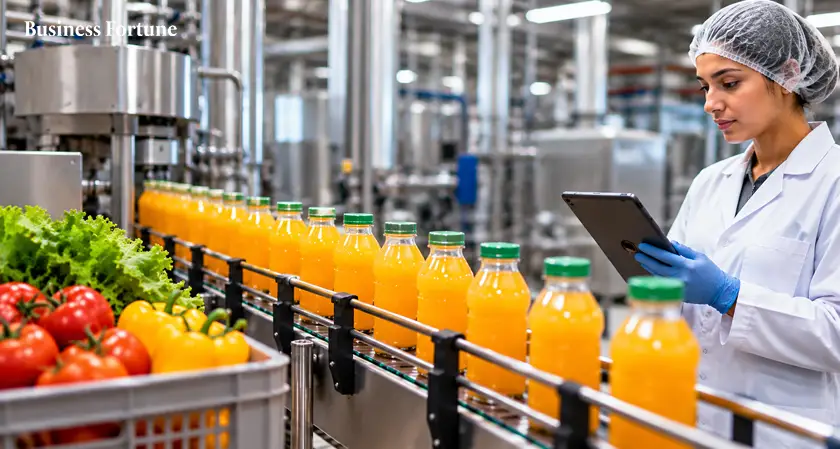
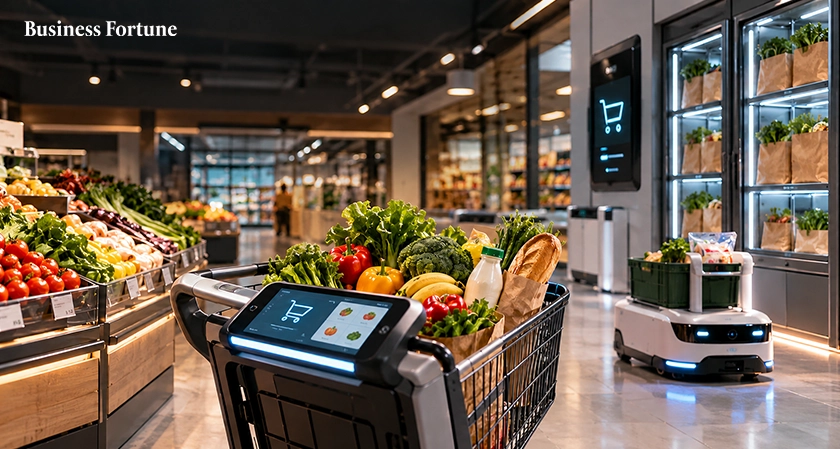
AI in food and beverage industry spending is climbing, but results lag the hype. Market data, company pilots and FDA deadlines show where it works.
Nearly 90% of food and beverage manufacturers already use AI and machine learning or plan to soon, Rockwell Automation's 2026 State of Smart Manufacturing Report found. The AI in food and beverage industry story, though, turns on a less flattering figure from the same research: manufacturers effectively use only about 45% of the data they collect.
That gap between ambition and execution runs through everything below. Some deployments pay off in measurable ways. Others never leave the pilot stage.
How big is the market and can the forecasts be trusted?
Analysts agree on today and disagree on tomorrow. Four research houses put the 2026 market between $18.34 billion and $22.6 billion. Their forecasts then fan out from $79.38 billion to $382.44 billion.
|
Research firm |
2026 estimate |
Forecast |
|
$18.34 billion |
$88.37 billion by 2031 |
|
|
$19.38 billion |
$79.38 billion by 2030 |
|
|
$19.44 billion |
$382.44 billion by 2035 |
|
|
$22.6 billion |
$84.7 billion by 2030 |
The three predictions are all within a tight range of $79.38 - $88.37 billion. If you take into account the outlier (which simply lasts a few years longer) and compound, you can see they’re all within a range.
AI in Food Manufacturing
PepsiCo have the most straightforward example of Artificial Intelligence in Food Industry. They built digital twins of two brownfield sites (one a beverage site, one a snack site). They ran thousands of simulations before making any changes to machines. The pilot was carried out over 12 weeks. At the initial rollout sites, there was a 20% gain in throughput. They had up to 90% of potential design issues identified prior to any physical changes. Steve Hoinka (VP of Global Manufacturing Strategy) stated "We found things we didn’t actually expect."
However, you need to look at the benefits here. They are not saving labour, but saving capital. PepsiCo estimate they will save between 10-15% on capital expenditure. AI is being used on production lines to save on capital by not building items.
Smart Food Processing
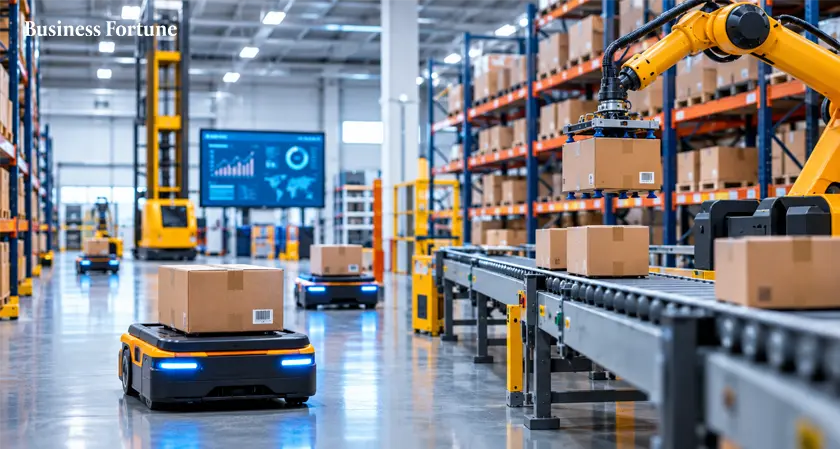
Overall, this is pretty unexciting. It uses sensors to create models to determine when a machine requires maintenance. Technology leaders at Heineken state "Rather than having regular scheduled maintenance (every month/season), we’re doing it when we actually need to." At AB InBev’s Leuven brewery, a Spot robot was able to detect over 150 anomalies within 6 months. This reduced downtime to be just 13 days.
Overall, this type of food industry automation will change the role of operators. Operators will now have to understand the information given to them from the line. Of the manufacturers surveyed in Rockwell’s research, 93% expect smart manufacturing to change their workforce and 40% have reskilled employees in the last year. The respondents also expect AI assisted manufacturing processes to increase from around 37% currently to over 60% by 2030. Intelligent processing lines are becoming the norm.
Using AI in Beverage Production - From forecasting to flavour sensing.
Coca-Cola used AI to forecast what products would be required on shelves. Sales agents would visit stores every few weeks and often coolers would be half empty. They created an algorithm using historical sales, weather data and Google location data. This was used to give recommendations to store managers on WhatsApp. This resulted in a 7-8% increase in sales in the 3 countries where it was piloted. Neeraj Tolmare (CIO) told Fortune. They have also seen gains of between 5-20% month on month in around 1000 test stores. Coca-Cola states they are deploying this tool with almost all of their bottling partners.
A good example of how this works in practice. The model will only give half of the solution. The other half is providing it in an app that the store manager will open. Tolmare only invests in pilots that have an actual outcome that will make a difference. As of mid-2025, they are still piloting their AI agents.
PepsiCo had a Gatorade plant where they increased throughput by 20% in 3 months. (Siemens).
Carlsberg have a Beer Fingerprinting Project which started in 2017 with Microsoft, Aarhus University and Technical University of Denmark. They used flavour sensors combined with Machine Learning. New beer can take between 8-24 months to create. They wanted to reduce this by around 30%. They invested around US$4 million in this project with an additional US$2.8 million from Innovation Fund Denmark. An early prototype of the sensor could differentiate between 4 Carlsberg beers.
Can AI help the food industry?
AI can help cut down the problem. According to FAO data, a huge 13.3% of all production (1.31 billion tonnes) is lost between harvesting and reaching retailers. This contributes to 8-10% of global greenhouse gas emissions.
AI can help with forecasting. In 2023, Kraft Heinz reported a $30 million increase in sales when they implemented AI in their control tower built using Microsoft's Azure. Danone also reported a 20% decrease in forecast error using their vendors ToolsGroup. Mandarin Oriental saw a 36% reduction in food waste after implementing Winnow's AI across four pilot hotels. Saving food this way means saving both costs and reducing emissions.
Using AI for traceability
FDA's intelligent food safety blueprint includes increased use of AI and learning technologies. They have demonstrated AI can be used to screen imported foods. However, they cannot enforce their Food Traceability Rule until July 20, 2028. This is because only a small number of entities will be able to meet this deadline. This is partly because all members of the supply chain need to work with accurate data. That admission is the real lesson for AI in food supply chain.
This shows that if there isn't accurate data being shared between models then they won't be effective. Giving more time to meet the deadline.
Which companies have reported real results?
|
Company |
Use case |
Reported result |
Reported by |
|
PepsiCo |
Digital-twin plant design |
20% throughput boost; up to 90% of design issues found early |
PepsiCo, via PYMNTS |
|
Coca-Cola |
AI restocking advice |
7% to 8% higher sales in a three-country pilot |
CIO, via Fortune |
|
Kraft Heinz |
Supply chain control tower |
$30 million added to sales |
Company presentation, via Supply Chain Dive |
|
Danone |
Machine-learning forecasting |
20% reduction in forecast error |
Vendor ToolsGroup |
|
AB InBev |
Robot-assisted maintenance |
More than 150 anomalies found in six months |
Industry seminar listing |
Every figure above is self-reported, by a company, an executive, a vendor or an event organizer. Treat them as directional, not as audited benchmarks.
Why do so few food companies scale AI?
Start with the headline statistics, which seem to contradict each other.
|
Survey |
Share |
What it measures |
|
TraceGains (423 F&B professionals) |
41% |
Organizations using enterprise AI tools |
|
Foods Connected (500+ leaders) |
49% |
Food manufacturers actively using AI |
|
Manufacturing poll (1,200 leaders) |
72% |
Manufacturers using AI in some form |
|
Rockwell Automation |
Nearly 90% |
F&B manufacturers using AI or planning to |
There is nothing wrong with these figures. They represent different ways of using AI. Using it vs. planning, individual vs. across the enterprise and having structured programs vs. using it informally across employees. From the same poll, only 10% of manufacturers have scaled AI across their operations.
Many challenges exist. Only 28% of food & beverage businesses had a clear plan to use AI, compared to 39% across all sectors, from a survey of over 800 c-suite leaders in the Operations Outlook 2026. Aptean and Vanson Bourne noted from a survey of 300 leaders there is a lack of strategy, governance and generalisation. Generalised models do not understand shelf life, allergen separation and lot traceability. AI is more of a plumbing problem than an algorithm issue.
Which food technology innovations should we watch?
NotCo's Giuseppe is the most advanced example of AI-Powered Food Technology. It uses AI to analyse animal based foods at a molecular level and find plant based substitutes. NotCo have partnered with Kraft Heinz to use this method. It can also adjust to changes in inputs e.g. switching pea protein suppliers. Digital twins and flavour sensors should also be mentioned.
Consumers are noticing. A survey of 1,040 UK & US consumers found 83% say companies should label foods & drinks that have been designed or produced with AI. However, 29% would be less likely to buy them and 26% more likely.
What AI-driven food industry trends will matter through 2030?
Cost saving - By simulating factories, operators can test their ideas. This is reducing costs from staff to capital expenditure.
Data over models - Only 45% of data is actually used.
Enforcing compliance - Traceability rules mean accurate data is shared. Despite the 2028 deadline.
Specialisation - General models cannot understand allergens or shelf life. Tools that have rules for food plants will be more successful.
Transparency - Consumers want to know if AI has been used to create their dinner. Therefore, labelling is a logical next step.
More to Know
A UN goal wants to halve per capita food waste at retail and consumer levels by 2030 (FAO).
FDA published their New Era of Smarter Food Safety blueprint on July 13th 2020. It is people-led, FSMA-based & technology enabled.
Coca-Cola signed a $1.1 billion 5-year deal with Microsoft for cloud & AI in April 2024.
Rockwell's report was based on 1,560 responses from 17 different manufacturing countries. The food & beverage analysis was published October 28th 2026.
TraceGains' survey was completed by 423 food & drink professionals. It was published July 1st 2026.
AI in the food industry is no longer a gimmick. The most obvious evidence is the cost saving from capital expenditure, more consistent shelves and intelligent maintenance. Companies who get their data in order will reap the rewards of AI in the food & beverage industry. Business Fortune foresees as the next wave of trends will focus on evidence over empty promises.
FAQs
How is AI used in the food industry?
AI is used to design plants, predictive maintenance, quality checks, demand forecasting, traceability and new product formulation.
How big is the AI in food & beverage industry?
4 research groups estimate it to be between $18.34 billion and $22.6 billion in 2026.
Which companies use AI in food plants?
PepsiCo, Coca-Cola, Kraft Heinz, Danone, AB InBev & Carlsberg all have documented projects.
Why can't food companies scale AI?
Data silos, no plans, lack of governance and general models that don't understand shelf life & allergens.
Is AI helping food safety?
FDA's blueprint mentions increased use of AI. However, their traceability rules cannot be enforced until July 20th 2028.






























































































.webp)

Comments