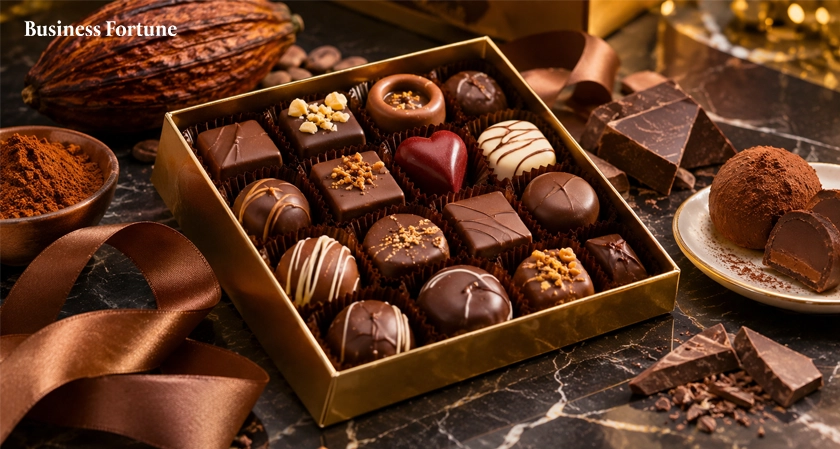
Ten luxury chocolate brands, each defined by what it owns: the praline, the bean, the ganache, the gift. Origins, signatures and how to choose.
Every great house among the luxury chocolate brands owns one idea its rivals can't claim. Neuhaus invented the filled praline in 1912. Lindt's conching process, developed in 1879, gave chocolate its melt. Amedei built its name on the cocoa of a single Venezuelan village. This guide sorts ten of the world's finest chocolate houses, spread across five countries, by what each does better than anyone else, then helps you decide where to spend.
The list runs oldest to newest. It is not a ranking, because the houses compete on different ground.
What Makes a Chocolate Brand Luxury?
Four things, in roughly this order: control of the cocoa, mastery of a technique, a recognizable ritual and a history that can be checked.
Price alone proves nothing and premium chocolate brands that lean on it tend to fade. Cocoa is only one cost among several and when raw cocoa fell below $4,000 per metric tonne in early 2026, for the first time since November 2023, the chocolate already on shelves had been made from beans bought near record highs. Luxury, in other words, is mostly paid for in labor, rarity and ceremony.
The Top 10 at a Glance
|
Brand |
Founded |
Home base |
Signature |
What it owns |
|
|
1 |
Debauve & Gallais |
1800 |
Paris, France |
Pistoles de Marie-Antoinette |
Royal provenance |
|
2 |
Lindt & Sprüngli |
1845 |
Zurich, Switzerland |
Conched chocolate |
Smooth texture |
|
3 |
Neuhaus |
1857 |
Brussels, Belgium |
The praline and ballotin |
Invention |
|
4 |
Valrhona |
1922 |
Tain-l'Hermitage, France |
Guanaja 70% |
The professional kitchen |
|
5 |
Godiva |
1926 |
Brussels, Belgium |
Pralines, gift boxes |
Global reach |
|
6 |
Teuscher |
1932 |
Zurich, Switzerland |
Champagne truffle |
One perfect truffle |
|
7 |
Patchi |
1974 |
Beirut, Lebanon |
Gift arrangements |
Chocolate as gift |
|
8 |
La Maison du Chocolat |
1977 |
Paris, France |
Ganache |
Dark, pure ganache |
|
9 |
Amedei |
1990 |
Pontedera, Italy |
Chuao 70% |
Single-origin cocoa |
|
10 |
Pierre Marcolini |
1995 |
Brussels, Belgium |
Bean-to-bar tablets |
Couture presentation |
The Finest Chocolate Houses, One by One
1. Debauve & Gallais: Who Made Chocolate Fit for Kings?
Found in 1900 by Sulpice Debauve (pharmacist to Louis XVI). As Marie Antoinette did not enjoy the taste of her medication, Debauve used chocolate to replace this. In 1823, Antoine Gallais (nephew) joined Debauve, making the company’s name. This meant Napoleon Bonaparte became a customer. The famous Pistoles de Marie-Antoinette (coin shaped chocolates) remains a signature product in the brand. The company can still be found in its original location on the Left Bank. Of all the labels on this list, few have an Emperor as an early customer.
2. Lindt & Sprüngli: Why Does Chocolate Melt So Smoothly?
Conching. The Sprüngli family set up a confectionary in Zurich in 1845. They created some of the earliest solid chocolate bars in German speaking Switzerland. However, in 1879, Rodolphe Lindt in Bern developed a slow mixing process allowing for smooth chocolate. Sprüngli purchased Lindt’s factory and method in 1899. The brand named Lindt is very widely accessible. This is because this method became the standard in chocolate making in the industry. The brand is currently run from Kilchberg, near Zurich.
3. Neuhaus: Who Invented the Praline?
In 1857, Jean Neuhaus, a Swiss pharmacist, opened the shop in Galerie de la Reine in Brussels. In 1912, Jean Neuhaus Jr. (grandson) changed the centre in Neuhaus’ products from medicine to a creamy filling creating the first Belgian praline. In 1915, Neuhaus’ wife Louise Agostini designed a gift box for pralines to stop the fragile chocolate from getting damaged in paper cones. This brand created both the praline and the praline packaging standard used in Belgian chocolate.
4. Valrhona: Which House Do Professional Pastry Kitchens Rely On?
Albéric Guironnet (pastry chef) created this brand in 1922 in Tain-l’Hermitage, within the Rhone valley. The name of the brand combines “valley” and “Rhone”. It became an expert in professional kitchens. In 1989 it opened The Grand Chocolate School (“L’École du Grand Chocolat”) to train people within the industry. In 1986 Valrhona released Guanaja 70%. At the time, this was the bitterest chocolate in the world. The brand’s centre for visitors (Cité du Chocolat) attracts 140,000 people per year. The brand is now owned by Savencia Fromage & Dairy.
5. Godiva: How Did a Brussels Workshop Become a Global Name?
Pierre Draps Sr. made pralines in his workshop in Brussels in 1926. His sons, Joseph, Francois and Pierre Jr were involved in the business from a young age. The brand name was changed to Godiva in 1945, inspired by the legend of Lady Godiva. The first shop outside of Belgium was opened in Paris in 1958. In November 2007, the brand was purchase by Yıldız Holding. Godiva now has over 600 shops. As the brand turns 100 in 2026, it is rare that a luxury brand has such widespread popularity.
6. Teuscher: What Is the Most Famous Swiss Truffle?
Champagne Truffle. Dolf Teuscher Sr. founded this chocolate brand in Zurich in 1932. The truffle was developed in 1947 and includes a centre of champagne cream, and a shell made from dark ganache using 66% base chocolate. The company is still run by the family. In addition to truffles, they produce dark chocolate bars with concentrations of between 55-99%, increasing in 11% increments. While other brands have many ranges, Teuscher is particularly well known for doing one thing extremely well.
7. Patchi: Who Turned Chocolate Into the Gift?
Nizar Choucair opened a shop on Hamra Street in Beirut in 1974. The idea of giving chocolate as a gift was introduced. Due to war, part of the business moved to Amman. In 1976, a small factory was opened. Patchi now has 203 stores, and is most popular in Lebanon, Saudi Arabia, Bahrain, Qatar, UAE and the UK. Over 5000 people work in the company. All stores focus on ‘giving’ as a concept.
8. La Maison du Chocolat: Where Did Dark Ganache Become an Art?
Robert Linxe opened a dedicated chocolate shop on 26th October 1977 on 225 rue du Faubourg Saint-Honoré (opposite the Salle Pleyel). Within the chocolate, Linxe focused on pure dark chocolate and allowing each ingredient to express itself. He quickly gained the nickname "the ganache sorcerer." In 1990, a second boutique was opened in New York. Under Nicolas Cloiseau (Meilleur Ouvrier de France Chocolatier 2007), creativity is led. The Maison is now owned by Savencia. As ever, the signature product of the brand is ganache.
9. Amedei: Can One Village's Cocoa Build a Brand?
Cecilia Tessieri founded Amedei in 1990, the name meaning her paternal grandmother. It produced pralines in a 45metre square workshop. Her first bar, Toscano Black 70% was not released until 8 years later. Since then, the company from Pontedera, Tuscany, has gained a reputation for using cocoa from the plantations in the village of Chuao, Venezuela (140ha). Chuao won Best Bean to Bar (Academy of Chocolate) in 2005 and 2006. This brand requires patience!
10. Pierre Marcolini: Who Made Chocolate Look Like Couture?
Pierre Marcolini opened his first workshop near Brussels in 1995. In the same year, Marcolini won the World Pastry Champion title. Then Boutiques were opened on Avenue Louise in 1996 and in 1997, in Grand Sablon (flagship store). Marcolini manages every part of the production, from selection of beans to final pieces. In 2021, the Maison celebrated 20 years of bean to bar production by creating 20 new tablets. Black packaging, seasonal products and a ‘fashion house’ feel distinguishes Marcolini from its older counterparts in Belgium.
Which Luxury Chocolate Brands to Choose?
Each brand can be better for a specific purpose.
If you want to give a visually impressive gift, Patchi, Godiva and Neuhaus would be best choices. If you want to try the chocolate, Amedei and Marcolini are great as they focus on origin and production. If using them in cooking/pastry, Valrhona is the best as it specialises in professionalism. If you love bitter chocolate, comparing the varying concentrations of Teuscher and the dark ganaches of La Maison du Chocolat may be best. If history interests you, Debauve & Gallais would be perfect.
A quick tip for all brands, look at the ingredients. The simpler, the better.
Interesting Facts:
-
Ballotin design was copyrighted by Neuhaus on August 16th 1915.
-
Amedei’s first bars were produced in 1998, 8 years after creating the company.
-
Guanaja 70% was created by Valrhona in 1986.
-
Godiva opened their first shop outside Belgium (Paris) in 1958.
-
Debauve & Gallais received its current name in 1823 when Antoine Gallais joined.
-
La Maison du Chocolat opened its New York Boutique in 1990.
-
Both Pierre Marcolini and Godiva originate from Brussels.
-
Lindt & Sprüngli merged as one company in 1899.
Business Fortune believes there are many ways to excel in chocolate making. Each of these 10 brands have their reasons for appearing as top chocolate brands. Neuhaus and Lindt have changed the way chocolate is made and presented. Valrhona, Amedei and Marcolini have created stories around the origin and production of their cacao. Godiva, Teuscher and Patchi have made giving chocolate a big part of their brand. La Maison du Chocolat and Debauve & Gallais demonstrate that a simple piece of ganache (or chocolate coin) can have a great reputation for decades.
To choose the best brand for you, match the brand’s concept to your purpose. Even the world's finest chocolate brands will make sense to buy.
FAQ
1. Which are the best luxury chocolate brands in the world?
While no one brand is best in all categories, Neuhaus is best for innovation, Valrhona is best for professional use, Amedei is best for single origin cacao and La Maison du Chocolat is best for dark ganache. Consider what you want the chocolate for.
2. What does ‘bean to bar’ mean?
It means that one company has complete control of the process; selecting the cacao beans, to creating the final product. Pierre Marcolini does this, choosing cacao beans from producers worldwide and making products in Brussels.
3. Which is the oldest brand?
Debauve & Gallais was founded in 1800, making it the oldest. Lindt & Sprüngli (1845) is next, then Neuhaus (1857).
4. Who invented the Belgian praline?
Jean Neuhaus Jr invented the praline in 1912, replacing the centre of products in his family’s shop in Brussels from medicine to a creamy filling.
5. Why are premium chocolate brands so expensive compared to chocolate in supermarkets?
In addition to the cacao in the chocolate, these brands can be expensive due to the sourcing, skilled production, limited runs and presentation.





















.webp)


.webp)

Comments