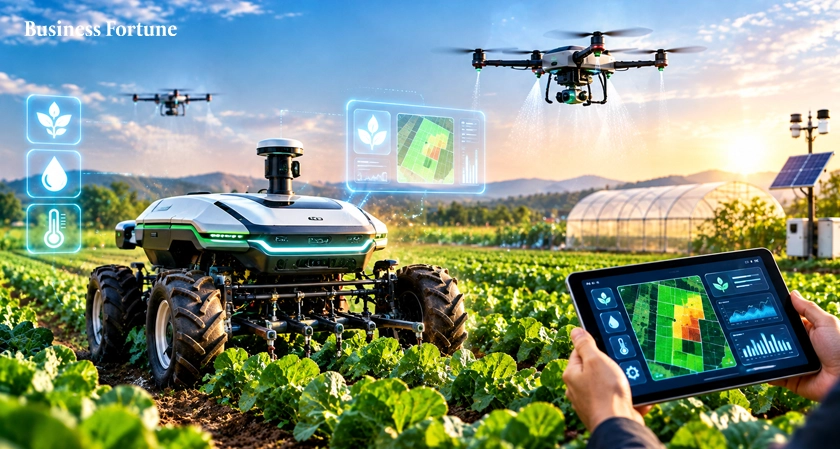
What if some of the hardest jobs on a farm could be handled by machines? Meet the Top agricultural robotics startups and explore how their robots are changing everyday farming in ways you might not expect.
Finding enough people to work on a farm is becoming a real challenge for farmers, especially when planting, weeding, or harvesting needs to happen at exactly the right time. From spotting weeds and picking fruit to monitoring crops and handling repetitive farm work, robots are becoming a practical solution of modern agriculture. But how useful are these machines in real farms and which companies are actually changing the way farming is done?
In this Business Fortune article, we explore the top agricultural robotics startups changing farming in 2026, the technology behind their machines, the jobs robots can handle, and what this could mean for farmers in the years ahead.
Top agricultural robotics startups in 2026
The agricultural robotics industry is no longer focused only on laboratory demonstrations. Startups are developing machines for very specific jobs and testing them in real farming conditions.
Carbon Robotics
Carbon Robotics is one of the well-known names in AI-powered farm automation. Its LaserWeeder uses cameras and computer vision to identify weeds among crops before directing lasers at them.
The company says its system uses 42 high-resolution cameras and deep-learning models to distinguish crops from weeds. Its newer Carbon AI platform is built around a large plant model trained on more than 150 million labeled plants across more than 100 crops and 15 countries.
Instead of applying treatment across an entire area, the machine identifies individual weeds and acts on them. That could make precision weed control more targeted while reducing the need for broad chemical applications.
Naïo Technologies
French start-up Naïo Technologies has been developing autonomous agricultural robots for quite some time now. Their robots are developed specifically for vegetable farms, vineyards, nurseries, and specialty crops.
Currently, the company offers four types of robots which include Oz, Jo, Ted, and Orio. The functions of these robots include soil preparation, seeding, weeding, and vineyard operations. The robots by Naïo Technologies are completely electric and have clocked more than 110,000 hours of autonomous farm labor.
What makes this approach interesting is its focus on practical farm work rather than one large machine trying to do everything. Different farms have different needs, and smaller specialized robots can sometimes fit those needs more easily.
4AG Robotics
Not every agricultural robot needs to work outdoors. The Canadian company called 4AG Robotics specializes in mushroom harvesting. The automated systems developed by this firm are able to pick, cut, and package mushrooms. The robots are designed to fit into existing mushroom farms, so farmers can use them without making major changes to their facilities.
It has been reported that the company raised $40 million in Series B funding in 2025 for its autonomous mushroom picking technology. It is an excellent example that shows how automation could focus on one single challenging task rather than automating the whole farm.
Fieldwork Robotics
Harvesting fruits is difficult for robots to perform since they can be soft or hidden within leaves and even vary in stages of ripeness.
The UK-based firm Fieldwork Robotics is developing autonomous robots that can be used for picking raspberries. It uses AI-enabled 3D cameras and sensors to learn which fruits need picking and do so while preserving the quality level achieved by human pickers.
In 2026, Fieldwork grew, having received £3 million funding, with the intention of testing in commercial environments and going global. In this case, however, the problem is not just the choice of picking one berry. What a good robot needs is the ability to know when the fruit is ripe, pick it up gently, and continue this process.
How are robots helping farmers?
For farmers, autonomous farming robots can reduce manual jobs, so they’ll have more time available for planning, supervision, crop decisions, and other work. This is particularly important when labor is hard to find during short harvesting windows. Missing the right harvesting period can affect both quality and revenue.
Smart farming robotics can also support precision farming. Rather than applying the same amount of water, fertilizer, or treatment everywhere, smart systems can use information from cameras, sensors, maps, and other tools to make more targeted decisions.
What tasks can agricultural robots perform?
The answer is growing every year but today's systems can already support several farming activities, including:
-
Weed detection and removal
-
Precision spraying
-
Crop monitoring
-
Soil preparation
-
Seeding
-
Vineyard maintenance
-
Fruit and vegetable harvesting
-
Mushroom picking and packing
-
Transporting materials around farms
-
Autonomous tractor operations
Some machines are designed for a single task, while others are built as platforms that can use different tools. This matters because farming is not one job. A vegetable grower, vineyard owner, grain farmer, and mushroom producer have completely different working environments. The agricultural robotics industry is therefore developing in many directions rather than following one single model.
How is AI being used in agricultural robotics?
AI is the element that allows robots to perceive their surroundings. The traditional machine will have to move through a fixed path or make a fixed move. The robotic machine using artificial intelligence in agriculture will use cameras and sensors to identify objects and make decisions accordingly.
For instance, a robot designed for weeding must be able to differentiate between the crop and the weed. The harvesting robot will need to identify mature fruits for picking. The autonomous tractor will have to know where it is located, how to move along, and react to surprises.
Machine learning can also improve performance over time. Carbon Robotics, for example, says data collected by its LaserWeeders is used to improve its large plant model, allowing updated models to benefit machines in the field.
This is where AI-powered agricultural robots become different from simple automated machines. They are not just following instructions. They are increasingly using information from the environment to decide what action to take.
Autonomous farming robots are becoming more practical
The idea of autonomous farming robots sounds futuristic but parts of that future are already being tested and deployed. Still, autonomy does not always mean that nobody is watching the machine. In real farms, remote supervision can remain important. A robot may handle normal operations independently while a person steps in when an unusual situation occurs.
And that is how agricultural robots changing farming, walk through a farm today, and you may notice something different. Alongside farmers and tractors, some machines are moving between crop rows, spotting weeds, checking plants, and handling jobs that once needed hours of manual work. Because of this agricultural robotics technology, robots can gather data about the field and understand what is going on instead of treating each field of a farm in the same way.
According to a review in 2026 about the use of AI in agricultural machinery and robotics, AI is increasingly being used for detection, navigation, decision making, planting, weed removal, harvesting, and resource management.
What is the future of farm automation?
The next chapter of farm automation may well be less about how fancy the robot is and more about how badly the farmer needs it and can afford it. A robot that saves time but expensive is of limited use to both large and small farms.
Here is where flexible options like leasing and robotics as a service can come into play. Rather than purchasing costly equipment, farmers could lease their robot whenever they require it. It already seems like there is investment interest, as predicted by Fortune Business Insights, the global agricultural robots market may hit $37.41 billion by 2034, up from $9.2 billion in 2026.
However, adoption is going to be slow, because farms differ greatly from each other in terms of size, crops planted, landscape, climate, and working conditions. The future of agriculture robots depends on their ability to work in reality rather than their capabilities demonstrated at shows.
FAQs
What are agricultural robotics startups?
Agricultural robotics startups are companies developing robots and automated machines for farming tasks such as weeding, planting, crop monitoring, harvesting, spraying, and farm transport.
Why are agricultural robots becoming important in 2026?
Labor shortages, rising farm costs, demand for precision, and the need to use resources more efficiently are increasing interest in automation. Improvements in AI and sensors are also making robots more capable.
Can agricultural robots replace farmers?
No. Most agricultural robots are designed to assist with specific jobs rather than replace farmers completely. People are still needed for planning, supervision, maintenance, decision-making, and handling unexpected situations.
Are AI-powered farm robots expensive?
Costs vary widely depending on the machine and its purpose. A specialized robot can require significant investment, which is why leasing, shared equipment, and robotics-as-a-service models may become important for smaller farms.
What could farming look like in the future?
Future farms could combine autonomous machines, AI software, sensors, drones, and traditional equipment. Robots may handle more repetitive work while farmers use data and their experience to make important crop and business decisions.


.webp)






























Comments