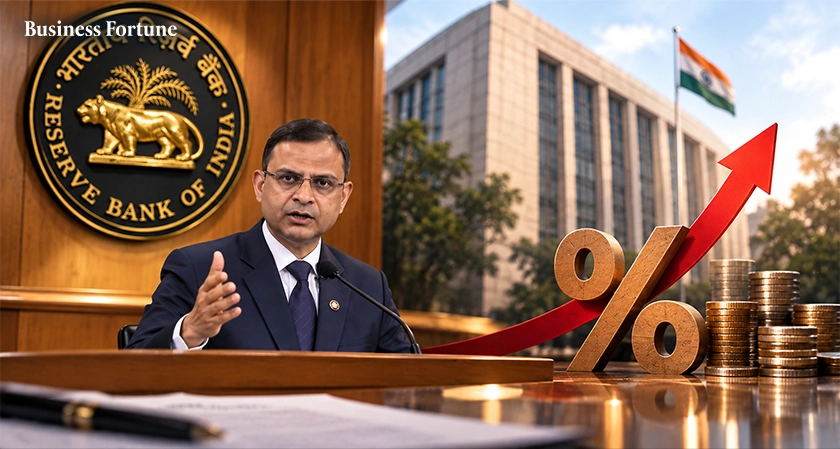
RBI Governor Sanjay Malhotra highlights persistent inflation, rupee pressure and geopolitical risks as economists assess borrowing costs, consumer demand and future policy moves.
The RBI MPC Meeting has resulted in a 25-basis-point increase in the policy repo rate to 5.50%, marking the Reserve Bank of India’s first rate hike since February 2023. The decision comes amid rising inflation risks, volatile crude oil prices and heightened geopolitical uncertainty linked to the West Asia conflict. According to Economic Times, RBI Governor Sanjay Malhotra said the global environment remained challenging, while India’s economy continued to show broad-based momentum.
Why Did the RBI Raise the Repo Rate?
The RBI’s decision reflects growing concerns over inflation and external economic pressures. As reported by Economic Times, the central bank noted that the escalation of the West Asia conflict has contributed to sharp movements in crude oil prices, increasing uncertainty for global markets.
The RBI also pointed to stronger inflation pressures in major economies and a shift towards tighter monetary policies globally. The US Federal Reserve’s September rate hike and similar actions by other major central banks have increased expectations of higher global interest rates.
The central bank also changed its policy stance to calibrated tightening, signaling that inflation risks are receiving greater attention. According to Times of India, economists said the move could help protect inflation stability and limit pressure on the Indian rupee.
What Does the Rate Hike Mean for India?
The higher repo rate could create some pressure on borrowing costs, particularly for consumers and businesses dependent on credit. According to Debopam Chaudhuri, Chief Economist at the Piramal Group, it could be a speed bump for large-ticket, discretionary expenditure and was doubtful about its impact on consumer demand and MSME Capex.
However, the economy is resilient in its economic forecast. The RBI has estimated 7.1% growth in GDP for the FY27 period, while healthy services performance and solid employment and credit will help domestic demand.
Real estate is also expected to remain relatively stable. According to Times of India, Shishir Baijal of Knight Frank India said higher borrowing costs could affect affordability in some segments but are unlikely to cause a major disruption to the sector in the near term.
Global Risks Keep RBI on Alert
The RBI remains cautious about external risks, including elevated crude prices, supply chain pressures, weak monsoon conditions and strong El Niño effects. The central bank expects these challenges to influence domestic activity, although food grain reserves and government measures could help limit their impact.
DK Srivastava of EY India said inflation could rise to 6% in the third quarter and 5.7% in the fourth quarter of FY27, keeping the possibility of another rate increase in December open.
As India navigates global uncertainty, the RBI’s calibrated approach suggests that future policy decisions will depend heavily on inflation, growth, currency movements and commodity prices.
Thus, Business Fortune believes that the RBI’s calibrated tightening will balance inflation control with India’s resilient growth amid persistent global economic uncertainty.
Sources: https://timesofindia.indiatimes.com/business/india-business/rbi-mpc-meeting-october-2026-live-updates-governor-sanjay-malhotra-repo-rate-cut-fd-rate-monetary-policy-committee-emi-west-asia-crisis-rbi-news-today/liveblog/134753997.cms https://economictimes.indiatimes.com/news/economy/indicators/rbi-raises-rates-amid-global-uncertainty-geopolitical-conflicts-and-economic-outlook-explored/articleshow/134756872.cms?from=mdr


.webp)





























Comments