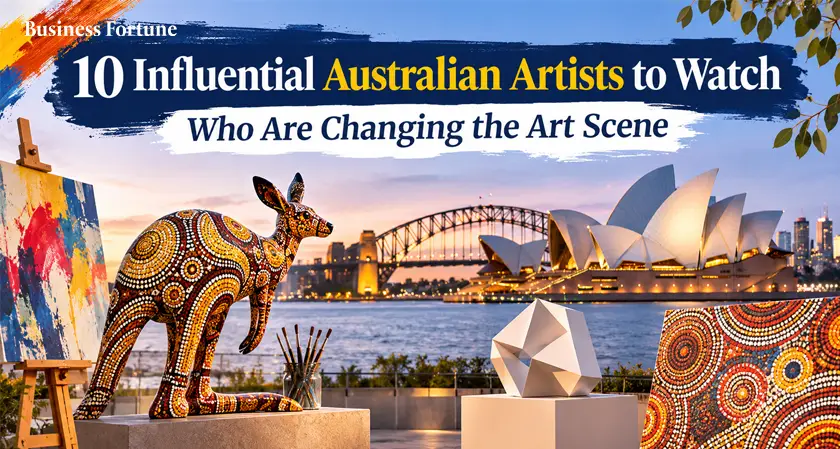
Discover the influential Australian artists bringing fresh ideas to the art world. Get to know their unique styles, inspiring stories and the creative work making them worth watching.
Art has a way of telling stories that words sometimes cannot. This is why art exists. It makes people stop, think and feel something. It expresses culture, feelings and it gives people a fresh way to see the world. Australia's art scene is doing exactly that, with artists bringing together traditional stories, modern ideas and bold creative styles.
But which artists are really making a difference? In this Business Fortune article, we look at some of the most influential Australian artists to watch, exploring their unusual ideas, creative journeys and the stories behind their work.
Ten Australia's Most Influential Artists to Watch
Tony Albert
Tony Albert is a creative artist whose art has made him to start meaningful discussions around topics related to history, identity, and culture. He was born in Townsville, Queensland, and hails from the Girramay, Yidindji, and Kuku Yalanji tribes. Most of his art pieces focus on how the Aboriginal community has been portrayed throughout Australian history.
Albert’s practice includes photography, sculpture, paintings, installations, and found objects. An interesting aspect about Albert’s practice is his use of optimism. While addressing challenging topics, he explores the idea of how communities can progress with the help of understanding and positivity. He is a well-known artist who has produced many public art pieces and been a great contributor to the development of First Nations artists. The upcoming exhibition of 2026 at the Museum of Contemporary Art Australia is another indication of his importance within the Australian artistic community.
Reko Rennie
What occurs when ancient aboriginal art comes into contact with the contemporary street culture? Rennie is an artist from the Kamilaroi tribe who lives in Melbourne. He creates artworks through blending ancient cultural designs and graffiti, bright colors and modern visual styles. Rennie was introduced to art through graffiti as a teenager.
His artworks have diamond design, bright colors and powerful symbols. These elements help him explore identity, cultural recognition and the place of First Nations people in modern Australian society.
What makes Rennie's work particularly interesting is how he brings cultural stories into urban spaces. His art challenges the idea that Aboriginal identity belongs only to the past or traditional settings. Instead, he shows that culture can remain strong while continuing to change.
Daniel Boyd
Daniel Boyd is another artist making people look at history from a different point of view. Being an artist descended from the Kudjila and Gangalu tribes of Central Queensland, Boyd paints installations, films, and art pieces that deal with issues of identity, memory, and the colonial history of Australia.
One of the things that stand out about his work is the small dots he uses in his work. This helps build layers which help conceal parts of images but also allow them to be somewhat visible. This makes one look closely instead of believing everything in front of their eyes. Also, Boyd has used pictures from his family album and personal records to question the way in which history is recorded. This is particularly significant since Boyd relates personal stories to broader issues concerning Australian society.
Ramesh Mario Nithiyendran
Ramesh Mario Nithiyendran is a sculptor who proves that one does not have to follow any particular norm when making sculptures. Ramesh was born in Sri Lanka and currently resides in Sydney and he is famous for his bright ceramic sculptures.
Some of his sources of inspiration include the South Asian heritage, religion, pop culture, and issues related to gender identity. Even his use of various materials in making the artworks such as bronze, concrete, and neon suggests that his interests are much wider than making ceramics only. His sculptures contain exaggerated shapes and expressive faces. Some are recognizable, but some are strange. This combination makes him hard to ignore.
Claudia Lau
Sometimes, the smallest changes can create the most surprising results. Working from Melbourne and Jingdezhen in China, Claudia Lau explores the potentialities of ceramic art. The city of Jingdezhen has been renowned for the making of fine porcelains and Lau’s works use the glazing techniques that have come out of ancient Chinese pottery practices. Through her exploration of kiln temperatures and firing positions, she makes unusual transformations of color and surface.
Lau was also nominated for the 2025 Rigg Design Prize as well as having done a residency at the Guldagergaard International Ceramic Research Centre in Denmark in 2024. Her art is also a great example of how innovation doesn't necessarily have to involve turning away from traditions. Sometimes, it comes from learning an old technique deeply and finding a new way to use it.
Monica Rani Rudhar
Rudhar uses sculpture, performance, and video work to combine personal history into contemporary art. An artist based in Sydney, Monica takes inspiration from her Indian and Romanian background, as well as her family memories to talk about migration, identity and belonging.
One of her most striking creative ideas involves turning family heirlooms into large terracotta sculptures of earrings. Other works by her include the three-channel video installation that was commissioned at the 25th Biennale of Sydney, which focuses on her grandfather who was a freedom fighter. This video installation was titled The fire in me was lit long ago and she received the 2026 Ravenswood Australian Women's Art Prize.
Elynor Smithwick
Not every powerful artwork needs to be large or dramatic. Elynor Smithwick is gaining attention for her small paintings that capture simple moments from everyday life.
Her works are created using oil paint on aluminium flashing. These are postcard size pictures, making them unique compared to the large paintings usually presented at art galleries.
The uniqueness of her paintings comes from the subtle way that she paints. Unlike many artists who rely on dramatic themes and ideas for their paintings, Smithwick’s art work features common sights and experiences. She gained recognition at the 2026 Melbourne Art Fair where her paintings were among the notable pieces presented there. Smithwick’s rising fame proves that artists don’t have to go along with popular trends in order to gain recognition.
Linda Sok
Linda Sok is a female artist who blends her family memories, culture and artistic experimentations.
Her one such interesting piece of art, "Deities in Temples XXI," finds its inspiration from the cultural artifacts called pidans in Cambodia. Unfortunately, many of these artifacts have been lost during the Khmer Rouge era.
Instead of trying to replicate the same process of weaving, she used her own technique. She used family drawings, screen printing and threads to create new works inspired by the missing pieces.
Her work was also featured in the Museum of Contemporary Art Australia's Primavera 2026 exhibition, which highlighted young Australian artists exploring history and memory. Sok's creative journey shows how art can help preserve cultural connections while giving old stories a new form.
Ursula Napangardi Marks
Ursula Napangardi Marks is the next generation of First Nations artists who have the traditional knowledge within their contemporary paintings.
Marks is a Warlpiri artist who is inspired by Jukurrpa, which is known as Dreaming, and the knowledge inherited by the senior artists of her community. Her work also uses traditional ceremonial designs connected to ancestral stories.
One of the highlighted works by the artist includes that on Bush Potato Dreaming. This is a story based on how the Warlpiri women can tell when the bush potatoes are ready to be collected, through signs. The theme reflects on the relationship between art and the environment, foods and social life. Her art shows that the future of art in Australia lies with the people themselves.
Justina Willis
Justina Willis is an artist whose artworks reflect the beauty and narratives of the Pilbara country of Western Australia. Willis is an indigenous artist who comes from Roebourne and is famous for her use of precise brush work, color layers, and dot painting. The themes of her artworks are inspired by her connection to the landscapes, rivers, and her family background.
Her paintings often reflect places such as the Tablelands, Millstream and Green Pool. Willis began her artistic practice in 2006 and has continued to develop a style that combines personal experiences with cultural knowledge.
What Makes Australia's Art Scene Worth Watching?
The artists featured here come from different backgrounds and work with different materials. Some artists explore traditional culture, while others experiment with modern materials, unusual designs and personal stories.
Artists of First Nations are taking the step toward sharing the culture and tales with more people. The artists including Claudia Lau and Ramesh Mario Nithiyendran have taken the initiative to see how the traditional materials and inspiration can be transformed into something new. There are some upcoming artists like Monica Rani Rudhar and Elynor Smithwick who are doing something interesting.
There is also growing support for new creative voices. Exhibitions such as Primavera at the Museum of Contemporary Art Australia and programs like Hatched at the Perth Institute of Contemporary Arts provide opportunities for emerging artists to present their work to wider audiences.
For art lovers, collectors and anyone interested in creativity, following the leading artists in Australia offers an opportunity to understand how the country's culture and creative ideas are changing.
Final Thoughts
The arts in Australia are taking some interesting paths forward, with both experienced artists and new ones contributing towards its development. The influential Australian artists show that art can do much more than decorate a space. Their art can preserve history, question familiar ideas, celebrate identity and bring communities closer together.
The artists’ journey also serve as an inspiration for people interested in exploring the creative process. It is no matter whether you use a tiny canvas, huge sculpture, or an intensely personal installation, each artist demonstrates how a good concept and individual point of view can make a memorable statement.
FAQs
Who are some of Australia's most influential artists?
Tony Albert, Reko Rennie, Daniel Boyd and Ramesh Mario Nithiyendran are among the notable names in Australian contemporary art. Their work explores culture, identity, history and creative experimentation.
What makes Australian contemporary art different?
It brings together First Nations storytelling, multicultural influences, modern techniques and personal experiences. This mix gives Australian art a wide range of styles and subjects.
Why are First Nations artists important to Australia?
They share Aboriginal and Torres Strait Islander histories, cultural knowledge and connections to Country. Their work also gives audiences a deeper understanding of Australia's cultural heritage.
Where can people discover contemporary Australian artists?
People can explore Australian art through institutions such as the National Gallery of Australia, the Museum of Contemporary Art Australia, state art galleries, independent galleries and events such as the Darwin Aboriginal Art Fair and Melbourne Art Fair.
How are Australian artists influencing modern art?
They are introducing new ways to use traditional materials, combining different cultural influences and exploring subjects such as identity, migration, history and the environment.

































































































































.webp)



Comments