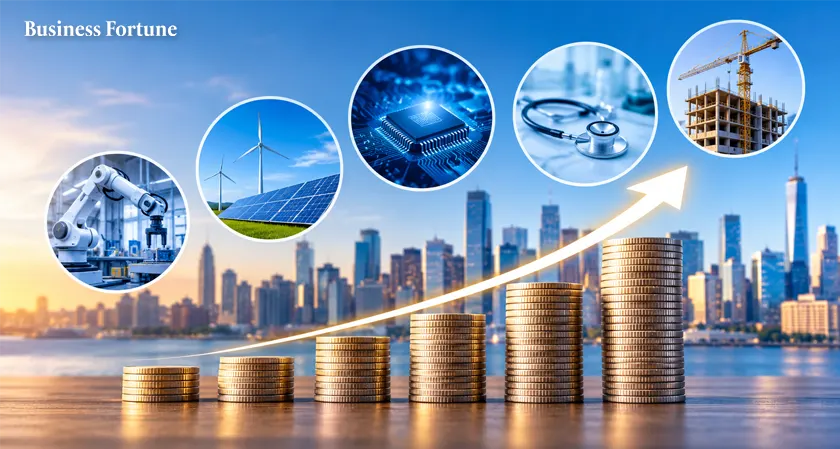
The fastest-growing industries of 2027 are built on AI, power and security. See the numbers, the regions and the business opportunities behind them.
Global investment in artificial intelligence will reach $3.64 trillion in 2027, up from $2.67 trillion in 2026. Thus, the fastest-growing industries will all have a similar theme around AI, the power source and security.
The International Energy Agency (IEA) expects investment in energy to rise by $2.2 trillion of this year's $3.4 trillion towards renewables, grid, storage, nuclear and electrification. Coupled with an ageing global population and a world economy growing at 3.4% in 2027 (IMF), this creates a trend of investment towards industries with limitations. This guide details how we can rank the fastest growing industries in 2027 using evidence, where they are located and the business opportunities available which most lists overlook. The global industry outlook is strong but not extremely exciting, with global market opportunities within gaps.
What Are the Fastest-Growing Industries in the World in 2027?
Artificial intelligence will be the fastest growing industry by a large margin. Spending will grow by 49.5% in 2026 and then 36.2% in 2027. All segments will continue to grow. However, infrastructure will get the biggest chunk of investment. Cybersecurity for AI will have the fastest growth but will be much smaller.
|
AI spending segment |
2026 (US$ billions) |
2027 (US$ billions) |
Growth |
|
AI infrastructure |
1,484.4 |
1,977.7 |
33.2% |
|
AI services |
576.5 |
745.7 |
29.3% |
|
AI software |
461.6 |
656.4 |
42.2% |
|
AI cybersecurity |
51.3 |
86.0 |
67.5% |
Source: Gartner, September 2026. Growth rates calculated from Gartner's figures.
Software and security are the real growth drivers in high-growth industries. Hardware is still needed as we saw earlier, with chips and concrete being the first items you will invest in. However, the next dollar will go towards what will make your build out profitable. According to Gartner’s own analyst, 2026 will be the year in which true investment begins from enterprises.
Why AI Growth Drives Power & Grids?
Ultimately all of this money gets turned into Kilowatt-hours. According to IEA analysis, the demand for electricity in data centres will grow to more than double the previous figures. This will increase to around 945 TWh by 2030 with those optimised for AI seeing consumption increase by more than 4 times. Almost 80% of this growth is coming from the USA and China.
We are already seeing this, as 2025 sees demand increase by 17%. More than 5 times the growth of 3% globally.
Labour figures also show this. The U.S. Bureau of Labor Statistics expects Utilities to be the fastest growing major industry between 2025-2035 at 9.8%. Computing Infrastructure, Data Processing & Web Hosting will grow by 25.1% creating 120,400 new jobs. Those working within grid operations, transformers, electrical contractors and storage will all benefit from the increased demand. They won’t care which model wins.
Clean Energy & Storage Potential
This is a big one. Solar will see investment of $665 billion going into renewable power this year: $365 billion, Wind will see ~$1 billion a day, plus $200 billion and Hydropower will see $75 billion, according to the IEA’s World Energy Investment 2026 report.
Battery investment is set to exceed $100 billion in 2026, up more than 35% from about $80 billion earlier in the year. Increased volatility from AI driven datacentres has caused interest in batteries to increase. Capital costs for adding 1 GW of solar PV have reduced by 80% over the last decade.
Energy security is a huge driver. Fatih Birol, the Chief of the IEA, refers to the current situation as the biggest energy security crisis the world has ever seen. They argue using domestic renewables can help hedge against this.
Human resources are a big issue. The BLS expects Solar Photovoltaic Installers (+36.5%) and Wind Turbine Service Technicians (+29.5%) to be some of the fastest growing jobs in the USA up to 2035. There is some labour growth.
Is Cybersecurity a High Growth Industry?
Yes! Thanks to AI. Gartner expect global information security investment to hit $247.5 billion in 2026, up 13.6% in current dollars, rising to $372.8 billion by 2030. Cloud Security was the fastest growing subsegment of the 11 available with growth of 28.8% according to Gartner’s March outlook.
Every time you deploy AI, you are increasing identities, data flow and autonomous agents which all have to be protected. This is why the Cybersecurity row in the table above shows growth from $51.3 billion in 2026 to $86.0 billion in 2027. When you are protecting your business, security becomes an asset.
Which Emerging Industries Come From an Ageing World?
This is slower to change than technology and almost never goes backwards. The UN show that the number of people aged 65+ will grow to 1 Billion in 2030 from 783 Million in 2022. By 2030, Japan will have 31.1% of their population aged 65+ in a medium scenario according to the UN.
Home care, Assistive Devices, Remote Monitoring & Care Co-ordination will benefit. The BLS expects Private Healthcare & Social Assistance to grow by 9.5% between 2025-2035, creating more than 2.2 Million new jobs in the USA. This isn’t quite as dramatic as AI, but it is much more predictable. This is the only one of future growth industries which can be scheduled.
Where are the fastest growing industries in 2027?
It depends. AI driven power demand will focus on the USA and China. India will see record energy investment of $170 Billion in 2026. The IEA show that Solar PV investment has grown by 25% every year over the last 5 years. India’s growth has been upgraded to 6.7% in 2027 according to the IMF’s July update.
However, Australia will see Lithium & Other Non-Metallic Mineral Mining, Battery Material Mining and Wind Farm Construction as their top 3 fastest growing industries according to IBISWorld.
Fast-growing business sectors will always be country specific. An Australian lithium miner and Indian solar developer will each benefit from the change in energy.
Does it depend on how you measure it?
Absolutely! Coal Mining, Commercial Aircraft Manufacturing & Sports Betting & Lotteries are the top 3 fastest growing industries according to IBISWorld’s 2026 global rankings. No AI, no Solar. Fast growing business sectors can disappear from one list to the next.
Investment forecasts, spending forecasts and revenue growth all ask different questions. Revenue growth will benefit those bouncing back from a low or those benefiting from price increases. Spending forecasts will benefit those in a capital cycle. Labour forecasts will benefit anything requiring labour. Every ranking will be answering a specific question. Match it to your own.
What Global Market Trends Are Creating Growth Industries In 2027?
The IMF released its World Economic Outlook in October 2026 stating worldwide economic growth will slow down to 3.1% in 2026 compared to 3.5% in 2025. However, it is expected to increase again to 3.4% in 2027, although energy prices are putting pressure on this. Overall, the global industry is average meaning there are opportunities in high-growth areas.
Growth Areas
Constraint
Energy, cooling, connection and security are in short supply. There isn’t a shortage of another AI wrapper. Companies getting into the bottleneck receive revenue regardless of what application wins.
Adoption Gap
The U.S. Census Bureau found that between December 2025 and May 2026, 17-20% of businesses were using AI. This increased to 37% for companies employing 250+ employees. With trillions of money being spent on this and low adoption rates, this means there will be opportunities in integration, training and consultancy for specific sectors.
Sector + Country
Lithium (Australia), Solar (India) and Care (Japan). The best opportunities will come from where growth in a sector meets strengths in a country.
Did You Know?
-
Global spending on AI was $1.79 trillion in 2025 (Gartner).
-
Data centres used around 1.5% of global electricity in 2024 (IEA).
-
The cost to add 1GW of solar PV has dropped by 80% over the last decade (IEA).
-
Total employment across the U.S. is expected to grow by only 3.5% between 2025-2035 (BLS), less than the 10.9% seen between 2015-2025.
-
Global inflation is expected to be 4.7% in 2026 (IMF) and decrease to 4.1% in 2027.
The fastest growing industries in 2027 are all linked. As AI grows, so does electricity. As electricity grows, so does storage and connections. As these grow, so does security. An ageing population means there is a constant base requirement. These future growth industries are all linked together. Whilst global industry trends show one direction, the key to success lies in the data, location and timing.
Business Fortune concludes, to find business opportunities in 2027 you need to pick the constraint, look at the data and bet on where the money is flowing.
FAQs
1. What are the fastest growing industries in the world in 2027?
The fastest growing industries are AI infrastructure, software and cybersecurity. Gartner has forecast $3.64 trillion will be spent on AI in 2027. Clean Energy and Battery Storage are the fastest growing in terms of investment. Care services are seeing more consistent demand due to an ageing population.
2. How are new industries changing the global economy?
New industries are changing the flow of capital. The IEA expects only $2.2 trillion for clean energy, grids and related areas in 2026, against $1.2 trillion to go into Fossil Fuels. Data centres are changing the way electricity is demanded. Security is set to reach $372.8 billion.
3. Which countries have the fastest growing industries globally?
It depends on the sector. The U.S. and China are driving growth in AI powered by energy. Solar investment growth is fastest in India. Lithium and battery material investment is fastest in Australia. Ageing related care is fastest in Japan.
4. How do global market trends create business opportunities?
Global market trends create bottlenecks. Bottlenecks create customers. Data centre demand is increasing meaning there will be a need for connection equipment, storage and security. AI adoption rates are low meaning there will be work for integration and consultancy.
5. What will hinder high growth industries in 2027?
Energy prices and inflation are putting pressure on budgets. Global inflation is expected to be 4.1% in 2027 (IMF). Gartner also states that enterprises want more predictable ROI when scaling up AI.


.webp)































Comments