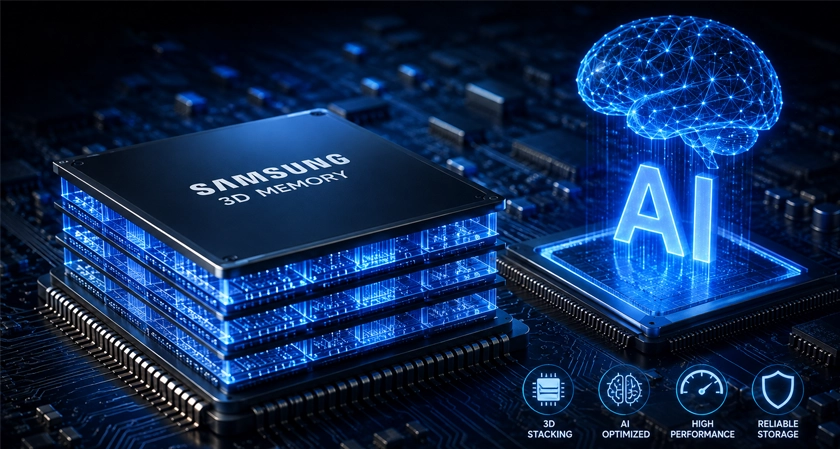
Samsung 3D memory has introduced a fresh vision for AI infrastructure with groundbreaking new designs. A new approach to data processing but what makes it so different?
Samsung has launched its next-generation AI memory technology with a new vision for the future of AI infrastructure. From a 400-plus-layer V-NAND prototype to revolutionary Samsung 3D memory concepts, the company is preparing for an era where faster, smarter and more energy-efficient AI systems become the new standard.
At the Future of Memory and Storage (FMS) 2026 conference in Santa Clara, California, Samsung introduced its next-generation AI memory portfolio, highlighting innovations designed to meet the rapidly growing demands of AI inference and high-performance computing.
Details of the AI memory technology
Samsung's biggest announcement was its V10 Bonding V-NAND (BV-NAND) prototype, built using a new wafer-bonding architecture with more than 400 memory layers. According to the company, the design delivers approximately 58% higher storage density than the previous V9 generation while improving read, write, and input/output performance. The architecture is also designed to reduce power consumption, making it well suited for future AI servers handling increasingly complex workloads.
The company also revealed two concept memory architectures, zHBM and zNAND-O, that rethink how memory interacts with AI processors. Instead of placing high-bandwidth memory beside AI chips, Samsung's zHBM stacks memory directly above AI accelerators. This shorter data path is expected to increase bandwidth, improve power efficiency, and reduce heat generation. Samsung says the approach could eventually deliver more than ten times the memory density of today's HBM5 technology while tripling energy efficiency.
"Driving the wave of the AI revolution requires new 3D innovations in memory and storage architecture," Samsung executives said while outlining the company's vision during the opening keynote at FMS 2026.
Why does this matter for the future of AI?
As AI models continue to grow, moving data efficiently has become just as important as processing it. Faster memory allows AI systems to generate responses more quickly while consuming less energy, a critical advantage for hyperscale data centers and enterprise AI deployments. Samsung also showcased technologies such as HBM4E, HBM5, LPDDR5X-PIM, and enterprise storage solutions, reinforcing its long-term roadmap for AI infrastructure.
While Samsung has not announced commercial launch dates for its newest memory technologies, the unveiling signals where the semiconductor industry is headed. As Business Fortune observes, AI adoption accelerates across industries and next-generation memory architectures are expected to play an increasingly important role in delivering faster, more efficient, and scalable AI systems.
FAQs
What is Samsung 3D memory?
Samsung 3D memory refers to the company's advanced memory technologies, including V-NAND and new 3D memory architectures, designed to improve AI performance, storage density, and energy efficiency.
What is V10 BV-NAND?
V10 BV-NAND is Samsung's latest NAND prototype featuring a wafer-bonding architecture with more than 400 memory layers and around 58% higher storage density than the previous generation.
What is zHBM?
zHBM is Samsung's next-generation memory concept that stacks high-bandwidth memory directly above AI accelerators to increase bandwidth while reducing heat and power consumption.
Why is AI memory becoming more important?
Modern AI models require rapid access to enormous amounts of data. Advanced memory helps improve inference speed, energy efficiency, and overall system performance.
When will Samsung's new AI memory technologies be available?
Samsung has not yet announced commercial availability or production timelines for the newly introduced technologies.


.webp)






























Comments