
Looking for the best storage solutions for AI/ML workloads? Let’s explore the companies behind them, what they offer, and why the right storage can make a real difference to AI performance.
When we think about AI or machine learning, we usually think about powerful computers, smart software and how it simplifies our work. But there is another part that no one seems to notice, where all that data is stored. AI systems can deal with huge amounts of data every day, and that data needs to move quickly when the system needs it. If the storage is slow, the whole process can slow down. This is why finding the best storage solutions for AI/ML workloads has become an important part of building a reliable AI system. So, which companies are building storage that can actually keep up with AI and machine learning and how are they doing it?
In this Business Fortune article, we explore some of the leading AI data storage companies, how their platforms differ, what makes storage suitable for AI, and the key points businesses should consider before making a decision.
What storage is best for AI and machine learning?
There is no one storage solution that fits all AI workloads. It depends on the size of the dataset, type of AI, number of GPUs, performance requirements, budget and whether the company is on site, in the cloud, or hybrid.
Some of the companies active in this space include WEKA, VAST Data, DDN, IBM, NetApp, Dell Technologies, and Everpure, formerly known as Pure Storage. NVIDIA's current certified storage list includes systems from these vendors for different AI and GPU environments.
For businesses running large AI training environments, platforms such as WEKA, VAST Data and DDN are designed around high-performance, large-scale data access. Enterprise storage providers such as IBM, NetApp, Dell and Everpure also offer systems aimed at demanding AI and data workloads.
The important point is that a storage platform should be matched to the actual workload instead of being selected simply because it has a high speed figure on a product sheet.
Why does AI need high-performance storage?
AI systems process data differently from many traditional business applications. During model training, GPUs need a steady flow of data. They may repeatedly read large datasets while also creating checkpoints, logs and other files. If the storage layer cannot deliver data quickly enough, the GPUs may spend time waiting. That can affect the overall cost of an AI project. GPUs are expensive resources, so keeping them busy is important.
This is where high-performance data storage becomes useful. Modern AI storage platforms are designed to handle high data throughput, large numbers of files and demanding read and write operations.
The problem is not always simply about having more storage capacity. A company may have several petabytes of space and still experience slow AI jobs if the storage architecture cannot deliver data efficiently.
Leading companies in AI storage
WEKA
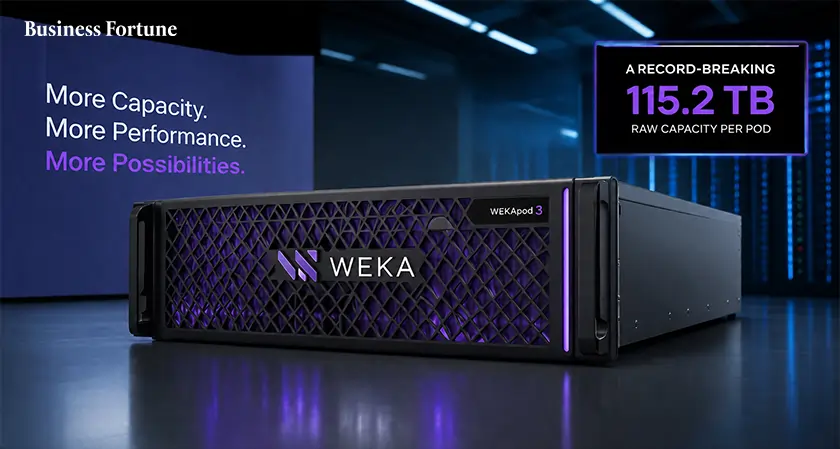
WEKA focuses strongly on AI, machine learning and high-performance computing. Its Data Platform is designed to support AI data pipelines across on-premises environments and public clouds. The company says its platform can bring different data sources together while providing high-performance access for AI applications.
WEKA is particularly relevant for organizations that need fast access to data across large AI environments. Its presence on NVIDIA's current certified storage list also reflects its focus on GPU-based infrastructure.
VAST Data
VAST Data has built its platform around large-scale data infrastructure for AI and other demanding workloads. Its technology has been used in NVIDIA reference architectures for machine learning and artificial intelligence.
NVIDIA has published a VAST Data reference architecture for DGX systems that combines VAST storage with NVIDIA computing and networking technologies for AI training and inference.
This makes VAST worth considering for organizations looking for a shared storage platform that can support large AI environments.
DDN
DDN has a long history in high-performance computing and storage. Its AI-focused systems include the AI400X3 and AI400X3i, which appear on NVIDIA's certified storage list for enterprise and other AI environments.
DDN can be particularly relevant to research organizations, large enterprises and environments where high levels of parallel data access are required.
IBM
IBM brings its long experience in enterprise storage into the AI market through IBM Storage Scale and other storage technologies. IBM Storage Scale systems are currently listed by NVIDIA among certified storage platforms for enterprise AI environments, including configurations supporting large GPU deployments.
For organizations already using IBM infrastructure, its AI storage products can also offer the benefit of fitting into an existing enterprise technology environment.
NetApp
NetApp is another established enterprise storage provider moving deeper into AI infrastructure. Its storage systems appear on NVIDIA's certified storage list, including the AFF A90 and AFX 1K platforms.
NetApp's long-standing focus on enterprise data management can make it relevant for companies that need AI storage alongside existing business applications, data protection and hybrid cloud environments.
Dell Technologies
Dell offers storage platforms for enterprise and AI environments, including PowerScale systems. NVIDIA currently lists Dell PowerScale F710 among its certified storage systems for different GPU configurations.
Dell can be relevant for companies looking to connect AI infrastructure with a broader enterprise data center environment rather than building a completely separate storage setup.
Everpure
Everpure, is another major name in enterprise and AI storage. Its FlashBlade systems appear on NVIDIA's current certified storage list for AI environments.
The company focuses on flash-based storage designed for demanding workloads where fast access and simple data management are important.
What are the key features of AI storage?
The storage architecture for AI needs to do more than simply hold large amounts of information.
-
High throughput is one of the most important factors. Training systems may need to move huge amounts of data quickly between storage and compute.
-
Low and predictable latency also matters. A storage system that delivers inconsistent performance can create bottlenecks during demanding workloads.
-
Scalability is another major requirement. AI datasets can grow quickly, so businesses need systems that can expand without creating major disruptions.
-
Support for different data types is useful as well. AI environments may work with structured data, images, video, documents, model files and other forms of information.
-
Data protection cannot be ignored. AI training can involve months of work and enormous datasets. Backup, replication, recovery and security features help protect that investment.
-
GPU integration is increasingly important too. Businesses should check whether their chosen storage system supports the computing architecture and networking technology used in their AI environment.
How does AI storage differ from traditional enterprise storage?
Traditional enterprise storage is often designed around applications such as databases, business software, virtual machines and general file services. AI storage has a different set of demands.
AI workloads can involve very large datasets, thousands or even millions of files, parallel access from many computing systems and repeated movement of data. Training and inference can also create different performance patterns. This does not mean traditional enterprise storage cannot support AI. In many cases, modern enterprise platforms have added capabilities specifically for AI and high-performance workloads.
The difference is that AI projects often place much greater pressure on input, scalability and parallel data access.
How do companies choose storage for AI workloads?
The first step is understanding the workload. A company training large language models will have different requirements from a business running computer vision, recommendation systems or smaller machine learning models.
Next, businesses should look at the number of GPUs and servers that will access the storage. A platform that works well for a small AI team may not deliver the same experience when hundreds or thousands of GPUs are involved.
Cost also matters. Companies should consider not just the price of storage hardware, but networking, software, support, power, cooling and administration.
Data location is another important question. Some organizations need on-premises storage because of security, compliance or data residency requirements. Others may prefer cloud storage or a hybrid approach.
Finally, businesses should test the system with their own data and workload. Vendor benchmarks can provide useful information, but real-world testing can reveal how a platform behaves with the company's actual files, applications and AI models.
What makes high-performance storage for AI different?
A good AI storage system needs to deliver performance as the environment grows. It should also handle different access patterns without becoming difficult to manage.
For example, training may require large amounts of sequential data access, while other AI applications may involve many smaller files. Checkpointing creates another type of workload because large model states need to be written and recovered efficiently.This is why modern storage architecture for AI is increasingly designed around scale-out systems, fast networking and parallel data access.
The future of AI storage
AI workloads are becoming more varied. Businesses are moving beyond model training and exploring inference, generative AI, retrieval systems and AI agents. That means storage will increasingly become part of the wider AI infrastructure rather than simply a place where datasets are kept.
NVIDIA's current certification program shows how broad the market has become, with storage systems from companies including DDN, Dell, IBM, NetApp, Everpure, VAST Data and WEKA certified for different AI environments.
For businesses, the takeaway is simple: choosing AI storage should start with the data and workload, not with a brand name alone. The right platform should provide the required speed, scale, reliability, security and flexibility while fitting into the company's wider technology environment.
As AI models continue to grow and businesses process more data, storage will play an increasingly important role in determining how efficiently those systems can operate.
FAQs
What is the most important feature of AI storage?
Performance is important, but it is not the only factor. Businesses should also consider scalability, latency, reliability, data protection, networking, security and compatibility with their AI infrastructure.
Can traditional enterprise storage be used for AI?
Yes. Modern enterprise storage systems can support many AI workloads. However, large-scale AI training may require storage designed specifically for high throughput and parallel data access.
Which companies provide storage for AI and machine learning?
Companies active in AI storage include WEKA, VAST Data, DDN, IBM, NetApp, Dell Technologies and Everpure. Their products differ in architecture, scale, performance and intended use.
Why do GPUs need fast storage?
GPUs need a steady supply of data during AI training and inference. If storage cannot provide data quickly enough, GPUs may spend time waiting, reducing the efficiency of the overall system.
How should a company test an AI storage platform?
Companies should test storage using their own datasets and AI workloads where possible. They should measure throughput, latency, file operations, checkpoint performance, scalability and GPU utilization before making a final decision.


.webp)


























Comments