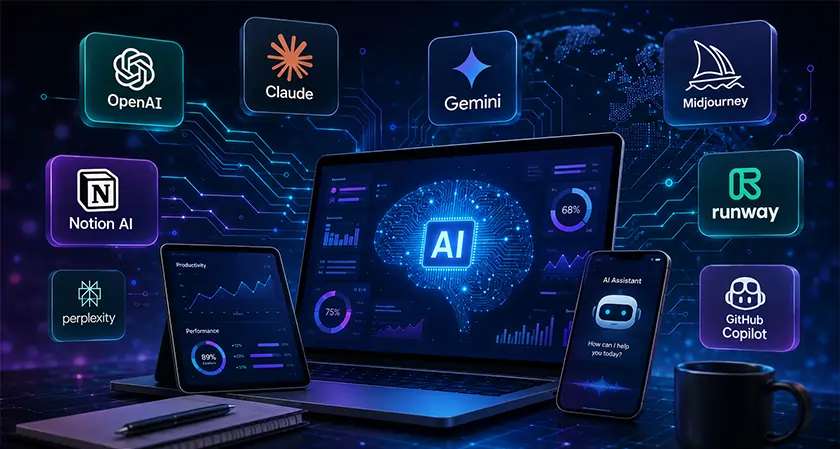
Artificial intelligence has become a core business technology in 2026, transforming how organizations create content, analyze data, automate operations, develop software and improve customer experiences. The best AI tools of 2026 are helping businesses streamline workflows, boost productivity and unlock new opportunities for innovation. While consumer AI assistants continue to gain popularity, businesses are increasingly investing in enterprise-grade AI platforms that deliver measurable productivity, security, and scalability.
This article explores the leading AI tools of 2026, highlights the growing shift toward professional B2B AI solutions and examines why demand for AI-skilled professionals continues to surge across industries.
AI Is Becoming an Essential Business Companion
Artificial intelligence tools are no longer viewed as an experimental technology. Instead, it has become a standard component of modern workflows across industries including finance, healthcare, manufacturing, retail, education, marketing and software development. Organizations are adopting AI not simply to automate repetitive tasks but to improve decision-making, accelerate innovation and unlock new AI business tools opportunities.
The AI landscape has also become more specialized. Rather than relying on a single platform, businesses now combine multiple AI tools designed for specific use cases, from coding assistants and research platforms to enterprise automation and customer support.
Top AI Tools of 2026
Some AI platforms continue to dominate due to their versatility, while others have become industry leaders in specialized areas.
-
ChatGPT – One of the most widely used AI assistants for writing, coding, research, brainstorming, document analysis and business productivity. Businesses increasingly integrate it into daily workflows for knowledge management and customer support.
-
Google Gemini – Google's multimodal AI platform offers deep integration with Workspace applications, enabling organizations to generate reports, summarize meetings, analyze spreadsheets and automate collaborative tasks.
-
Microsoft Copilot – Embedded throughout Microsoft 365, Copilot helps employees create presentations, draft emails, analyze Excel data, generate documents and streamline enterprise workflows directly inside familiar productivity software.
-
Claude – Known for handling lengthy documents and complex reasoning tasks, Claude has become a preferred AI assistant for legal teams, analysts, researchers and organizations working with extensive documentation.
-
Perplexity AI – Designed for AI-powered search and research, Perplexity provides sourced answers and rapid information retrieval, making it valuable for professionals conducting market research, competitive analysis and technical investigations.
-
GitHub Copilot – Software developers continue to rely on GitHub Copilot for code generation, debugging, testing assistance, documentation and accelerating software development across multiple programming languages.
These tools illustrate how AI has evolved from simple chatbots into specialized productivity platforms supporting nearly every professional function.
Beyond Prompting: The Rise of Professional B2B AI Platforms
While consumer AI assistants continue to attract attention, the biggest AI transformation in 2026 is happening within enterprise organizations. Businesses are moving beyond simple prompting and adopting AI platforms that integrate directly with CRM, ERP, finance, supply chain and internal knowledge systems to automate complex workflows.
Modern B2B AI solutions can retrieve business data, analyze information, generate reports, recommend actions and complete multi-step processes with minimal human intervention. This enables organizations to improve productivity, streamline operations and make faster, data-based decisions.
Security and governance have also become top priorities. Enterprise AI platforms now include advanced access controls, compliance features, audit capabilities and responsible AI frameworks to protect sensitive business data and meet regulatory requirements.
At the same time, industry-specific AI solutions are gaining momentum across healthcare, banking, legal services, manufacturing, logistics, and insurance. These specialized platforms understand sector-specific terminology and workflows, delivering greater accuracy and business value. As enterprise AI evolves, organizations are increasingly adopting the best AI tools for business automation to reduce costs, improve efficiency, and enhance customer experiences across every department.
Demand for AI Skills Continues to Surge
As AI adoption accelerates, companies worldwide are expanding hiring for professionals with artificial intelligence expertise. Demand now extends beyond machine learning engineers to include AI engineers, prompt engineers, AI product managers, automation specialists, cybersecurity professionals, cloud engineers and data analysts. Organizations are also seeking employees who can integrate AI into functions such as marketing, fintech and financial services, human resources, customer service and software development.
Technical skills in Python, machine learning, cloud platforms, API integration and large language models remain highly valuable. However, employers increasingly prioritize professionals who can apply AI strategically to solve real business challenges rather than simply use AI tools.
Generative AI literacy is quickly becoming a core workplace skill, with employees expected to automate tasks, analyze data and improve productivity using AI. At the same time, businesses are investing heavily in workforce upskilling through AI training programs and certifications. As AI continues to reshape industries, continuous learning and practical AI expertise are becoming essential for career growth and long-term employability.
AI in the Years Ahead
Artificial intelligence is expected to become even more integrated into everyday business operations in the coming years. Organizations will increasingly adopt AI agents capable of managing complex workflows, making real-time decisions, and collaborating with human teams. Industry-specific AI solutions will continue to expand, while advances in multimodal AI, robotics, and autonomous systems will unlock new opportunities across healthcare, manufacturing, finance, and education.
At the same time, stronger regulations and responsible AI practices are likely to shape how businesses develop and deploy these technologies. Companies that invest in AI innovation, workforce training, and ethical implementation will be better positioned to stay competitive in an increasingly AI-based economy.


.webp)































Comments