
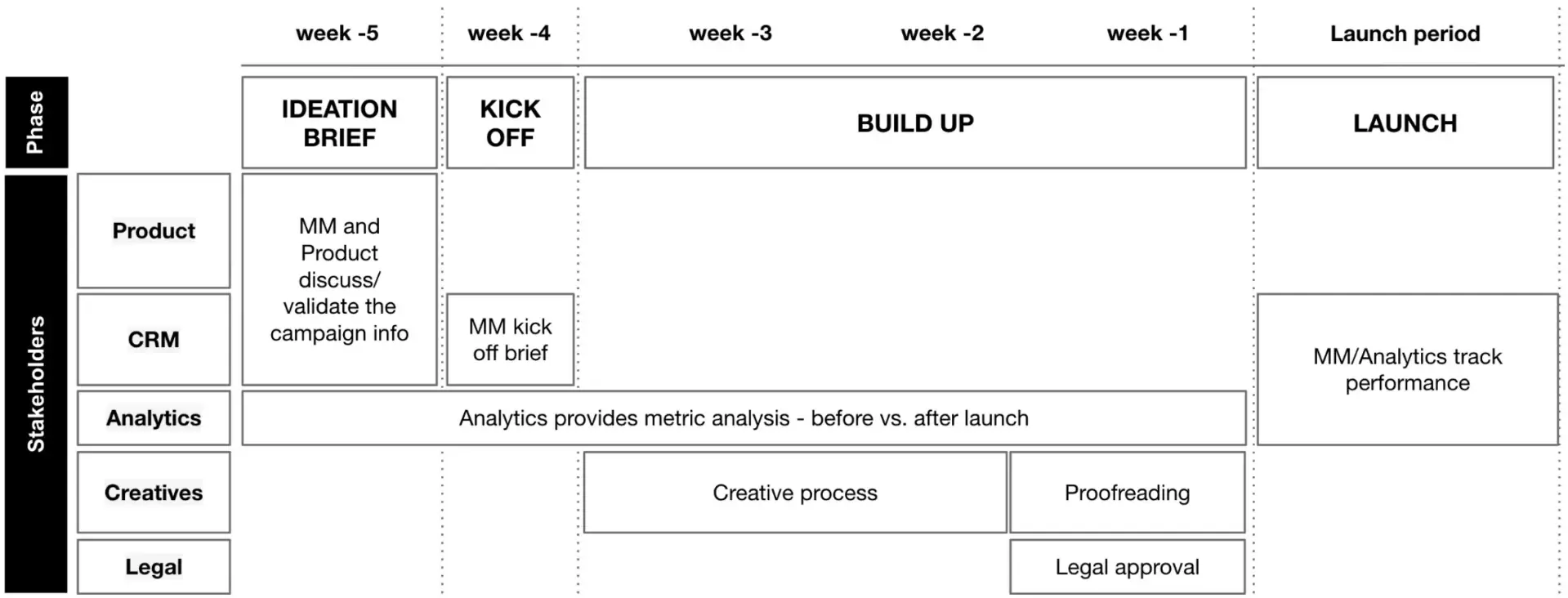
In 2020, it used to take me five weeks to get a single experiment up and running at Uber. Not five weeks to see results — five weeks just to launch. Here’s what that looked like: pre-experiment analysis, creative briefs, getting a designer and a copywriter cooking, (easily) two rounds of feedback. Then waiting for a developer and QA, and finally deployment. Only then did we start collecting data. And that was on a well-resourced growth team at one of the hyper-growth tech startups at that time.
Fast forward to 2026. AI has compressed that same cycle from five weeks to as fast as 3 days.
I expected that to be the end of the story. It wasn't. Removing the production bottleneck exposed a much harder one: strategy.
And most teams have not re-structured around that shift yet.
The bottleneck has moved — not disappeared
Most of what I read about AI in growth marketing is about efficiency. Faster research, faster content, faster analysis, faster iteration. That's true. But it's only half the picture. When production friction goes away, the constraint shifts to strategy. And judgment doesn't scale the way production does.
At Uber, strategy was stuck waiting on execution. By the time a five-week loop came back with results, priorities had already moved on. We ran fewer experiments per quarter than the business needed.
Today, experiment velocity isn't a production problem anymore. It's a thinking problem.
|
What constrained Growth team velocity before |
What constrains it now |
|
Creative production cycles (designer, copywriter, dev) |
Quality of strategic prioritization |
|
Developer queue for email builds and QA |
Clarity of hypothesis before the experiment runs |
|
Analyst bandwidth for results synthesis |
Judgment about channel, segment, and timing decisions |
|
Five-week loops before data collection begins |
Whether the experiments being run are the right ones |
What does the AI stack actually look like?
Our stack runs in three layers:
-
Research and discovery: Claude Code with browser control maps the user journey screen by screen, logs every drop-off point, and benchmarks competitors. This used to be a full day of screenshotting and Figma work. Now it takes about two hours and runs as a repeatable script. We re-run it monthly as the product changes. Point it at a competitor and you get the same analysis.
-
Production: Email production — the cycle that used to require a copywriter, designer, developer, and QA pass — now runs from a prompt template. The model drafts subject lines, preheader, body copy, CTAs, and renders mobile-friendly HTML. One review pass, one deployment.
-
Analysis and optimization: Multi-armed bandit algorithms, built into platforms like Braze and Mailchimp, replace static 50/50 splits. Traffic routes to winning variants in real time rather than waiting weeks for statistical significance to accumulate. Post-experiment analysis across variants, segments, and channels — previously days of analyst work — runs in minutes.
One caveat on production: this works best for copy-heavy, plain-text sends. For image-heavy emails like feature announcements or visual product education, a designer is still faster and does better work.
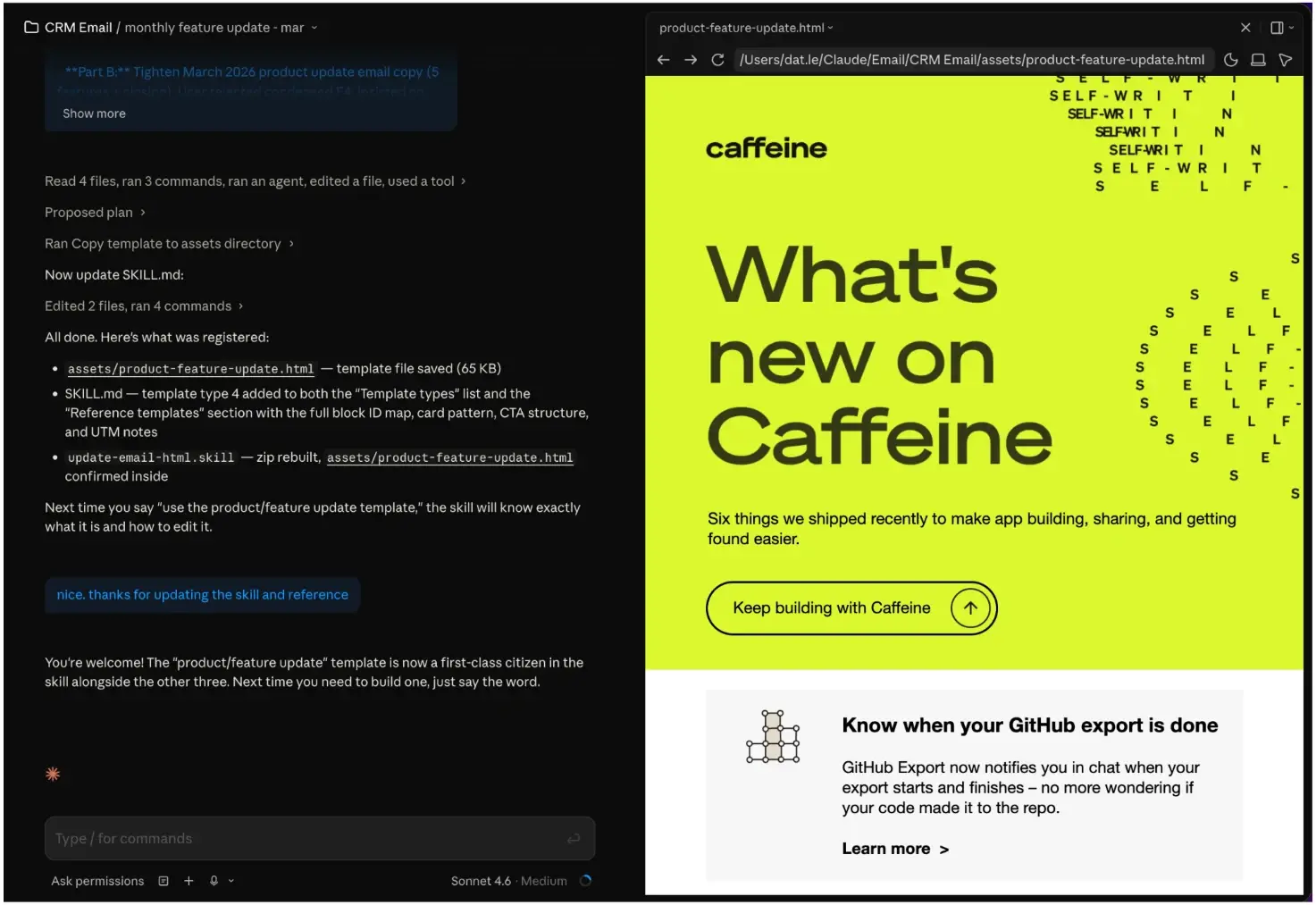
Funny enough, one of our AI-written and AI-built emails ended up on Really Good Emails, a curated library showcasing more than 15,000 examples of effective email marketing, design, and coding.
Long story short: our experiment velocity roughly tripled. Not because the team works more hours, but because the constraint moved from production to strategy.
Where does the stack break down?
There are three decisions AI still can't make for you. This is where the real work lives now.
-
Strategic prioritization: AI can tell you that, say, 40% of users drop off at the pricing page. It can't tell you whether that's a messaging problem or a trust problem. And it can't decide that this quarter you should focus on reactivating lapsed users instead of optimizing onboarding. That call takes business context, competitive positioning, and a gut sense of where the leverage is. It's now the critical path.
-
Channel and timing decisions: Should this user get an email, a push, an SMS, or an in-app message? And when? That requires reading the state of the relationship, not just optimizing a send-time variable. AI can find the best send window within a channel. It can't pick the channel for you.
-
Data infrastructure: AI platforms are adding connectors fast. But getting reliable event data from your warehouse into your CRM, keeping segments clean, and keeping trigger logic current as the product changes is still an engineering problem. AI can process the data once it arrives. It can't build or maintain the pipes (yet).
The strategic vacuum
Here's the risk nobody talks about.
If you adopt AI for CRM execution without moving your team's time toward strategy, you'll just run faster loops on the same assumptions. Velocity triples. Strategic quality stays flat.
Think of AI as a multiplier. It multiplies whatever your team was already doing.
If your team spent 80% of its time on production and 20% on strategy, removing the production bottleneck doesn't magically flip that ratio. Someone has to decide to flip it. And most teams aren't making that decision.
The uncomfortable math
Salesforce's 2026 State of Marketing report found that 75% of marketers are already using AI for content creation. Platform-level multi-armed bandit optimization is table stakes in every major CRM tool. If every growth team is now running faster loops with similar infrastructure, the competitive advantage from execution speed alone compresses toward zero.
The experiment velocity gap is closing. The strategic judgment gap is not.
The teams that win the next few years won't be the ones that adopted AI first. They'll be the ones that grew their strategic muscle as fast as their execution speed, and used the time AI gave back to run better experiments, not just more of them.
So what should growth leaders do?
Adopting an AI in your marketing stack and getting your team AI-fluent is the right move right now. But as you do, ask yourself: in a world where you and your competitors have all achieved efficiency through AI, what are we focusing with the time AI gives us back – an average of 13 hours a week, according to ActiveCampaign?
Here's where I'd start:
-
Reallocate on purpose: Set a target split between production and strategy time, then check it every quarter.
-
Redesign roles: Hire and promote talents who can both set strategy and run the tools, rather than production specialists.
-
Put the saved hours into customer conversations: Interviews and support calls give you information AI can’t produce, and they feed better bets.
When every competitor moves at the same speed, direction is what separates them.
Dat Le is a growth marketing/product expert with previous experience at Uber, Block, Amazon & IEEE Senior Member.


.webp)





























Comments