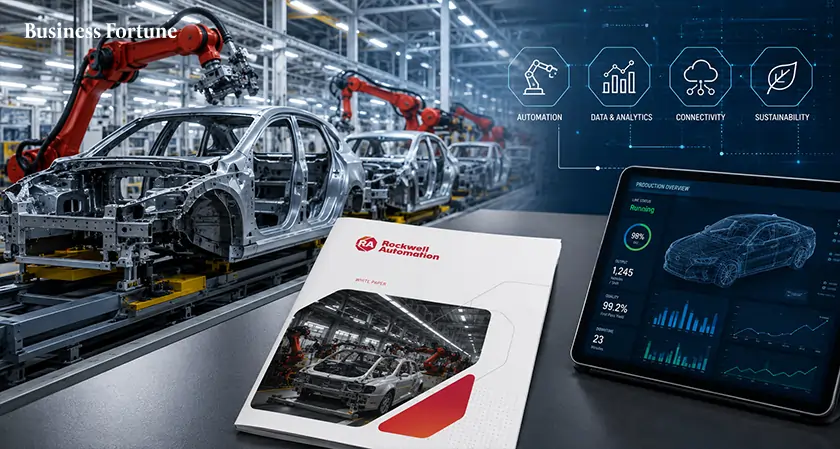
The Rockwell Automation white paper reveals how AI, machine learning, and automation are transforming automotive manufacturing and boosting efficiency.
The automotive industry is entering a new era, and the latest Rockwell Automation white paper suggests that the race is no longer about whether manufacturers should adopt smart technologies. Instead, it is about how quickly they can put them to work.
Rockwell Automation, in partnership with the Center for Automotive Research (CAR), has released a new report titled Smart Manufacturing in Automotive: Deployment and Impact. The study explores how artificial intelligence (AI), machine learning (ML), and advanced automation are transforming automotive, tire, and battery production.
Smart Manufacturing Is Moving Beyond Traditional Automation
For years, automakers have relied on automation in areas such as welding, painting, and body assembly. Now, manufacturers are expanding these technologies into more complex operations that were once difficult to automate.
These new areas include:
-
Electronics assembly
-
Validation and testing processes
-
Production planning and coordination
-
Supply chain and logistics management
At the same time, AI and machine learning are helping companies improve predictive maintenance, enhance inspection accuracy, and optimize overall plant performance.
According to CAR, manufacturers that move faster in adopting these technologies are already gaining a competitive edge.
What Is Driving This Rapid Adoption?
Several industry challenges are accelerating investment in smart manufacturing solutions.
Manufacturers are dealing with:
-
Growing production complexity
-
Rising material and operating costs
-
Increased global competition
-
Ongoing warranty and quality concerns
-
Labor shortages affecting local production
Automation and AI are helping businesses address these pressures while maintaining efficiency and profitability.
The Numbers Show Real Business Benefits
The report highlights measurable improvements already being achieved by manufacturers using advanced automation and analytics.
Reported results include:
-
Up to 50% reduction in unplanned downtime in certain applications
-
Around 5% improvement in overall equipment effectiveness
-
Throughput gains of 5% to 7% through real-time production analytics
These improvements allow manufacturers to identify issues earlier, reduce costly disruptions, and make better operational decisions.
Could a Technology Gap Create Industry Winners and Losers?
One of the report's most significant findings is the growing divide between companies that rapidly embrace smart manufacturing and those that delay adoption. Early adopters are seeing gains in productivity, quality, and uptime, while slower-moving organizations risk falling behind. This gap could influence supplier performance, profitability, and long-term competitiveness across the automotive ecosystem. As vehicles become more advanced and production demands increase, smart manufacturing is shifting from a competitive advantage to a business necessity.
Looking Ahead
As Business Fortune observes, the next phase of automotive manufacturing will likely be defined by deeper integration of AI, machine learning, and data-driven automation. Companies that successfully scale these technologies across their operations may be better positioned to handle future challenges, improve efficiency, and remain competitive in an increasingly complex global market.
FAQs
What is the new Rockwell Automation white paper about?
The report examines how AI, machine learning, and automation are reshaping automotive, tire, and battery manufacturing operations.
Who created the white paper?
The white paper was developed through a collaboration between Rockwell Automation and the Center for Automotive Research (CAR).
What areas of manufacturing are seeing new automation adoption?
Manufacturers are increasingly applying automation to electronics assembly, validation testing, production coordination, and logistics.
What benefits are companies reporting from smart manufacturing?
Benefits include reduced downtime, improved equipment effectiveness, increased production throughput, and better operational decision-making.
Why is smart manufacturing becoming important now?
Growing production complexity, labor shortages, rising costs, and stronger global competition are pushing manufacturers to accelerate digital transformation efforts.


.webp)