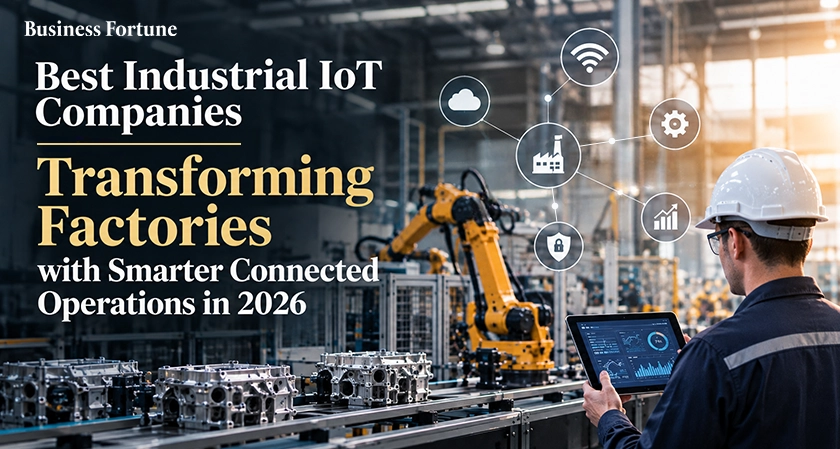
From predictive maintenance to industrial AI, discover how leading IIoT providers are helping businesses turn machine data into smarter decisions.
Best industrial IoT companies are becoming central to how factories, energy facilities, warehouses and other industrial operations use data. In 2026, the conversation is no longer only about connecting machines. Businesses want connected equipment to explain what is happening, spot problems early and help teams make faster decisions. That is why Siemens, Honeywell, Schneider Electric, ABB, Rockwell Automation, Cisco, PTC and other technology providers continue to appear in discussions around industrial IoT platforms and services.
Modern industrial sites produce huge amounts of information through sensors, machines, controllers and software. When that information is connected and analysed, companies can move from simply watching equipment to understanding its condition and performance. Siemens mentions asset monitoring, manufacturing performance, quality predictions and operational data when explaining their IIoT strategy. On the other hand, Schneider Electric integrates their devices, edge controls, apps and analysis using the EcoStruxure platform. The two examples demonstrate how the IIoT concept is becoming an integrated part of regular business operations.
So, which companies matter, how industrial IoT works and what should businesses watch in 2026? Here is a practical look at the technologies, providers and trends shaping the market.
What is industrial IoT?
Industrial IIoT refers to the connection between machines, sensors, manufacturing processes and other assets in an industrial setting to capture, exchange and analyze data. Unlike consumer IoT, IIoT focuses on environments where uptime, safety, quality and productivity matter.
A simple system may collect temperature, pressure, vibration, energy use, production speed or equipment status. Edge devices can process some information close to the machine, while cloud platforms can combine information from different sites. Analytics and AI then turn that data into alerts, patterns and recommendations.
The IIoT helps establish an effective connection between the physical aspect and the digital aspect. According to Siemens, their Industrial Edge helps bridge the gap between the physical and the enterprise by processing near real-time data either on the edge or on the cloud. This model is becoming essential in IoT-enabled manufacturing because it provides managers with the visibility that is not possible through reports.
How industrial IoT works?
How industrial IoT works can be understood as a chain that begins with physical equipment and ends with an operational decision. Sensors first capture information from machines or processes. Gateways and edge systems collect and organise the data, sometimes analysing it locally before sending selected information to a central platform.
The next stage is contextualization. Raw numbers become more valuable if the software knows what machine created them, what typical behavior would be for that machine and what kind of manufacturing process is going on. Analytics can detect anomalous behavior and AI models can provide forecasting capabilities.
A simple IIoT workflow often looks like this:
-
Sensors and machines generate data.
-
Edge devices collect and process data.
-
Industrial platforms store and contextualise information.
-
Analytics and AI identify patterns.
-
Dashboards, alerts or automated systems support action.
Similarly, Honeywell Forge adopts the connected operations approach, involving the integration of installed assets, operational data and intelligence of particular domains. It is in such a scenario that real-time industrial IoT becomes useful since one will respond to a problem when it arises.
What are the benefits of industrial IoT?
The benefits of industrial IoT extend to making the factory appear more connected. The technology will allow organisations to increase visibility, eliminate unnecessary downtimes and make decisions based on present operational data.
For maintenance teams, connected sensors can reveal changes in vibration, temperature or other conditions that may signal equipment trouble. Production teams can use machine and process data to identify bottlenecks or quality issues. Energy teams can track consumption and look for inefficient operating patterns.
Key benefits can include:
-
Earlier detection of equipment problems
-
Better visibility across machines and sites
-
Improved production monitoring
-
More data-based maintenance planning
-
Faster response to operational changes
-
Greater understanding of energy and resource use
Cisco’s 2026 research shows that industrial organisations are moving AI into operational settings, while infrastructure, cybersecurity and IT/OT collaboration remain important considerations.
Which are the top industrial IoT companies?
The top industrial IoT companies are not identical in what they offer. Some combine automation hardware with industrial software, while others focus more strongly on cloud platforms, connectivity, analytics or application development. Market lists commonly include Siemens, Cisco, ABB, Rockwell Automation, Honeywell and Schneider Electric, alongside technology companies such as AWS, Microsoft, IBM, SAP and PTC.
Siemens offers Insights Hub and Industrial Edge for asset monitoring, operational analytics and connectivity. Honeywell Forge connects industrial assets and uses domain-specific intelligence to support real-time operations. Schneider Electric’s EcoStruxure platform combines connected products, edge control, applications and analytics.
ABB Ability, Rockwell FactoryTalk, Cisco industrial networking and PTC’s ThingWorx ecosystem also represent different approaches to industrial connectivity and software. For companies evaluating providers, the important question is whether a platform fits existing equipment, data architecture, security requirements and operational goals.
What are the leading industrial IoT companies offering in 2026?
Leading industrial IoT companies are increasingly moving beyond basic monitoring. Their platforms are adding AI, edge computing, digital twins, industrial analytics, cybersecurity and workflow automation. The goal is to turn operational data into something teams can act on.
Siemens positions Insights Hub within a broader Industrial Operations X portfolio, while Schneider Electric uses EcoStruxure to connect industrial assets with edge control and cloud-connected digital services. Honeywell Forge describes itself as an intelligence layer across operations, connecting existing assets and putting contextualised data to work in real time.
How is industrial AI and IoT changing factories?
Industrial AI and IoT are increasingly being combined because connected machines provide the data that AI systems need to understand physical operations. Instead of using AI only for office-based analysis, industrial organisations are applying it to predictive maintenance, quality inspection, process automation, logistics and energy forecasting.
Cisco’s 2026 State of Industrial AI research, based on more than 1,000 operational technology decision-makers across 19 countries and 21 industrial sectors, found that AI is already delivering measurable operational benefits in several of these use cases. The same research points to infrastructure, cybersecurity and collaboration between IT and OT teams as important factors in scaling industrial AI.
How does industrial IoT help with predictive maintenance?
Industrial IoT for predictive maintenance uses connected equipment data to identify signs of possible failure before a breakdown occurs. Sensors can continuously track conditions such as vibration, temperature, pressure or operating behaviour. Analytics can compare those signals with historical patterns and normal operating ranges.
The process offers maintenance staff a way to diagnose problems before they result in expensive stoppages during production. Rather than performing services on all machines at regular intervals, firms will be able to focus on machines that need the attention.
The predictive maintenance as a concept was recently introduced in a paper published in September 2026. It is described there as an Industry 4.0 technology which uses AI, IoT, digital twins and sophisticated data analytics. However, it does not mean that all the failures will be solved automatically.
What are the industrial IoT trends 2026 businesses should watch?
Industrial IoT trends 2026 revolve more around intelligence, interoperability and action. The industry is transitioning from connectivity of devices to data interpretation for decision making.
Several themes stand out:
-
Edge intelligence for faster local processing
-
Industrial AI embedded into operational workflows
-
Digital twins for simulation and performance analysis
-
Stronger IT/OT cybersecurity
-
More vendor-neutral connectivity
-
Greater use of real-time analytics
-
Integration of IIoT with maintenance and enterprise systems
These trends point toward a more connected industrial environment where data does not simply sit inside dashboards. Instead, it increasingly feeds maintenance, production, quality and operational workflows.
What should businesses consider before choosing an IIoT company?
Choosing industrial IoT vendors depends upon the challenge that needs to be addressed. If a manufacturer is concerned about machine connectivity issues, then it will require a different solution from that of an energy company interested in asset performance management. The existing automation setup is another important aspect, as compatibility will help to fast-track a pilot project into production.
Businesses should examine:
-
Connectivity with existing machines and protocols
-
Edge and cloud capabilities
-
Data ownership and integration options
-
Cybersecurity and access controls
-
AI and analytics capabilities
-
Scalability across sites
-
Integration with maintenance and enterprise software
-
Implementation and long-term support
The right technology should connect with the organisation’s existing environment while giving teams a clear path from collected data to useful action. This is especially important when older industrial equipment must work alongside newer digital systems.
What is the future of industrial IoT?
The future of industrial IoT will likely be less about simply connecting more machines and more about making connected operations intelligent enough to support timely decisions. Thus, Business Fortune believes that, the next phase will be shaped by the meeting point of IIoT, industrial AI, edge computing, digital twins and cybersecurity.
Real-time data could be used to modify processes, determine future maintenance and detect quality issues even as the production continues. However, increased governance will become necessary as well since more intelligence becomes involved in the processes. Suppliers that can connect legacy systems and new devices, simplify complex data and enable secure automation will continue to be relevant in the ongoing digitalization of industry.
For businesses, it is no longer a matter of whether industrial IoT applies to them. Rather, it is the matter of how smartly they utilize. The future of IIoT will not only revolve around connected devices but will also revolve around connected decisions.


.webp)





























Comments