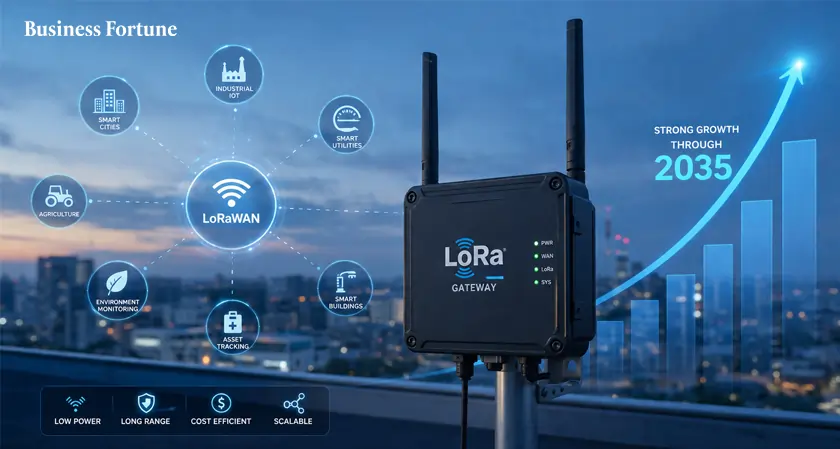
The Lora Gateway Module Market is projected to expand through 2035 as IoT adoption, smart cities, industrial automation, and agriculture drive demand.
Global Lora Gateway Module Market Gains Momentum as IoT Networks Expand
The global Lora Gateway Module Market is entering a period of significant expansion, driven by rising Internet of Things (IoT) adoption across industrial automation, smart city infrastructure, precision agriculture, and energy management applications. According to the latest IndexBox report, the market is expected to maintain strong momentum from 2026 to 2035, supported by increasing use of low-power wide-area network (LPWAN) technologies worldwide.
The market is projected to grow at a compound annual growth rate of around 12% during 2026–2035, with demand shifting towards advanced gateway modules featuring multi-channel support, edge processing, GNSS integration, and cellular backhaul capabilities. The global installed base of LoraWAN gateways has already surpassed millions of units, creating a replacement cycle as enterprises upgrade from basic indoor gateways to industrial-grade solutions.
Industrial automation remains the largest demand segment, accounting for approximately 32% of global demand in 2026. Manufacturers are increasingly adopting Lora-based connectivity for predictive maintenance, equipment monitoring, and factory sensor networks. Smart city infrastructure follows closely, with need in smart lighting, waste management, parking systems, and environmental monitoring.
Precision agriculture is also emerging as a key growth area as farmers and agribusinesses use Lora Gateway Modules for soil monitoring, irrigation management, weather tracking, and livestock monitoring in remote locations.
Asia-Pacific continues to dominate the market, supported by strong electronics manufacturing capabilities and rapid IoT deployment across China, India, Japan, and Southeast Asia. China remains the largest production hub, while North America and Europe represent major demand centers due to industrial IoT investments and smart infrastructure programs.
Challenges continue
However, the industry faces challenges including semiconductor supply fluctuations, regulatory differences across ISM frequency bands, and pricing pressure from low-cost manufacturers. Suppliers are increasingly focusing on certified reference designs and integrated solutions to improve competitiveness and reduce development timelines.
“The next phase of the Lora Gateway Module Market will be shaped by intelligent, connected infrastructure where edge computing, security, and flexible network integration become essential requirements for global IoT deployments,” industry analysts said.
Business Fortune believes that with continued investment in smart cities, industrial digitalization, and connected ecosystems, the Lora Gateway Module Market is expected to remain a critical component of the global IoT infrastructure landscape through 2035.
FAQs
What is driving the growth of the Lora Gateway Module Market?
The market is growing due to increasing IoT adoption, smart city projects, industrial automation, precision agriculture, and smart energy initiatives.
What is the expected growth rate of the Lora Gateway Module Market?
The market is projected to expand at around a 12% CAGR between 2026 and 2035.
Which region dominates the Lora Gateway Module Market?
Asia-Pacific leads the market due to strong manufacturing capabilities and widespread IoT deployment.
What industries use Lora Gateway Modules the most?
Major industries include industrial automation, smart cities, agriculture, utilities, logistics, and asset tracking.
What challenges could affect market growth?
Key challenges include semiconductor supply constraints, regulatory variations, supply chain concentration, and pricing competition.


.webp)































Comments