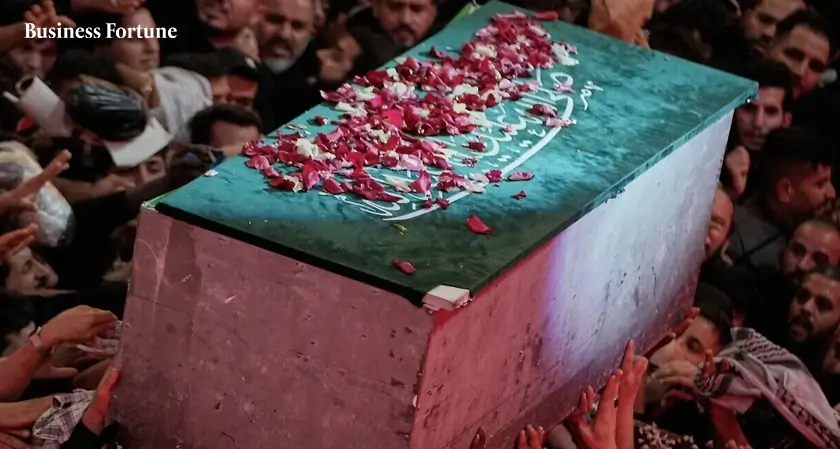
Iran leader funeral concludes in Mashhad as Khamenei’s burial follows days of mourning, conflict and rising Middle East tensions.
Iran's slain Supreme Leader Ayatollah Ali Khamenei was buried in Mashhad on Friday, bringing nearly a week of funeral ceremonies to an end after his death in US and Israeli airstrikes.
The iran leader funeral at the Imam Reza Shrine marked a historic moment for the country, as millions mourned the leader who governed Iran for almost 37 years and played a central role in shaping its political direction and foreign policy.
Khamenei Laid to Rest in Sacred Shrine
Khamenei's remains were transported to the Imam Reza Shrine in Mashhad, one of the most revered religious sites in Shia Islam. He became only the second Iranian ruler to be buried in the city, following Nader Shah, who was laid to rest there after his assassination in 1747.
Nationwide Mourning Draws Large Crowds
Funeral processions began last Saturday, with authorities shutting roads, restricting airspace and bringing normal activities to a halt in Tehran and several other cities. Large crowds gathered along the funeral routes to honour the former Supreme Leader, whose decades-long rule was marked by strict domestic control and opposition to Western influence.
Ahmad Alamolhoda, Khorasan Razavi Supreme Leader representative -
“Although no exact date has been set for the funeral ceremony of the martyred leader, it is expected that the necessary conditions for the accommodation and hosting of pilgrims who will travel to the holy city of Mashhad for the ceremony be provided.”
Key points:
-
Khamenei ruled Iran for nearly 37 years
-
Burial ceremony held at Imam Reza Shrine
-
Massive crowds attended nationwide mourning events
-
Mostafa Khamenei conducted funeral prayers
-
Mojtaba Khamenei was absent from the ceremony
Leadership Transition Gains Global Attention
According to claims, Khamenei's eldest son, Mostafa, led the funeral prayers, while Mojtaba Khamenei, the second eldest of his four sons and designated successor, did not attend the final ceremony. The absence increased international attention on Iran's leadership transition and the future direction of its government.
Middle East Tensions Continue Rising
The iran supreme leader funeral took place amid renewed tensions between Tehran and Washington after military exchanges involving the United States and Iran. Earlier strikes and retaliatory actions intensified regional instability, despite a previous agreement aimed at reducing hostilities.
Iran's mourning ceremonies and Khamenei burial developments are expected to remain under global observation as the country moves into a new political phase.
The leadership change could influence Iran's diplomatic approach, security policies and relations with international powers.
Thus, Business Fortune believes Iran’s leadership shift could significantly influence regional affairs and shape future international diplomatic relations.
FAQs
Where was Ayatollah Ali Khamenei buried?
He was buried at the Imam Reza Shrine in Mashhad.
How long did Khamenei serve as Iran's Supreme Leader?
He led Iran for nearly 37 years.
Who performed the funeral prayers?
His eldest son, Mostafa, led the prayers.
Why was the burial held in Mashhad?
The city houses the important Imam Reza Shrine.
What impact could Khamenei's death have?
It may influence Iran's future leadership and policies.


.webp)






























Comments