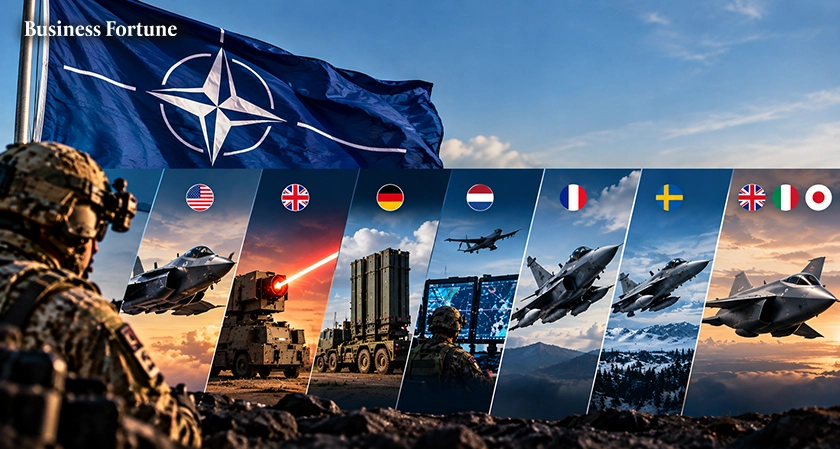
Discover how top defence tech innovations from NATO member countries are transforming modern warfare through artificial intelligence, autonomous drones, directed-energy weapons, integrated air defence and next-generation combat aircraft.
Top Defence Tech Innovations from NATO: AI, Laser Weapons and Next-Generation Warfare
The most groundbreaking defence technologies developed by NATO member countries are transforming how allies detect, respond and defend against threats, safeguard key infrastructure and execute military operations. Artificial intelligence (AI), autonomous drones, directed-energy weapons and integrated air-defence networks are set to move from experimental projects into practical use.
There is an added sense of urgency, as fighting in Ukraine has shown how readily available cheap drone strikes, electronic warfare and precision attacks can weaken even the most sophisticated forces. In NATO's response to this challenge, the use of state-of-the-art platforms is being combined with more adaptable software, affordable unmanned systems and technologies that can operate across borders.
NATO's overview of emerging and disruptive technologies shows that the Alliance is working with industry, researchers and innovation programmes to identify, test and adopt those technologies at the speed and scale required by modern defence.
The challenge is less about creating individual "better" weapons and more about linking firepower, sensors, software and personnel into a force that can react faster than its enemies.
Which NATO countries lead in defence technology innovation?
No nation dominates in all categories, but the United States has clear strengths in combat aviation and integrated military networks, while the United Kingdom is making great strides in directed-energy weapons. Germany has sophisticated air-defence systems, France has expertise in combat aircraft and missiles and the Netherlands is developing software to coordinate drones and sensors.
Other allies also bring valuable expertise to the table. Sweden specialises in adaptable combat aviation, Italy is involved in next-generation aircraft development and Estonia has developed expertise in cybersecurity and digital resilience. The following comparison highlights notable programmes and their strategic relevance.
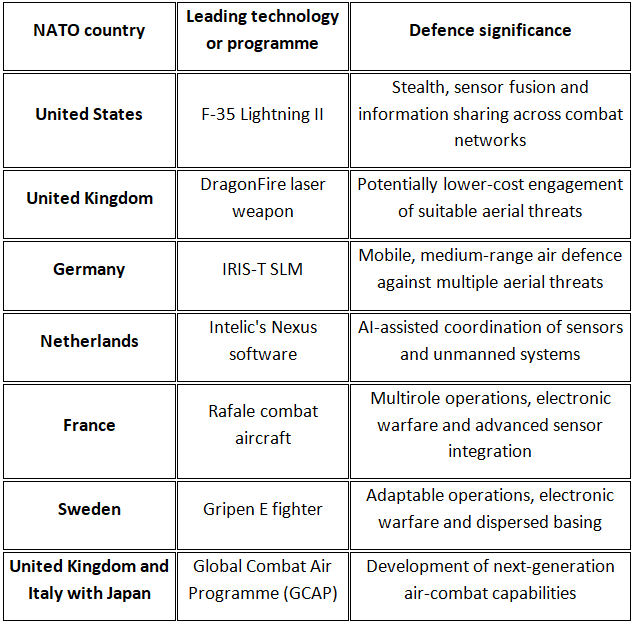
These programmes include operational aircraft, such as the F-35, Rafale and Gripen E; the IRIS-T SLM missile system which has already been deployed in Ukraine; Dragonfire which is close to entering service and GCAP which is being developed.
It is therefore not surprising that the distinction between a testy success and a proven capability is of utmost importance.
How is artificial intelligence transforming NATO defence systems?
AI binds sensors, human analysts and warfighting functions. It does not seek to replace humans at every level of decision-making, but it seeks to make sense of surveillance inputs, identify patterns, prioritize them and act on the most pertinent ones, at the speed required to respond to hundreds of simultaneous demands.
The Netherlands provides a recent example. According to Reuters news agency, in an article published on October 8, 2026, Intelic’s Nexus software, which seeks to unify radars, sensors and vision-recognition systems in order to carry out counter-drone operations, has been tested in a converted airfield and is now being used in Ukraine, where pressure on air-defence systems is at its highest ebb.
What are the latest military technology developments in NATO?
Three areas are witnessing the most innovation in next-generation defence technology: directed-energy weapons, advanced air defence and network-centric combat aviation. They illustrate how NATO military technology advancements seeks to respond to hybrid and sophisticated threats, from low-cost drones to advanced missiles and aircraft.
- The UK
Britain’s DragonFire programme is one of the most anticipated initiatives in the field of laser weapons. On November 20, 2025, the UK Ministry of Defence announced that the technology had successfully demonstrated its ability to destroy high-speed drones during tests and that a £316M contract had been signed with MBDA UK for weapons to be delivered to the Royal Navy starting in 2027. According to the government’s announcement, the technology’s cost per shot is estimated at around £10, which provides a powerful economic argument for directed-energy weapons. Traditional missiles can be prohibitively expensive, particularly when multiple firings are necessary to destroy a target. Laser weapons could allow a country to retain its missile stocks for more difficult-to-intercept targets.
- Germany
Germany’s mobile IRIS-T SLM air defence system, manufactured by Diehl Defence, is designed to intercept aircraft, helicopters, cruise missiles and drones. The system, which uses a combination of radar, a tactical command post and launch vehicles, has a theoretical range of 40km and a ceiling of 20km, according to the technical specifications of the Bundeswehr.
While a stand-alone missile launcher would have limited ability to engage multiple targets at once, the IRIS T-SLM’s radar and command functions give it enhanced combat capabilities. Moreover, the system can connect to other sensors and command posts in order to form an integrated air-defence network. Having already been deployed in Ukraine, where it has had ample opportunity to test its combat performance, the system is now being integrated into Germany’s air-defence architecture.
- The USA
The F-35 Lightning II’s stealthiness is well known, but what is less often appreciated is that the aircraft’s onboard sensors, computing power and communication equipment fundamentally change the way in which pilots perceive the battlespace. By virtue of its sensor-fusion capabilities, the F-35 allows a pilot to make sense of multiple sources of information rather than having to interpret individual tracks or sensor returns. Moreover, the aircraft can share this information with other F-35s, as well as with ships, aircraft and friendly forces on the ground. For NATO, with its multinational operations, such interoperability is critical, as it allows allied fighter aircraft to share a common operational picture, despite having been built by different prime contractors.
The F-35 is part of a broader trend of combat aircraft, which are set to fundamentally change the way in which airpower is used in future military operations. Essentially, the value of an aircraft is determined not only by the information that it carries but also by the way in which it processes and shares this information with other military assets.
- Netherlands
Software plays an important role in the evolution of advanced defence systems. Intelic’s Nexus software is one example of a growing number of technologies that seek to exploit commercial off-the-shelf technologies in order to transform existing equipment. Reuters news agency, in an article published on October 2026, reports that the software has been designed to unify radar, sensors and vision-recognition systems in countering drone strikes. The system has been tested in Ukraine, where it has been used to try to disrupt enemy drone traffic.
- The UK, Italy and Sweden
The future of air power will not be dominated by fourth-generation fighters. The UK and Italy, which are partners in the Global Combat Air Programme (or GCAP), with Japan, seek to design and build a new fifth-generation combat aircraft. GCAP is still a development programme; its proposed aircraft has not yet been built. Nevertheless, the programme’s goals illustrate the direction in which air power is set to evolve. Sweden’s Gripen E is another example of a next-generation fighter aircraft, which embodies a philosophy of operational flexibility, electronic warfare and networking capabilities.
Why are NATO members investing in next-generation military technology?
The transformation of the economics of war is an important factor in this evolution. Drones, which can often be bought at a fraction of the cost of traditional aircraft, can offset substantial expenditures on air defence systems. A single drone costs far less than a single missile, but a formation of drones can challenge a much larger missile inventory and the attrition of both can have significant financial and operational implications for either side. NATO members are therefore prioritising three broad areas of investment in military technology: affordable mass, resilience and faster acquisition cycles. Affordable mass refers to the need for militaries to acquire drones, sensors and other technologies in sufficient quantity in order to achieve strategic objectives.
NATO’s Innovation Scale-Up Package, announced in July 2026, seeks to address another critical challenge in military technology, which is the transition from a promising prototype to series production.
How is NATO promoting the adoption of new technologies by military organisations?
NATO’s Defence Innovation Accelerator for the North Atlantic (DIANA) fosters partnerships between companies, academia, warfighters, mentors and test centres in order to accelerate the transition of promising technologies to defence applications. DIANA’s efforts were highlighted in a presentation made by NATO in February 2026, which noted that 150 innovators, more than 200 test centres and more than 600 mentors were supporting the initiative. The Alliance can also point to more than 25 innovators whose technologies have been adopted by NATO Allies or have been tested in an operational environment.
The most innovative defense technology in NATO is related to allies’ efforts to improve their air defense, combat aviation, surveillance and decision-making on the battlefield.
Business Fortune concludes, the defense technology trends in NATO point to the direction of connected, interoperable systems that leverage cutting-edge platforms, low-cost alternatives and linkages enabled by software.


.webp)































Comments