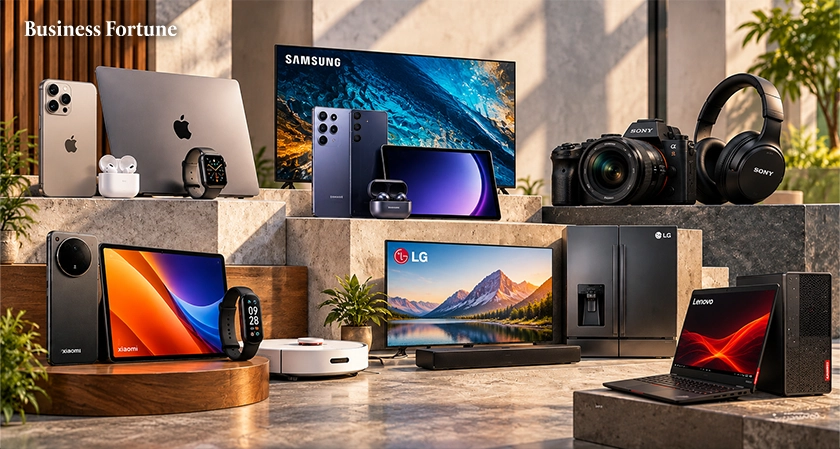
The top consumer electronics companies in 2026, compared on revenue, momentum and AI strategy and why memory chips now decide who earns the profit.
Figures current to early October 2026.
It is the defining year for top consumer electronics companies 2026. They are growing in value but stagnating in terms of units sold, being less constrained by consumers looking to buy than by the data centers powered by artificial intelligence looking to buy memory chips. This article profiles the major consumer electronics companies, identifies who is winning in each category and tracks the flow of profits.
Who are the biggest consumer electronics companies worldwide?
By revenue Apple is ahead of Samsung and the rest, yet beyond the top two, the ranking changes depending on the source since the companies' reports conflate gadgets with chips, servers, cars and film studios. The table below uses the most recent figures published by each company. Since they use different currencies and report earnings on different fiscal calendars, look at the change in growth rather than the absolute change.
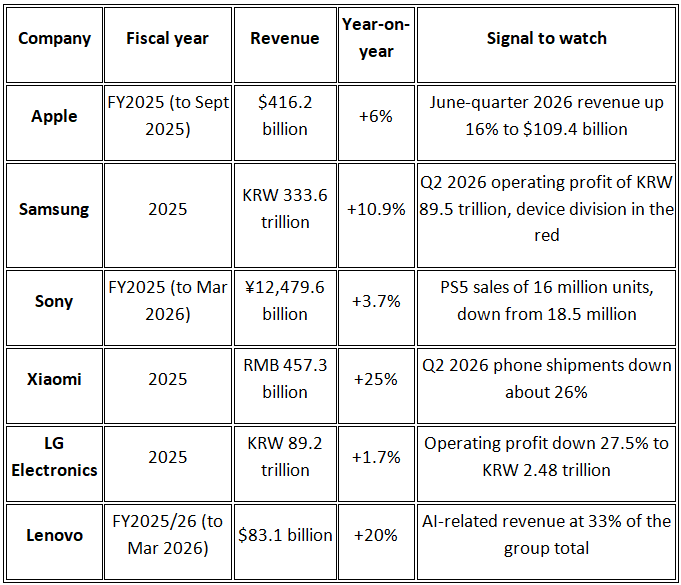
Samsung's chips, Lenovo's servers, LG's vehicle parts and Xiaomi's EV and AI segment (RMB 106.1 billion on its own) all sit inside those revenue lines. Apple's Services arm alone passed $100 billion in fiscal 2025.
Which consumer electronics companies are leading the market?
The leading consumer electronics companies depend on the aisle.
In phones
Samsung had 22.6% of second-quarter shipments and Apple 20.1%, according to IDC. The market fell 6.7% to 277.5 million units. Counterpoint's preliminary estimate was a steeper 11% fall, but its later market monitor puts the drop at 7%.
Revenue tells a different story: Counterpoint said sales rose 7% to $109 billion as the average selling price climbed 17% to $400, with Apple capturing 49% of the money.
Fewer phones, richer mix. Apple's own results support the pattern. June-quarter revenue jumped 16% to $109.4 billion and iPhone sales leapt 22%, which Tim Cook called the "strongest June quarter ever."
In April, Apple announced that John Ternus would succeed Cook as chief executive on September 1.
TVs are a three-way brawl
Samsung led first-half shipments with 17.6 million units, ahead of TCL at 15.08 million, Hisense at 14.23 million and LG at 11.3 million, according to TrendForce. In Mini LED, Samsung jumped from third to first in the second quarter with a 28.2% share, displacing TCL, which had 30.2% in the first, Omdia says. The household names achieved the feat by cutting entry prices, with Samsung and LG both lowering the cost of getting into Mini LED.
In PCs
Lenovo had 24.4% of global shipments in its fiscal fourth quarter, its best fourth-quarter share on record.
Which top consumer electronics brands are gaining ground fastest?
Size and momentum point in different directions. Samsung and Apple are largest, but the fastest are a rung below.
TCL had the fastest first-half growth in TVs among the four largest sellers, at 7.1%, while Samsung's 6.3% beat both Hisense and LG.
In phones, Counterpoint said Google's shipments rose 16% in the second quarter and Huawei's 6%, while Xiaomi, Oppo and Vivo shrank.
In smart glasses, Meta has 68.7% and a set of contenders is gathering behind it.
Look more closely at the growth leaders in the table and a pattern emerges. Xiaomi's 25% revenue growth is based on a car business that grew 223.8% and Lenovo's infrastructure arm grew 32%. Much of this year's growth was achieved not in handsets.
Why is the memory shortage reshaping the 2026 market?
AI data centers want memory and chipmakers are offering it to them. IDC calls the shift a possible permanent reallocation of wafer capacity away from phones and PCs, with shortages until 2027. Memory makes up 10% to 20% of a smartphone's build cost, so the squeeze gets to shelves fast.
Not everyone is feeling it
Apple and Samsung absorbed the additional costs without big price hikes. Xiaomi, Oppo and Vivo raised prices and lost double-digit volume. Sony shows the console version: the PS5 is now $650 after a $150 increase from its peak, its fourth-quarter unit sales fell 46% to 1.5 million, but Sony lifted its operating profit forecast for the year to March 2027 to ¥1.72 trillion.
Tariffs add noise
Apple's 50.1% June-quarter gross margin incorporated about two points from tariff refunds, after the Supreme Court struck down the emergency-powers tariffs in February. Reports put the refund near $2.2 billion. For the September quarter Apple guided to 47% to 48%.
How are consumer electronics companies using AI?
Three strategies have emerged, plus one new product category.
Apple rents
The rebuilt Siri unveiled at WWDC26 is run on Google's Gemini and avoids China and, on iPhone and iPad, the EU at launch. Constellation Research said Apple also benefits from having avoided heavy AI capital spending.
Samsung distributes
It plans to double Galaxy AI to 800 million devices this year, from about 400 million and has put Gemini into TVs and appliances. TM Roh, in charge of the device division, said in January to Reuters that AI looks "a bit questionable" currently but should become mainstream in six to twelve months.
Lenovo monetizes
Its AI-related revenue from NPU-equipped PCs and phones, GPU servers and services rose 105% to 33% of group sales.
The new surface is glasses
IDC counted XR headset and glasses shipments up 35.3% in the second quarter, with Meta at 68.7%. Google and Samsung plan Android XR eyewear this fall.
So far, AI has sold more chips than gadgets.
What is the future of the consumer electronics industry?
Value is outrunning volume
The Consumer Technology Association projects U.S. consumer tech revenue of $565 billion in 2026, up 3.7%, while unit shipments grow 0.7%. Spending on software and services rises 4.2% to nearly $194 billion, faster than hardware's 3.4%. LG's subscription revenue grew 29% to nearly KRW 2.5 trillion in 2025. The trade group also warned that rising costs will land unevenly, with smaller companies more exposed to margin pressure.
The harsh numbers are in phones
Pointing to the future of consumer electronics, Counterpoint expects 2026 smartphone shipments to fall about 14% and Samsung says it plans to overhaul its device division's structure.
What should you watch before the year ends?
Four events will show whether the squeeze is easing.
Apple's September quarter
Guidance points to 9% to 11% growth, with supply constraints that increase significantly from the prior quarter.
Sony's November
Its game-profit forecast relies partly on Grand Theft Auto VI arriving that month, despite selling fewer consoles.
The fall eyewear launches
Google and Samsung's Android XR glasses are the first real test of Meta's lead.
Samsung's device overhaul
The company plans to restructure the division that is currently losing money.
More to Know
The top consumer electronics companies are no longer measured only by gadgets. Apple wins on premium pricing and services, Samsung on owning both sides of the memory squeeze, Lenovo on AI hardware and Xiaomi on a bet that cars can replace phone growth.
The consumer electronics industry rewards firms that ride AI demand rather than fight it and their approaches differ: Apple rents, Samsung distributes, Lenovo monetizes.
Business Fortune forecasts; for buyers, expect higher prices into 2027. For watchers, follow memory costs first.


.webp)


























Comments