A sourced guide to the top robotics companies drawing Nvidia, Amazon, Google and Meta money and what each bet actually buys.
Nvidia, Amazon, Google and Meta are buying in to a select number of top robotics companies in 2026 and the top names on that list are commanding software-like valuations. $39 billion for Figure AI, more than $14 billion for Skild AI. That’s the news. The bigger question is whether they can deliver.
This article will help you make sense of the biggest robotics companies of 2026, based on who is funding them, what those investors might want and what remains unproven.
Which robotics companies are backed by tech giants?
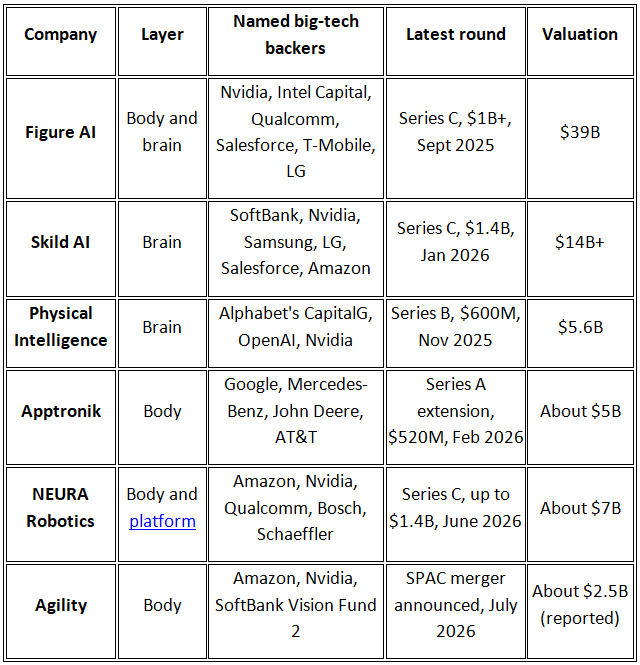
Six names stood out in our review. The table below represents them with comparable metrics, using the most recent data available.
Why are tech giants investing in robotics?
Start with the chips: Jensen Huang has positioned NVIDIA’s emphasis on physical AI as a complement to its data-center dominance, given that synthetic data and simulation require “racks and racks of accelerators.” Robots are another reason to buy GPUs.
Amazon’s rationale is similar but with an emphasis on the cloud: upon its June investment in NEURA, it noted its intent to provide the robotics firm with cloud and AI infrastructure, including Amazon Bedrock and Trainium chips. Amazon Nafea Bshara said the investment reflected the company’s conviction in the transformative potential of Physical AI.
Some of the value is circular: Investment dollars are funneled back into the ecosystem via cloud and compute. Not illegitimate, precisely, but indicative of who gets to benefit most when a round closes.
Meta took a different route, acquiring Assured Robot Intelligence in May and folding its staff into its Superintelligence Labs division. The Verge has since characterized humanoids as the “AR-sized bet” for Meta, while CTO Andrew Bosworth has speculated about a software stack license model akin to Google’s Android for robots.
Jensen Huang speaks of $50 trillion opportunities, but that’s marketing.
How AI is changing the robotics industry?
The new generation of robot is fundamentally different from the last: better able to learn, rather than merely programmed. The catalyst is the vision-language-action model, which takes imagery and natural language as inputs and produces control signals as output.
Nvidia’s open GR00T N1.6 is designed for humanoids, while Google DeepMind has announced Gemini Robotics ER 2, capable of real-time video understanding and multi-robot collaboration, on July 30, 2026.
The economics favor learning over programming: a lighter version of Gemini runs on devices and requires only “50 to 100 demonstrations to learn a new task,” per Sacra’s profile of Apptronik. Meanwhile, at scale, Amazon says new foundation models will improve its fleet performance by 10% (per The Robot Report).
A glance at the financing reveals why: Skild AI does not produce hardware, its model is designed to run across a range of robots; Physical Intelligence does not produce robots either.
A $14 billion valuation for a software company suggests where the profits are expected to be. Even Jensen Huang appeared to hedge: his press release for the January 2026 humanoid robot convention spoke of the “ChatGPT moment for robotics,” but in the investor presentation, per Fortune, he spoke of it as “nearly here.” The difference between the two statements is instructive.
Which companies are leading the robotics industry?
It depends how you measure dominance: if by installed base, Amazon is light-years ahead of the pack, having passed the milestone of one million robots across its logistics network of over 300 warehouses in July 2025, per Automate. Hyundai, the parent company of Boston Dynamics since 2021, has announced the release of an Atlas production model at CES 2026.
If by valuation, Figure leads the pack of humanoid robot makers; if by public market value, look out for Unitree: its recent IPO valuation, per Crunchbase, is worth noting at $905 million at a $9 billion. China as a whole leads the world by a wide margin in robotics venture capital investment, with 43% of global deal value, per Crunchbase.
Tesla is the wildcard: depending on who you ask, the company has anywhere between a couple hundred to over 50,000 Optimus units, but these numbers are not borne out in third-party due diligence. If taken at face value, they suggest that no one outside of Tesla knows what the company is doing.
The pattern is instructive: the companies that lead the pack in terms of installations and valuation are not, generally speaking, the same.
What are the most promising robotics startups to watch?
Anyone compiling a shortlist of the best robotics companies to watch in 2026 would be hard-pressed to leave out the following five, for different reasons.
Skild AI is a pure play on the software layer having raised nearly $1.4 billion in funding led by SoftBank in January 2026 and seeing its valuation triple in the process.
Physical Intelligence, which raised $600 million in November at $5.6 billion in funding led by CapitalG, has seen its valuation discussed in deal talks at as high as $1 billion round at more than $11 billion before its subsequent funding round.
Apptronik is the deepest partnership with Google, which announced in July that data from its Apollo 2 humanoid would contribute to the training of Gemini Robotics.
Agility has the deepest “commercialization” credentials, its Digit robot having delivered over 100,000 totes at GXO, per TFN and planning a merger listing with Churchill Capital Corp XI.
Finally, Mind Robotics, the robotics spinoff from Rivian, has seen a $500 million Series A led by Accel and arieessen horowitz, per Crunchbase.
Is the investment in robotics outpacing its practical applications?
Some of it certainly is: Figure’s $39 billion mark dates to September 2025 and no new primary round has priced it since. Secondary quotes ranged from $162 to $194 a share between June and September 2026, a spread that tracker called noisy rather than a verdict.
NEURA's "up to $1.4 billion” is contingent on specific milestones, per CNBC.
Much of it depends on who is doing the counting: Crunchbase has 2026 robotics startup funding at $18.8 billion by late June, against $15 billion for the year to date, vs. $55.8 billion, per Dealroom, for the same period.
The giants are not immune to setbacks: Amazon has all but terminated its Blue Jay sortation project after six months, per The Robot Report.
None of this detracts from the rise of the industry as an unprecedented boom, but it helps to put it in perspective.
Physical AI is AI that takes effect in machinery, from warehouse automation to humanoids.
Vision-language-action models are the software layer which enables robots to perform tasks.
Agility Robotics changed its name to Agility on March 5, 2026.
Mobileye has agreed to acquire Israeli humanoid start-up Mentee Robotics for roughly $900 million and XPeng's physical AI unit raised over $900 million at a $6.3 billion valuation, per Crunchbase and AI News.
First-half 2026 funding was dominated by 521 venture capital deals, according to Crunchbase, with the total value reaching $47.4 billion in funding raised.
Where to go from here?
The best robotics companies of 2026 are a funding map rather than a product roadmap: Nvidia, Amazon, Google, Meta and a few other groups are diversifying their bets across multiple avenues and harvesting the prize in chips, cloud and options on the winner; Figure, Skild, Apptronik, NEURA and Physical Intelligence are the robotics companies backed by major tech giants like Amazon, Hyundai and Agility the ones with working robots.
Business Fortune tells readers to put these two lists in your head and cross-reference them against your company and you will see which companies have the potential to evolve from pilots to production.


.webp)




























Comments