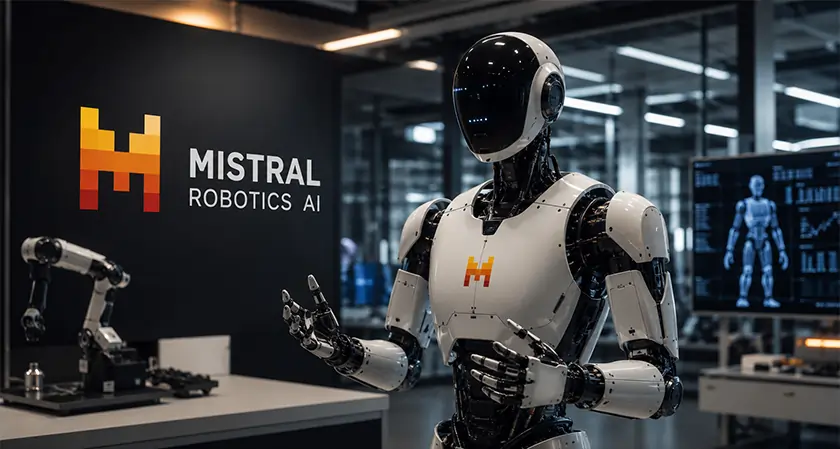
Mistral robotics AI launches Robostral Navigate, a new camera-only navigation model that helps robots move through factories and warehouses using simple language instructions.
Mistral robotics AI is taking a major step beyond language models with the launch of Robostral Navigate, the company's first robotics-focused AI system. Developed by the Paris-based startup, the new model is designed to help robots move through factories, warehouses, and other indoor spaces using just a single camera and simple language instructions. Founded in 2023 by former researchers from Google DeepMind and Meta, Mistral has quickly become one of Europe's most prominent AI companies.
The launch marks Mistral's entry into the rapidly growing field of physical AI, where companies are developing software that allows machines to understand and interact with the real world. Unlike many robotic navigation systems that rely on expensive hardware such as LiDAR sensors or multiple cameras, Robostral Navigate works with a standard RGB camera, potentially lowering deployment costs for businesses.
A Simpler Approach to Robot Navigation
Robostral Navigate focuses on helping robots find their way through unfamiliar environments rather than handling or manipulating objects. The model processes camera images alongside human instructions, allowing robots to move autonomously while following directions. According to Mistral, the system achieved a 76.6% success rate on the Room-to-Room Continuous Environment (R2R-CE) benchmark, a widely used test that measures how effectively an AI system can follow navigation instructions in environments it has never encountered before.
"Our goal is to make robotic navigation more accessible and adaptable across different environments and robot platforms," Mistral said while introducing the model.
The company added that the model was built entirely in-house and trained using simulated environments, enabling it to work across robots of different shapes and sizes.
Could One Camera Be Enough for Industrial Robots?
One of the most notable features of Robostral Navigate is its ability to operate without specialized navigation hardware. The model has already been tested on wheeled robots, legged machines, and aerial vehicles. When navigating, the system identifies target locations within its field of view. If the destination is not visible, it automatically switches to movement commands that guide the robot toward the intended location.
This flexibility could make the technology useful in manufacturing plants, logistics centers, delivery operations, hospitality settings, and other industries where autonomous movement is becoming increasingly important.
Building a Stronger Robotics Future
The launch comes shortly after Mistral acquired Austrian startup Emmi AI, a company known for developing physics-based simulation software for engineering and industrial applications. The acquisition strengthens Mistral's ambitions in robotics and industrial AI.
With Robostral Navigate, Mistral is bringing AI-powered navigation to industrial robots without requiring costly sensor setups. By combining a single camera with language-based instructions, the company aims to make robotic automation more practical and accessible. As Business Fortune observes, industries continue investing in smarter machines and Mistral's latest innovation could play an important role in shaping the next generation of autonomous robots.
FAQs
What is Robostral Navigate?
Robostral Navigate is Mistral AI's first robotics AI model, designed to help robots navigate indoor environments using a single camera and language instructions.
How is it different from traditional robot navigation systems?
Unlike many existing systems, it does not require LiDAR or multiple sensors. It relies mainly on a standard RGB camera.
What industries can benefit from this technology?
Manufacturing, warehousing, logistics, delivery services, hospitality, and industrial automation sectors can potentially use the technology.
How well does Robostral Navigate perform?
Mistral reported a 76.6% success rate on the R2R-CE benchmark, which evaluates how effectively robots follow instructions in unfamiliar environments.
Why is Mistral's move into robotics important?
The launch expands Mistral's focus beyond language models and positions the company in the growing market for physical AI and industrial automation.


.webp)





























Comments