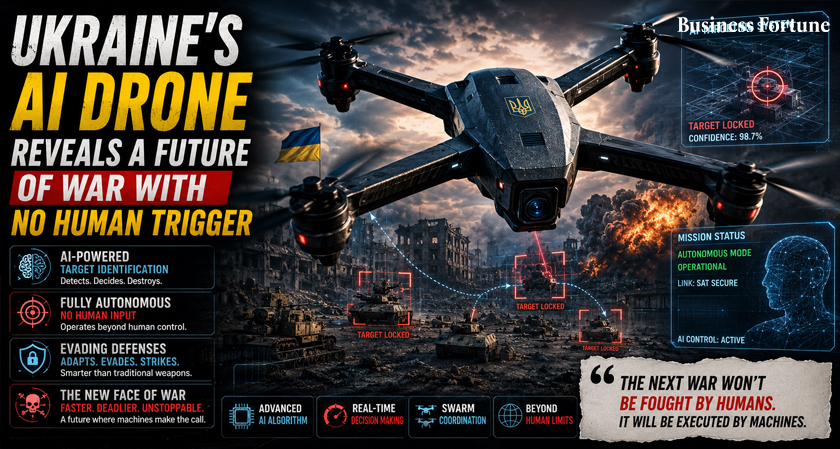
Ukraine's AI drone reportedly carried out a fully autonomous battlefield test, reigniting global debate over AI-powered weapons, military ethics, and the future of modern warfare.
For years, experts warned about a future where machines could decide who lives and who dies in war. Now, that future may have already arrived. A Ukrainian drone developer has revealed that Ukraine's AI drone technology was used in a battlefield test that reportedly killed Russian soldiers without any human involvement during the final attack decision.
The disclosure came from Alexander Kokhanovskyy, CEO of Ukrainian drone maker Aero Center, during a press event hosted by the Ukrainian Embassy in London. According to him, the test took place about two years ago near the cities of Bakhmut and Chasiv Yar during a Ukrainian counteroffensive.
A Battlefield Experiment Unlike Any Before
Kokhanovskyy said 10 AI-controlled quadcopter drones were launched toward a designated area. The drones traveled between 3 and 5 kilometers before switching into what he described as "Terminator mode."
In this mode, the onboard artificial intelligence independently searched for targets, identified them, and carried out attacks without receiving instructions from a human operator. "We just launch it and we know everything will be dead," Kokhanovskyy said, explaining that there was no live video feed or communication link with the drones once they entered autonomous operation.
After the mission, human-operated drones were sent to assess the area. According to Kokhanovskyy, they found casualties that included Russian soldiers and a military truck.
Why Is This Revelation So Significant?
Most military drones today still require a human to approve a strike, even when AI assists with navigation or target tracking. This reported test is different because the final decision to attack was made entirely by software. Weapons experts say this could be the first publicly acknowledged case of a fully autonomous weapon system selecting and engaging human targets without direct human control.
Key details from the test include:
- 10 AI-controlled quadcopter drones were used.
- The drones flew autonomously after reaching a designated area.
- No live monitoring or communication was possible during the mission.
- The test was described as a one-time experiment.
The Debate Over Autonomous Weapons Is Growing
The revelation is likely to intensify global discussions about the ethics and legality of autonomous weapons. Ukraine currently requires human verification before a lethal strike can be carried out, and fully autonomous attacks are not permitted under existing regulations. Despite those restrictions, Kokhanovskyy said he would prefer to operate without that requirement. Ukraine's Ministry of Defence has not commented on the reported test.
As Business Fortune observes, AI continues to advance, militaries around the world are investing heavily in autonomous systems. The challenge ahead will be determining how much control humans should retain as warfare increasingly moves from human judgment to machine decision-making.
FAQs
- What is a fully autonomous drone?
A fully autonomous drone can identify, select, and attack targets without human control during the engagement process. - Where did the reported test take place?
The test was reportedly conducted near Bakhmut and Chasiv Yar in eastern Ukraine. - How many drones were involved?
According to the developer, 10 AI-controlled quadcopter drones participated in the experiment. - Are autonomous lethal drones currently legal in Ukraine?
No. Ukrainian regulations require human verification before a lethal strike is executed. - Why is this event considered historic?
It is being described as the first publicly acknowledged case of a fully autonomous weapon reportedly killing human targets without direct human involvement in the attack decision.


.webp)