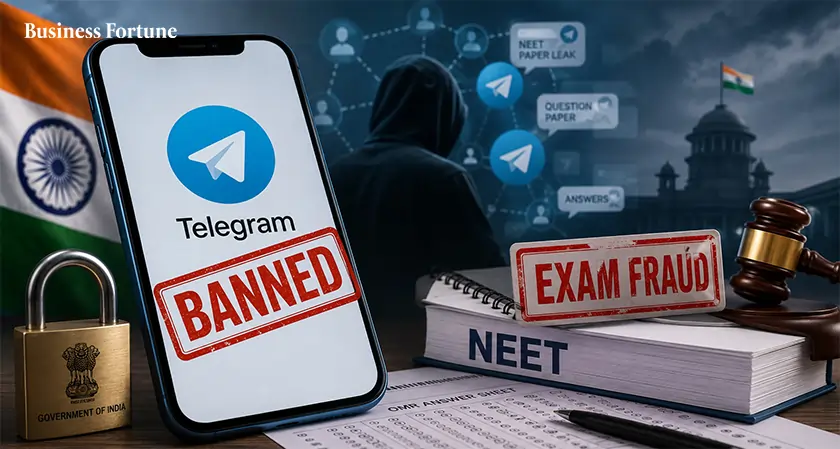
India’s Telegram restriction sparks a major debate as authorities target cheating groups while questions grow over digital regulation.
India bans Telegram has become an important move after officials temporarily restricted access to the messaging platform due to worries that it was being used by groups engaging in examination fraud. Prior to the re-conducted National Eligibility cum Entrance Test Undergraduate (NEET-UG), the decision was made in response to concerns that question papers had been leaked and misleading claims were circulated through digital platforms.
The National Testing Agency (NTA) expressed concerns about cheating networks using Telegram channels and groups to target students taking the medical entrance exam, which led to the implementation of the prohibition. According to the government, the action was taken to protect the validity of the testing procedure and stop dishonest behavior prior to the planned retest.
After officials looked into claims of question paper leaks and irregularities, the original NEET-UG exam was cancelled. The ruling had an impact on millions of applicants, forcing officials to set up a new test and strengthen supervision.
Could the Telegram restriction address concerns linked to NEET paper leaks?
India temporarily ban Telegram was implemented as part of a larger effort to keep cheating networks from operating during the re-examination session. In addition to limiting access to the platform, officials ordered Telegram to temporarily suspend its message editing capability in India due to worries that altered messages would be used to fabricate claims about leaked papers that had been made public.
The controversy has also sparked a renewed discussion about the regulation of digital platforms in high-stakes exams. Opponents have questioned if limiting a whole platform is the best course of action, while officials contend that doing so may make it harder for fraud groups to reach candidates.
Allegations of a NEET paper leak have increased pressure on examination authorities to bolster security measures and increase openness. The government has insisted that the major goals of the temporary limits are still to protect students and ensure a fair test environment.
As debates about accountability, digital governance, and preventing examination-related fraud persist, Telegram has come under criticism and scrutiny. Authorities will continue to keep an eye out for potential abuse of internet platforms, and the temporary limitation is anticipated to stay in effect until after the re-examination period.
Thus, Business Fortune is of the view that India’s Telegram restriction highlights the need for stronger digital safeguards in examinations.
FAQs
Why was Telegram temporarily blocked in India?
Telegram was restricted due to concerns that cheating networks were using the platform to spread fraudulent exam-related information.
Which examination was linked to the Telegram restriction?
The restriction was connected to the NEET-UG re-examination conducted for medical college admissions.
Was the NEET examination cancelled earlier?
Yes, the earlier NEET-UG examination was cancelled after allegations of question paper leaks and irregularities.
How long was Telegram access restricted?
The restriction was announced as a temporary measure covering the period around the NEET re-examination.
Did the government restrict any Telegram features besides access?
Authorities also directed Telegram to limit message editing features for a specific period to prevent misuse.


.webp)