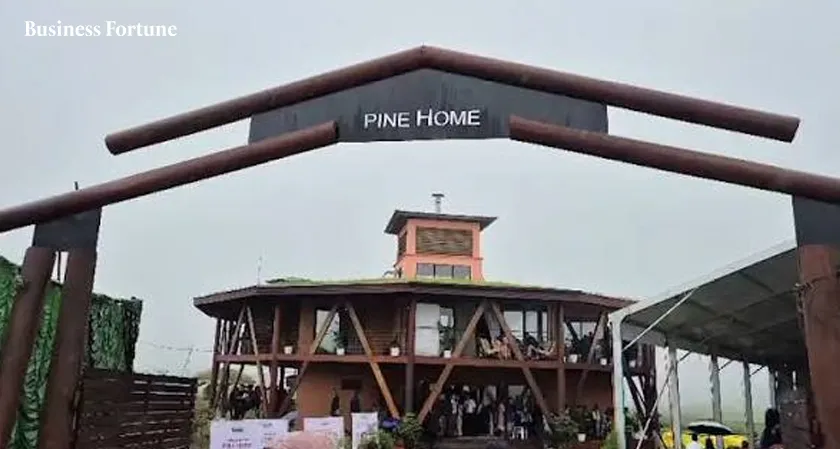
Meghalaya’s Pine house emerges as a new icon of sustainable tourism as Chief Minister Conrad K. Sangma inaugurates the state’s first eco-sustainable habitat at Mawlangwir village in South West Khasi Hills.
Meghalaya’s Pine House, an eco-tourism model project, is a confluence of local skills, innovation and traditional and contemporary architecture. The government is also promoting this as a climate resilient model of construction.
Locally crafted, modern day architecture
The Pine Home was constructed with the skills of local masons and artisans and the design expertise of Slovakia-based Emage Architecture Studio and Picassso Pupils Art Society along with the Saitsnad Multipurpose Co-operative Society.
Use of locally available resources such as wood and brick has been encouraged in this project. In addition to this, recycled wool has been used for insulation in the walls to trap heat. During the inauguration function, Chief Minister Conrad K. Sangma said, “The role of the government is to create the ecosystem so that communities and enterprises thrive. Our role is limited to creating the ecosystem and facilitating the support systems – policy, resources and others so that organizations and enterprises flourish.”
Community based tourism initiatives
This Pine House eco-tourism model project has been linked to the Meghalaya Homestay Mission which targets promoting community based homestay tourism and provides financial assistance to host families who adopt tourism friendly accommodation practices.
During the inauguration function, 15 beneficiaries were given sanction letters amounting to Rs.10 lakh each under the CM’s Homestay scheme while three tourism societies also received Rs.5 lakh each to develop tourism circuits. The objective is to leverage tourism to generate economic benefits for local communities.
Heritage conservation efforts
On the occasion, the chief minister also laid the foundation for the remote inauguration of the Twahlongwar Open Museum at Mawsynram. This museum complex preserves the archaeological finds of the 18th century ancient Khasi village. The museum has more than 20 ancient structures, megaliths, an ancient market place, an iron smelting furnace and ancient trade routes. Grants of Rs.63 lakh have been sanctioned for the development of the museum. Conrad K. Sangma also announced a Rs.20 core project for involving research institutes and Deoxyribonucleic Acid experts to document the history of Khasi, Pnar and Garo communities.
Looking forward to a bright tourism future
While Meghalaya’s Pine House is an innovative experiment in conserving local traditions even as it embraces modernity, the state is now eyeing to make its tourism sector more sustainable and inclusive.
“We are heading in the right direction. I feel people have started believing that Meghalaya can change for the better,” said the Chief Minister.
Business Fortune believes that for Meghalaya, the Pine House is a step towards a sustainable and responsible future.
FAQs
What is Meghalaya’s Pine House?
Meghalaya’s Pine House is the state’s first eco-sustainable habitat. Also called Pine Home, this eco tourism project is situated at Mawlangwir village.
How much did the Pine House cost?
The eco-friendly accommodation facility has been developed at a cost of Rs.4 crore by the Meghalaya government.
What makes the Pine House eco-friendly?
This sustainable residential project uses locally available wood and bricks for its construction. In addition to this, recycled wool has been used for insulation in the walls to trap heat.
What is the Twahlongwar Open Air Museum?
The Twahlongwar Open Museum is an archaeological tourism circuit that preserves the 18th century ancient Khasi village at Mawsynram.
How will local communities benefit from the Pine Home project?
Under the Meghalaya Homestay Mission, local communities would be able to benefit from host family schemes, tourism societies, local mason skills and other community based tourism schemes.


.webp)




























Comments