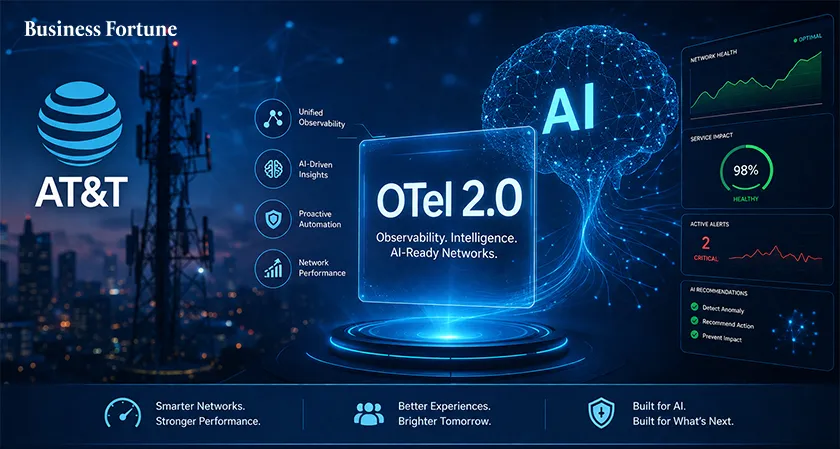
AT&T launches OTel 2.0, a telecom-focused AI model built for faster, cheaper network operations. Here's why experts believe it could reshape the future of AI in telecom.
AT&T launches OTel 2.0, a new open-source telecom AI model designed specifically for network operations, customer service, fraud detection and business workflows. Imagine asking an AI to solve a telecom problem, only to realize it doesn't understand how telecom networks actually work. That's been one of the biggest challenges for phone companies trying to use AI.
The announcement was made during AMD's Advancing AI 2026 keynote, where AT&T Chief Technology Officer Jeremy Legg revealed that the company now processes more than one trillion AI tokens every month across over 100 generative AI models already running in production.
Unlike general AI systems that often struggle with telecom data, OTel 2.0 has been trained using 400 billion telecom-specific tokens. It was developed with support from the GSMA, Microsoft, AMD, Dell, and Red Hat, making it one of the largest open AI projects focused on the telecom sector.
A telecom AI built for real-world problems
AT&T says the model can understand technical network documents, vendor data, and telecom standards much better than traditional AI systems. The company also introduced an AI Gateway capable of processing 45 billion tokens every day, helping reduce AI inference costs by as much as 90% through smarter routing.
Speaking at the event, Jeremy Legg explained the company's long-term vision. "You need as an enterprise to manage your data. Your data is your fuel. We don't want to be tied to one chipset, one model, or one development platform."
That approach allows AT&T to run workloads across AMD and Nvidia hardware while choosing the most cost-effective AI model for each task.
Why does this matter beyond AT&T?
The telecom industry has struggled to use AI effectively in network operations. Industry research from GSMA suggests that only a small share of telecom AI deployments currently support core network management because most general-purpose models lack telecom knowledge.
AT&T believes specialized AI can solve that challenge. Today, the company already uses AI to analyze more than 300,000 customer calls every day, detect fraud, improve customer support, and even decide where future cell towers should be built. It also says its AI investments are delivering roughly twice the return in free cash flow, showing that focused AI projects can produce measurable business value.
Business Fortune believes OTel 2.0 could become a blueprint for how other industries build specialized AI. As businesses focus on lower costs, better accuracy, and greater control over their data, purpose-built AI models may become the new standard rather than the exception.
FAQs
What is OTel 2.0?
OTel 2.0 is AT&T's latest open-source AI model family designed specifically for telecom operations, customer service, fraud detection, and network management.
Why is OTel 2.0 different from general AI models?
It is trained on telecom-specific data, allowing it to understand network standards, technical documents, and telecom operations more accurately than general-purpose AI.
How much AI does AT&T use today?
AT&T processes more than one trillion AI tokens every month across over 100 production AI models and analyzes more than 300,000 customer calls daily.
What is the AI Gateway introduced by AT&T?
The AI Gateway is a routing system that processes around 45 billion tokens each day while helping reduce AI inference costs by up to 90%.
Why are telecom companies investing in specialized AI?
Specialized AI models deliver better accuracy for industry-specific tasks, improve efficiency, lower operating costs, and provide greater control over sensitive business data.


.webp)





























Comments