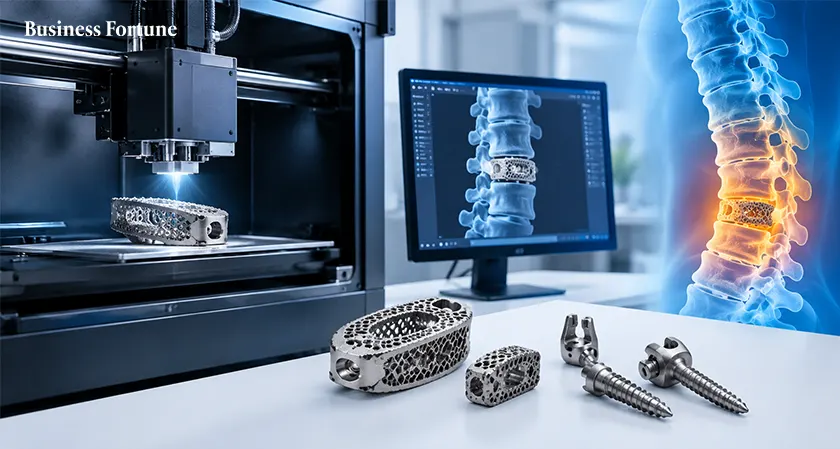
NovaSpine’s latest spinal implant marks a major step in medical manufacturing, with 3D Systems helping speed up production and regulatory readiness.
NovaSpine DIVA 3D One, a spinal implant developed by French medical device company NovaSpine, has advanced toward commercialization through its long-standing partnership with 3D Systems. This collaboration has led to the production of highly complicated titanium implants in an ISO 13485 certified factory of 3D Systems in Leuven, Belgium. Since 2015, a total of more than 30,000 implants have been produced from eight different lines of devices.
This example demonstrates how metal 3D printing is facilitating the industrialization process for medical technology companies.
How Did the Partnership Accelerate Implant Production?
NovaSpine collaborated with 3D Systems’ Application Innovation Group (AIG) to accelerate the development process of their DIVA 3D One spine implant. This development project demanded coordinated efforts from all the aspects related to design review, industrialization, regulatory documents, and validation through the EU MDR framework.
The AIG team provided technical recommendations and engineering feedback from the earliest prototyping stages. This support helped define the project scope and establish a production framework that met the required standards for material certification, inspection, quality assurance, and regulatory compliance.
Following the preparation of the manufacturing process, the first production order was completed at 3D Systems’ advanced manufacturing facility in Leuven. The team used validated DMP Flex 350 Dual metal 3D printers and Grade 23 titanium to manufacture the implantable devices.
The first approved implants were delivered in less than six months from the project's start. However, this timeline represents a standard application and may vary according to device complexity, validation requirements, and the number of review cycles involved.
How Does Metal 3D Printing Support Medical Implants?
The Flex 350 Dual from DMP is an additive manufacturing machine that creates complicated medical parts out of biocompatible metals. The functions of the Flex 350 Dual include making complicated one-piece lattices that facilitate the osseointegration of the implant and the bone.
This technology also allows patient-specific implants to be designed, giving more freedom to healthcare devices manufacturers in designing solutions for various needs. The use of grade 23 titanium is important in implant manufacturing due to its well-known application in challenging biomedical applications.
According to Pascal Khalifé, CEO of NovaSpine SAS, 3D Systems’ ability to meet demanding technical requirements helps accelerate industrialization and reduce time to market for complex medical devices. He also highlighted the engineering team's contribution to improving production efficiency while maintaining performance and safety standards.
Currently, NovaSpine offers a variety of 3D-printed titanium implants in more than 25 countries. The international growth of the company has involved Brazil, as it was certified by ANVISA in 2025.
This collaboration highlights the potential role that engineering expertise, certified additive manufacturing technologies, and regulatory readiness can play to facilitate the transition of sophisticated implant devices from development into production.
Thus, Business Fortune believes that NovaSpine’s partnership with 3D Systems highlights how advanced 3D printing can accelerate medical innovation while maintaining safety and quality.
Sources: https://3dadept.com/novaspine-brings-a-3d-printed-spinal-implant-to-market-in-under-six-months/
FAQs
What is NovaSpine DIVA 3D One?
NovaSpine DIVA 3D One is a spinal implant developed by NovaSpine using advanced implant manufacturing technologies.
Who manufactures the DIVA 3D One implant?
NovaSpine collaborated with 3D Systems’ Application Innovation Group to industrialize production at its Leuven facility in Belgium.
Which material is used to manufacture the implant?
The production process uses Grade 23 titanium, a material used in biomedical applications.
How long did the project take to deliver the first approved implants?
The first approved, implantable devices were delivered in less than six months, although timelines depend on project requirements.
In how many countries does NovaSpine operate?
NovaSpine offers its 3D-printed titanium devices in more than 25 countries and expanded into Brazil following ANVISA certification in 2025.


.webp)































Comments