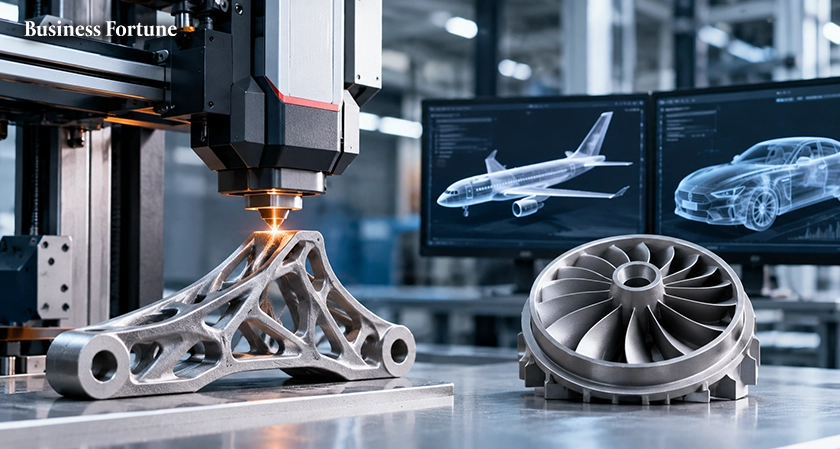
Discover how 3D printing in manufacturing is changing the way aircraft and vehicles are designed and built. Explore its real-world applications, key benefits, production challenges, and the innovations shaping the future of aerospace and automotive industries.
From the skies down to the roads, there’s been a great revolution in the manufacturing process. Manufacturers are making use of 3D printing to make light-weight airplane parts, strong vehicle parts, and even designs that were never possible before. 3d printing in manufacturing gives engineers more freedom to experiment with designs, reduce material waste. In this Business Fortune article, we explore how 3d printing in manufacturing is transforming the aerospace and automotive industries, the benefits it brings, the challenges it faces, and what its future could look like.
Understanding the Role of 3D Printing in Modern Manufacturing
For decades, manufacturing has been about the cutting, forming, and assembly of parts to form a final product. Though these techniques continue to be significant, 3D printing offers another approach to manufacturing.
Also referred to as additive manufacturing, 3D printing involves making an object piece by piece based on the digital design. It involves adding materials rather than subtracting material from a block to form the component. This begins with creating a 3D model with the help of a computer. Afterward, the printer prints the object using various materials, such as plastics or metals.
Based on the type of product being used, the completed piece will undergo further processing like cleaning, heat treating, machining, and testing. The uniqueness of the technology lies in its flexibility for engineers who are allowed to make complex shapes that are hard to achieve via conventional techniques, as well as unite different parts into one or experiment with different models without the need for costly tooling.
3D printing in aerospace
There are several sectors where the impact of the additive manufacturing technology is significant, but aerospace remains one of the best examples. Parts produced for aircraft or spacecraft must be light-weighted, strong, and reliable. Any decrease in weight will improve the performance and payload capacity of aircraft.
Manufacturing can produce such parts using traditional methods, although some designs would involve many steps in the manufacturing process and many different parts to assemble. Using 3D printing provides designers with greater flexibility for creating complex designs while minimizing the parts.
Where is 3D printing used in aerospace?
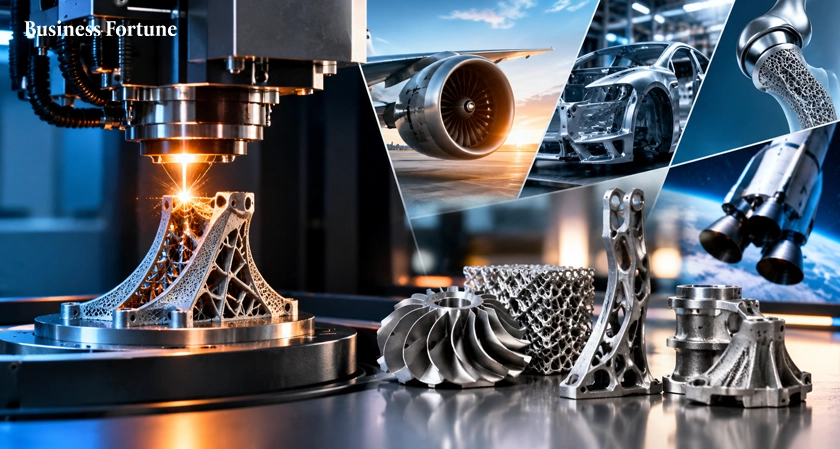
An interesting area of application is the manufacture of airplane engines. The parts used there need to withstand tough conditions such as heat and pressure. With metal 3D printing, it becomes possible for engineers to create parts with intricate designs and structure.
Yet another application is interior parts of airplanes. It will be possible to print interior cabin fittings, brackets, air ducts, seat parts, and many other parts using 3D printing technology. The advantage here is that the parts made in this way are lighter and have better using space.
This technique is also very helpful in making satellites and spacecrafts. Engineers are able to manufacture specialized brackets, housing, and other parts according to the desired specifications. In some situations, several different parts can be manufactured as one single part using printing.
One such benefit is that aerospace companies can manufacture certain parts as required rather than maintaining stock of all the different parts. This may prove especially advantageous in the case of old aircraft, wherein obtaining specific parts may prove to be troublesome.
There have been some standards for controlling the processes of additive manufacturing for space flight hardware as well. The standards include the equipment, materials, processes, and inspection processes involved. The following is a very vital consideration to make at this point: manufacturing of aerospace hardware is not just printing out a part.
How does it improve aircraft performance?
One of the major reasons for aerospace companies being interested in 3D printing technology is weight reduction. Reduced weight will lead to better fuel efficiency and increase the payload carried by the plane.
Another advantage of using this technology is that it enables designers to create lighter internal structures, but still retain the needed strength to perform the task. It is particularly useful when designing complex parts made of expensive materials like titanium.
The guidelines that the Aerospace Industries Association provided for additive manufacturing certification in 2025 similarly indicate the increasing attention paid to producing printing products that can be used in aerospace applications.
3D Printing in the Automotive Industry
Another sector where 3D printing technology has brought a revolution is the automotive industry. Car manufacturers are constantly in search of ways to produce lighter cars with enhanced performance and lower production cost along with quicker time-to-market for the new range. 3D printing in the automotive industry helps in achieving these objectives through providing greater flexibility during design and development phase.
1. Faster vehicle development
The process of developing and testing various components takes place before an entirely new automobile is put into the market. Making a prototype in the conventional sense of the term would take lots of effort and expense.
However, using 3D printers, engineers are capable of making physical models based on their digital design. They are able to see whether there are any issues with the form, fit, and functionality of a particular part. Therefore, it becomes possible to change the model in advance of production.
2. Lighter and more efficient components
The weight of the vehicle influences the fuel economy, handling, and the overall performance of the car. In the case of electric cars, the manufacturers are striving to increase the range and improve energy efficiency.
Three-dimensional printing enables creating parts with an optimized form and structure of the inside. 3D printing could assist in unifying several small parts into one, thus not requiring any additional connectors and assembly. For example, printed brackets, air ducts, interior parts, and unique structural elements.
3. Better production tools and equipment
One of the most useful applications of 3D printing within automotive manufacturing plants is the making of tools and equipment.
The purpose of tools is to enable workers to properly assemble vehicle parts. It takes quite some time to make the traditional kind of tools, particularly where changes have to be made to their designs. By using additive manufacturing, companies are able to make tools customized for their production lines much faster. In addition, they can also be lighter and thus easier for the workers to work with.
For example, Stratasys has illustrated how automobile makers use 3D printed tools to make their assembling procedures better. Examples include Ford, General Motors, and other automotive companies.
4. Customization and replacement parts
All automotive components don't have to be made in such large quantities. There are some vehicles that use special components especially when it comes to performance vehicles, limited editions, and vintage automobiles.
The use of 3D printing makes smaller quantities viable since there is no need for investment in costly molds and tools in most cases. It may be used for the production of spare parts for vintage automobiles since finding original parts may be challenging at times. It gives manufacturers and restoration companies an alternative means of satisfying customer demands.
For example, Volkswagen has applied 3D printing technology throughout its development process as well as in the production process.
Why Are Manufacturers Investing in 3D Printing?
This increasing enthusiasm about 3D printing is not about creating peculiar shapes alone. This is about solving practical manufacturing issues and improving efficiency in production. Here are some of the biggest advantages:
Less material wastage: Traditional manufacturing requires the removal of substantial material while creating a part. With 3D printing technology, material is added in layers that can help reduce wastage.
Less time to manufacture: Companies are able to make prototypes and some customised parts without having to wait for conventional tooling.
More flexibility in design: Engineers have greater freedom in designing complex shapes, cavities, and lighter materials.
Reduced stock levels: Specific spare parts can be produced as needed, saving on huge stock levels.
Customising easier: It becomes easier for companies to customise designs without altering their entire manufacturing process.
As per the US National Institute of Standards and Technology (NIST), the use of additive manufacturing technology helps with economic aspects of low volume production and manufacturing complex components.
What Challenges Still Need Attention?
Despite its benefits, 3D printing is not a replacement for every traditional manufacturing process. The cost of industrial printers, specialized materials, and maintenance can be high. Producing large quantities of identical components may also be more economical through established manufacturing methods.
The issue of quality control is also essential. The printed item should be strong and have certain dimensions and material characteristics. It is especially important for aerospace industry when any mistake during the manufacturing process can lead to something really serious.
The production process will depend on the size and complexity of the part to be manufactured. Some of the components can be produced for a long period of time ranging from several hours up to several days.
It is necessary for manufacturers to create teams who know all about the digital design, materials used in the process of production, the process itself and quality control.
What Does the Future Hold for 3D Printing in Manufacturing?
The future of 3D printing technology will be based on how the manufacturers will manage to integrate the technology into their existing manufacturing processes.
For example, aerospace companies are most likely to invest more time in researching the use of the technology in making light-weight components, engine systems, spacecraft components, and even spare parts.
In the automotive sector, the technology could support electric vehicle development, customised components, production tools, and specialised spare parts. As manufacturers explore new vehicle designs, the ability to test and improve components quickly will remain valuable.
A significant trend worth mentioning is the increasing integration of 3D printing with AI and automation technology, which can be used for better design solutions, control over the manufacturing process, and detection of potential problems with quality. Nevertheless, conventional manufacturing will remain relevant, especially when it comes to mass production. The key point here is to combine various approaches.


.webp)





























Comments