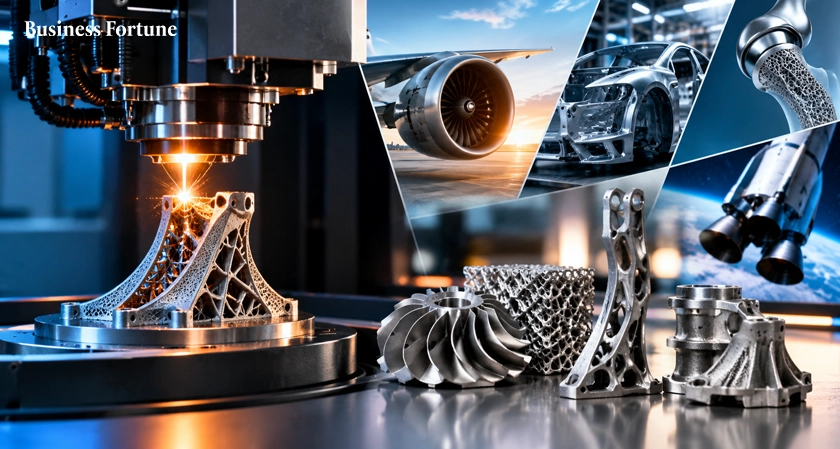
Curious about the companies turning digital designs into real metal parts? Come along as we explore the top metal 3D printing companies, the technology and the industries discovering new possibilities in 2026.
Imagine if a metallic component could be manufactured differently, using fewer materials and made into complex shapes that normal manufacturing equipment cannot achieve. This is the kind of benefit that metal 3D printing brings about. From aircraft parts to medical instruments and industrial equipment, the technology is providing new ways for the manufacture of various products. In this Business Fortune article, we explore the top metal 3D printing companies, how the technology works, where it is being used, and what businesses should consider before investing.
What is metal 3D printing and how does it work?
Metal 3D printing is a manufacturing process that creates parts directly from a digital 3D design. Instead of cutting a shape out of a solid block of metal, the printer builds the part layer by layer.
One of the most widely used methods is laser powder bed fusion. In this process, a thin layer of metal powder is spread across a build plate. A powerful laser then melts selected areas based on the digital design. The build plate moves, another layer of powder is added and the process goes on until the part is complete.
After printing, the part usually needs additional work. This can include removing support structures, heat treatment, machining, polishing, inspection, or other finishing steps.
There are also other approaches. Some systems use bound metal powder that is later processed to create a finished metal component. Markforged's Metal X, for example, uses Bound Powder Extrusion, where metal powder is combined with a binder and printed before further processing. The basic idea is in metal 3D printing is to use digital information to place material only where it is needed.
Top metal 3D printing companies in 2026
This particular market includes printer manufacturers, software providers, material specialists, and companies that offer complete production services. The following names have an important presence in the metal additive manufacturing space.
EOS
EOS is one of the established names in industrial metal additive manufacturing. Its systems use Direct Metal Laser Sintering, commonly known as DMLS, to produce metal parts layer by layer.
The company offers systems across different production sizes, from smaller machines to large platforms designed for industrial production. Its portfolio consists of materials like aluminum, titanium, nickel alloy, stainless steel, copper, and tool steels. EOS claims that its portfolio includes more than 35 alloys and over 100 processes.
Also, EOS is concerned with the entire production process. These consist of material, software, consulting, training, automation, and post-processing. This is important since successful industrial 3D printing is not just about purchasing the printer.
Nikon SLM Solutions
Nikon SLM Solutions is another major name in industrial metal additive manufacturing. The company manufactures selective laser melting systems for use in a wide range of industries such as aerospace, space, automotive, and energy.
The current product line consists of highly productive multi-laser systems which are capable of producing metals on a larger scale. Its connection with Nikon also brings together additive manufacturing with areas such as precision measurement and advanced manufacturing.
3D Systems
3D Systems has been providing 3D printing services for many years and provides metal additive manufacturing using its Direct Metal Printing process. Its range of metals includes titanium, stainless steel, copper, nickel super alloys, cobalt chrome, aluminum alloys, maraging steel, and refractory metals. The company also provides software and manufacturing services alongside its machines.
The company's current work also shows how metal printing is moving toward larger industrial applications. In August 2026, 3D Systems announced a $9 million U.S. Air Force contract for an advanced large-format metal 3D printing system.
Renishaw
The UK-based company Renishaw manufactures metal additive manufacturing systems based on the process of powder bed fusion. This technology uses a high powered fiber laser to melt metal powder in order to produce parts using CAD (computer aided design) information. The company produces various components using titanium alloys, cobalt chrome, stainless steel, nickel alloys, and aluminum alloys. Renishaw also uses additive manufacturing in various applications including aerospace, automotive, tooling, healthcare, and manufacturing industries.
TRUMPF
TRUMPF brings its experience in industrial lasers and manufacturing equipment into metal 3D printing. Its portfolio includes TruPrint systems based on laser metal fusion and solutions using laser metal deposition.
The company offers systems for different production needs, from compact machines to larger industrial platforms. It also works with materials such as steel, titanium, aluminum, nickel alloys, copper, and other metals.
One area that makes TRUMPF interesting is copper printing. Its TruPrint 5000 Green Edition combines a green laser with metal additive manufacturing to process copper and copper alloys.
Markforged
Markforged takes a different approach to metal printing with its Metal X platform. Rather than relying on a traditional loose-powder laser process, the system uses bound metal powder.
The Metal X printing method uses metal powder mixed with a binding agent, and prints it in a manner similar to filament printers in 3D printing. After printing, the part undergoes more processing before it becomes ready for use. This makes it easier for firms to undertake their own metal printing in cases where it is necessary to do so.
Materialise
Materialise is popular with its software and additive manufacturing knowledge. The significance of the involvement of Materialise in metal printing lies in the fact that software, design, manufacture planning, and control can have great influence on the end results of the process.
The company provides metal manufacturing and materials like titanium alloys. In addition, its 2026 work is another proof of the growing transition from experimenting to production.
What are the best metal 3D printing technologies?
The correct answer depends on the metal, part size, production volume, needed precision, surface finish, and budget.
Electron Beam Powder Bed Fusion (LPBF) is used mostly to create complicated industrial parts. It uses a laser to melt the metal powder layer by layer. LPBF may be suitable when manufacturers require complicated shapes, cavities, light parts, and other complicated parts.
Electron Beam Powder Bed Fusion (EBPBF) uses an electron beam rather than a laser. It can be suitable for some high-performance materials and applications where heat control is essential.
Directed Energy Deposition (DED) puts metal material into a concentrated energy source. DED can be used for repair, material deposition, and creation of large parts.
Bound metal printing involves metal powder with a binder. It can give another way for companies that want a simpler process for some parts. Therefore, the best technology depends on the task rather than the latest machinery.
What are the benefits of metal 3D printing?
The first big advantage is freedom of design. Engineers will be able to come up with designs which could otherwise not be possible using traditional machining or casting.
Weight savings is another important benefit. The component can be redesigned such that there are internal structures or lattices which save on material without compromising performance.
Tooling costs may be reduced as well through metal 3D printing. This can prove especially helpful for prototypes, custom parts, replacements and small-scale production.
Part consolidation is another benefit. Several components that previously needed to be manufactured and assembled separately can sometimes be redesigned as one printed component.
There is also a time advantage during product development. The engineers can digitally change the design to create a different product without having to create all new molds and tools.
However, the process is not going to be any cheaper or faster because machines, metal powder, energy, post-processing, testing, and labor raise costs.
What should businesses look for in metal 3D printing manufacturers?
First, manufacturers should evaluate what materials the system uses. The printer may look cool, but there is no point in having it if it cannot deal with the metals that will be used in the application.
Second, consider build size and production volume. A small printer may be suitable for prototypes, but a factory manufacturing lots of components will require a larger multi-laser printer.
Software and processes monitoring should also be taken into account. The process itself must provide a possibility for engineers to design, control the build process, monitor the production, and analyze the results.
Post-processing is something else that should be taken into account. Usually, any metal part requires either heat treatment, machining, surface treatment, or testing.
Finally, companies should think about technical support and training. Metal additive manufacturing needs a lot of knowledge, safety and quality control.
The future of metal 3D printing technology
Metal 3D printing needs to increase in productivity, repeatability, and integration into regular factory production. Increased machine speed is just one aspect of this change. Improved software, automatic powder handling, process control, material improvements, design optimization, and quality systems are equally important. The next phase will be more concerned with the question of whether the metal part can be printed again and again with sufficient quality and cost effectiveness.
FAQs
Which metals can be used for 3D printing?
Common options include stainless steel, titanium, aluminum, nickel alloys, cobalt-chrome, copper, tool steels, and some specialty or refractory metals. The exact choices depend on the printer and process.
How much does metal 3D printing cost?
There is no single price. Costs depend on the printer, metal material, part size, print time, production volume, energy use, labor, and post-processing. A complete industrial system can require a significant investment, while some smaller systems are designed to make metal printing more accessible.
Is metal 3D printing cheaper than traditional manufacturing?
It can be cheaper for complex parts, prototypes, customized components, and smaller production runs because it can reduce tooling and material waste. For simple, high-volume parts, traditional manufacturing may still be more economical.
How strong are 3D printed metal parts?
Metal 3D printed parts can have strong mechanical properties, but their performance depends on the material, printing process, design, build settings, heat treatment, and finishing. Quality control is essential when parts are used in demanding applications.
Are metal 3D printing companies moving toward mass production?
Yes. A major focus in 2026 is making additive manufacturing more repeatable and scalable for production. Companies are developing faster machines, better process controls, automated workflows, and larger material portfolios to support industrial manufacturing.


.webp)



























Comments