Corporate turnarounds at Ford, Delta, Best Buy and GM leaned on finance chiefs who secured cash, cut costs and rebuilt credibility.
Several of the most celebrated corporate turnarounds in the last two decades involved a finance chief's office before it got to the CEO's keynote. Ford's Don Leclair helped lay the groundwork of a $23.5 billion financing before Alan Mulally was hired. Delta's Ed Bastian oversaw the restructuring that got the airline out of Chapter 11 on April 30, 2007. Best Buy's Sharon McCollam directed the cost program behind Renew Blue.
None of these were solo performances, not even close, but this article asks a narrower question: to which of these rescues owe the most to the decisions of a CFO and what does the pattern teach? The answer says as much about what finance chiefs cannot do as what they can.
What makes a corporate turnaround "CFO-led"?
A CFO-led rescue is one in which the finance chief designed the financial mechanism that made the recovery survivable: the financing, the restructuring plan or the cost engine. The CEO still has a say in strategy, but credit flows up.
Three jobs repeat.
Liquidity comes first, buying time before creditors decided on an outcome.
Next is sacrifice design, choosing who to take losses on and what they get back. Last is credibility, the slow work of convincing the lenders, the courts and the investors that the numbers will hold.
Finance chiefs claim this territory increasingly. A 2018 McKinsey survey found the CFO was the second-most frequent leader, second only to the CEO, to initiate a transformation. A later McKinsey pulse survey found 52 percent of CFOs said transformation work took up most of their time during the past year.
"Best-performing" needs a yardstick and there isn't a public dataset that ranks rescues by whose ran them. This list uses three standards: the company survived, the CFO's role is documented in filings or contemporaneous reporting and the recovery ran beyond the first year.
Which CFO-led turnarounds performed best?
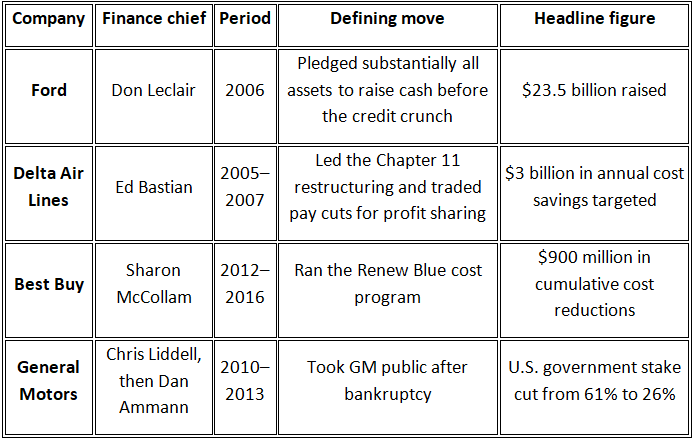
Four cases clear the bar. The table puts them on identical terms.
Ford
Leclair and treasurer Ann Marie Petach started the work in the summer of 2006, ahead of Mulally's arrival that September. Forbes reported in November that Ford had pledged substantially all its assets, a first in its 103-year corporate history, to secure $18 billion in loans. The deal closed in December at $23.5 billion: $18.5 billion of senior secured debt and credit facilities plus $5 billion of unsecured convertible debt, Mulally later told the Senate.
Timing did the rest. When credit markets seized two years later, Ford told Congress it needed no government bridge loan. Mulally, defending the decision to borrow even as profits fell, put it bluntly in Bloomberg: "I couldn't let the economy get in the way of what we needed to do." By February 2011, Ford had repaid $14.5 billion of the $23.5 billion, according to Stanford GSB.
Fortune argued in 2011 that without Leclair's plan, Ford would probably have run out of cash in the fall of 2008. That is a counterfactual, not a fact. Leclair retired that November at 56, and Fortune observed that his feat had faded from the story while Mulally collected the adulation. Time's business site, writing in 2012, placed Mulally's work among the most dramatic recoveries in the annals of American business.
Delta
Bastian resigned from Delta in January 2005, spent about two months as CFO of Acuity Brands and returned in July, according to his own bankruptcy-court declaration. Delta filed for Chapter 11 on Sept. 14, 2005. Alongside CEO Gerald Grinstein, his job was to make the numbers persuasive. He told the court the plan's $3 billion in annual cost savings was "absolutely necessary," and he helped close a $280 million-a-year pilot concessions deal, including an initial 14 percent pay cut, that a judge approved in 2006.
The design choice worth studying came next. Bastian pledged employees who had also taken deep cuts a share of future success, Fortune reported. His March 27, 2007 presentation projected profit-sharing payments of $171 million in 2007, rising to $457 million in 2010. Read plainly, concessions became a loan from employees, repaid out of profit. That interpretation is mine, not Delta's phrasing.
More than 95 percent of creditors backed the plan, which beat a $9.8 billion hostile bid from US Airways. Delta emerged on April 30, 2007, after nearly 20 months in court. Bastian has been CEO since 2016 and Delta's 2024 revenue approached $62 billion.
Best Buy
McCollam, a former Williams-Sonoma CFO, came out of retirement in 2012 to join CEO Hubert Joly. On her first Best Buy earnings call she described the first phase of a multi-year, $725 million cost program, one she said was "not all about headcount." By mid-2014, cumulative Renew Blue cost reductions stood at $900 million.
By the time Joly stepped down as CEO in 2019, Best Buy's non-GAAP return on investment stood at 25.8 percent, up from 10.5 percent in 2013, Forbes reported. His own sequencing is telling: "In my turnaround manual, which I have, you don't start with strategy." Cost discipline bought the room strategy needed.
General Motors
GM entered its 2009 bankruptcy with $82.3 billion in assets and $172.8 billion in liabilities. In November 2010 it sold 478 million shares at $33 and raised $23 billion, which GM called the largest public offering in history. Liddell led that process. Ammann, who succeeded him as CFO in April 2011, built what GM called a "fortress balance sheet." By December 2013, GM reported 15 consecutive profitable quarters since the IPO.
CEO Dan Akerson ran GM, so this is the least CFO-centric entry. It earns its place because the exit from government ownership was, at bottom, a finance project.
What did these rescues have in common?
The cash came first. In nearly every case, financing preceded strategy. Ford had the cash before the new CEO could put in place his corporate strategy and Joly's manual similarly puts cost ahead of vision.
Cash helped, but not always. The authors of a Springer literature review found that a parent's dry checkbook invested in a needy subsidiary, without a strategic rationale, failed to produce the desired result and often precipitated deterioration in the operating performance of the acquirer. Ford's $23.5 billion wasn't wasted on overhead; it was a runway for development, not a distribution for survival.
Subordination was a price. Both the profit sharing at Delta and the cost containment at Best Buy demanded sacrifice and the CFO is the steward of the returns.
Discipline had a better exit. Timing was more important than insight. Ford borrowed and Delta declared bankruptcy before either had to face creditors. Corporate historians will always find the most effective financial interventions were mundane acts by finance officers before the conflagration.
Why did the CFO rarely become the turnaround CEO?
The Spencer Stuart analysis of more than 1,300 CEO transitions within the S&P 500 universe found that just 10% of CEOs originated from the finance function and of those promoted from the ranks of CFOs, only 8% produced top quartile results. Moreover, compared to their non-CFO counterparts, operating income was initially higher for former finance chiefs who guided their firms through difficult times, generating $374 million more operating income than peers over the modeled period. They also grew revenue more slowly, risking nearly $1 billion lower losses during the period.
This fits with the narrative before this one, since finance officers were stabilizers, not disruptors. Exceptions to the lack of CFO CEOs include Bastian and Goodyear's Rich Kramer. The latter served as CFO of Goodyear from June 2004 to August 2007 and was then reappointed CEO for a stint lasting until January 2024. When Goodyear appointed him CFO, the previous CEO Robert Keegan said: "His expertise and experience will be an asset to the board and to our company as we continue our turnaround."
More about these companies
Apple's finance chief: Fred Anderson, who held the post from 1996 until 2004, was hired by Gil Amelio. The San Francisco Chronicle noted in its coverage that he played a critical role in the recovery of Apple's finances. Anderson was under investigation by the Securities and Exchange Commission for backdating options in 2007 and settled the dispute for around $3.5 million, without admitting guilt. Creditors are fickle.
Survivorship bias. This list contains recoveries of companies that have survived, because no one would nominate a restructuring that was completed by CFOs in the ranks for firms that have since failed. Therefore, this analysis represents a snapshot of a hypothesis.
Small steps can generate momentum. One of the cases cited by McKinsey in its memo about CFOs who drive change involved a chief financial officer who noticed that the same managers were reviewing two reports for the same business unit and consolidated them, cutting 40% of the reporting workload.
Corporate turnarounds favor the custodians of time and finance officers often occupy this presidential seat. Ford, Delta, Best Buy and GM were all stabilized by liquidity or shared sacrifice before strategic investment followed.
Business Fortune’s analysis brings out the limitations of finance chiefs who also rarely receive credit for subsequent growth and corporate annals wrongly celebrate the CEOs.

.webp)


























Comments