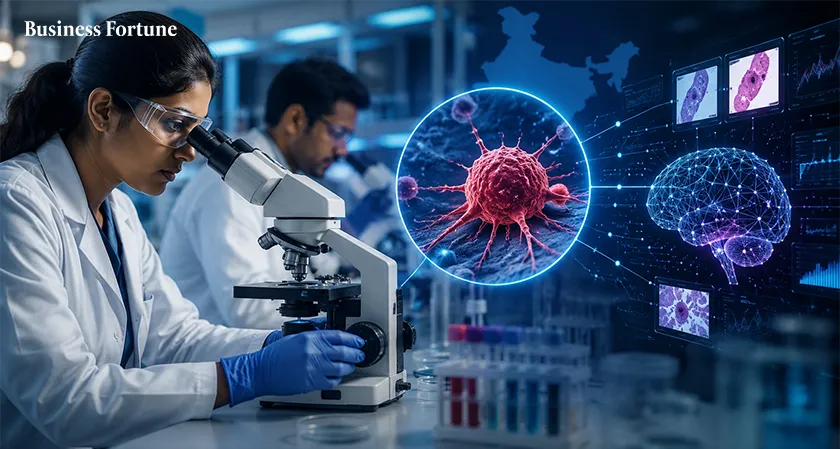
Researchers in India have developed MutAIverse, an AI powered platform that studies DNA damage and traces possible chemical exposures linked to cancer, opening a new path for cancer research and prevention.
The latest innovation on utilizing artificial intelligence to trace cancer roots has sparked the researchers' interest. The Indian scientists have engineered MutAIverse, an AI driven platform which enables tracing of chemicals provoking cancer through examination of DNA damage. A joint study led by researchers from IIIT-Delhi, NIPER Guwahati, CSIR-IGIB and Dr Bhubaneswar Borooah Cancer Institute has been published in the Journal of Cheminformatics in June 2026.
Tracing the Link beyond Cancer Diagnosis
A cancer diagnosis typically indicates what a patient is struggling with, but not necessarily the underlying causes of the disease.
This is where the newly developed MutAIverse comes into play. The researchers have focused on DNA adducts, meaning sensitive sites in DNA which can be altered when bound to a mutagen. These structural changes can lead to mutations if not properly repaired. The scientists have expanded the existing knowledge base of potential DNA adducts through extensive chemical modeling aided by generative AI to create an extended reference database. It allows the platform to examine patterns of altered molecules and infer possible parent chemicals which may bind to DNA.
The tool was tested on human head and neck cancer tissue samples, coming from smokeless tobacco users. The researchers have successfully identified a series of known and potentially new DNA adducts, part of which had been subject to further confirmation via MS/MS analysis.
Moreover, the innovative element of MutAIverse called AdductLinker enables it to go beyond DNA alteration patterns and attempt an inverse prediction of genotoxins potentially involved in causing cancerous mutations.
"We present here a robust, end to end and interpretable platform for advanced DNA adductomics analysis," the researchers stated in the paper.
The Limitations of Cancer Cause Detection
Unfortunately, the current capabilities of MutAIverse do not include the possibility of telling a specific patient what exact substance caused their cancer. While the presence of a DNA adduct confirms interaction with a genotoxic chemical, it does not necessarily mean that this substance caused cancer to develop. Thus, it remains unclear whether the predicted substance may be merely a bystander.
"The tool is indeed a research level discovery platform, but it still requires extensive validation before entering the clinical setting," the researchers note.
Potential Impact of Research and Future Clinical Applications
The new AI technology may enable cancer researchers to take a step beyond current limitations and begin exploring the intricate relationships between various carcinogens and DNA damage.
It may be especially crucial for countries like India which report numerous cases of smokeless tobacco use, often associated with oral cancer.
As of now, Business Fortune considers MutAIverse to be a promising but preliminary discovery which may contribute to a better understanding of cancerous mutation patterns.
FAQ
What MutAIverse is used for?
It is an AI driven research platform allowing to predict DNA adducts and trace their origin.
Can AI really trace the cause of someone's cancer?
Not yet, as the tool requires further validation to have sufficient accuracy to be used in clinical settings. It can predict interactions with substances potentially causing mutations, but cannot confirm them.
What cancer did the researchers test their theory on?
They used the tissue samples from head and neck cancer patients affected by smokeless tobacco.
What DNA adducts are?
They are alterations of DNA molecules caused by chemical interaction with a carcinogen.
Could MutAIverse be used in hospitals?
Not at the moment, but future research may allow for further validation and clinical use of the platform.


.webp)
































Comments