Is SAP still the right fit for every business? Explore the best SAP competitors for HR and finance, what they offer, and which business needs they can fit.
Choosing an enterprise platform for HR and finance is a major decision, especially when a business is moving away from SAP or reviewing its current ERP setup. The market now offers several strong options, from large enterprise suites to more focused HR and finance platforms. In this Business Fortune article, we look at the best SAP competitors for HR and finance, compare their strengths, explain where they fit, and share practical points to consider before choosing an alternative.
Why are businesses looking beyond SAP?
SAP still continues to be one of the most popular enterprise software companies offering their cloud ERP solution for fields such as finance, supply chain, procurement and human resources. Their present cloud ERP solutions also come with AI and real time analytics. However, not all businesses require the same kind of difficult software.
Some business could need an easy-to-use cloud solution, better human resources management capabilities, better integration with their existing solutions or something which fits them from a scale and budget perspective. Other businesses could be looking for a solution that integrates their finance, payroll, work force management and planning. That is why the search for SAP alternatives for HR and finance solutions has become more complex.
SAP competitor comparison: The main alternatives
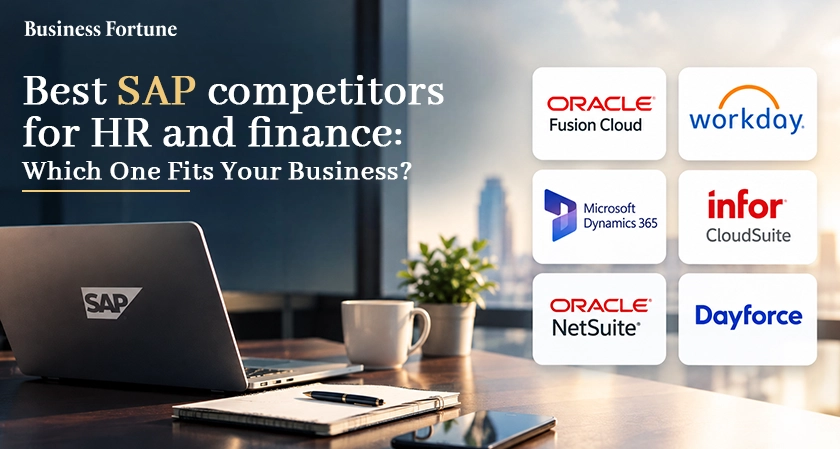
There is no single replacement that works for every company. Some platforms focus heavily on HR, while others are designed around finance and broader ERP operations. Here are several major names businesses can consider:
These platforms should not be treated as identical products. Their approaches to HR, finance, payroll, reporting, implementation and integrations can be quite different. Recent ERP research also places Oracle, Microsoft, Infor and Workday among the major enterprise ERP options, while NetSuite is commonly considered in the mid-market segment.
Oracle Fusion Cloud
Oracle is one of the most direct names to consider when looking at SAP ERP alternatives. Oracle Fusion Cloud combines enterprise finance and human capital management with other business functions. This makes it relevant for organizations that do not want separate systems for every major department.
For finance teams, Oracle offers accounting, reporting, planning and other financial management capabilities. On the HR side, Oracle provides tools covering areas such as talent, workforce management and employee processes. This makes Oracle particularly relevant to large organizations with complex structures, multiple locations or global operations. It is also worth considering when a company wants its ERP strategy to cover more than accounting and payroll. For large enterprises, that broader platform approach can be important.
Workday
Workday has built its reputation around human resources and financial management. Its platform brings HR, finance, planning and other business functions onto a cloud-based system. Workday describes its ERP as a platform covering financial management, human capital management, planning, procurement and operations.
Its HR capabilities can cover employee information, talent, payroll-related processes and workforce management, while its finance products support accounting, reporting and planning. The important point is that Workday is not simply an HR replacement. Its product strategy now covers a much wider set of enterprise processes.
Microsoft Dynamics 365
Microsoft Dynamics 365 is another big player when it comes to the SAP competitors. Microsoft Dynamics ERP suite includes Dynamics 365 Finance and Dynamics 365 Human Resources along with a number of other modules covering supply chain, commerce, projects and more. According to Microsoft, Dynamics 365 integrates financials, operations and HR data, whereas Dynamics 365 Finance provides features related to reporting, planning, forecasting and cash flow management.
One area that makes Dynamics 365 interesting is its connection with the wider Microsoft ecosystem. Companies already using Microsoft products may find that integration and familiarity are important parts of their ERP decision.
Dynamics 365 also serves smaller organizations through Business Central, giving businesses a path that can scale as their needs change.
Infor CloudSuite
Infor uses different strategy that involves heavy emphasis on industrial business requirements. Infor's ERP suite includes products for manufacturing industries, healthcare, distribution and other industrial sectors. This is important because HR and financial departments do not function in isolation from the rest of the business. For instance, a manufacturing firm would require its financial department to work seamlessly with production and human resources.
This makes Infor a good choice for firms that are looking for SAP alternatives for large corporations where industrial processes are as important as financial and HR processes. The core of the matter here is not whether the software offers modules for HR and finance but whether the software works well with the actual business process.
Oracle NetSuite
For companies that do not need a very large enterprise platform, NetSuite can enter the conversation. NetSuite is a cloud ERP platform that is widely used for financial management and broader business operations. ERP research identifies NetSuite among the major mid-market ERP options.
It can be particularly relevant when researching SAP alternatives for mid-market businesses. A growing company may need financial management, reporting, inventory, order management and other ERP functions without building an extremely complex enterprise environment.
However, businesses should look carefully at HR and payroll requirements. A finance-focused ERP and a full HCM platform are not necessarily the same thing.
Dayforce
If HR, payroll and workforce management are the main priorities, Dayforce deserves consideration. Dayforce is more focused on the people side of business than a traditional broad ERP. Its capabilities cover areas such as human resources, payroll, workforce management, talent and related employee processes.
That makes it relevant for businesses searching specifically for HR payroll and finance software, although companies should assess how its finance requirements will connect with their wider ERP environment.
This is an important distinction. Sometimes the best SAP alternative is not one huge replacement system. A business may choose a specialist HR platform and connect it with a separate finance system.
Which ERP is best for HR and finance?
A global company may need complex legal entities, multiple currencies, international payroll, detailed financial controls and advanced reporting to know which ERP fits the company's HR and finance requirements?
A mid-sized business may care more about ease of use, implementation time, cost and the ability to add new functions later. A company with thousands of hourly workers may put workforce scheduling and payroll ahead of other features. This is why businesses should avoid selecting software simply because it is popular. The platform has to match the organization's structure and working style.
SAP alternatives for HR and finance: What should you compare?
A proper evaluation should go beyond a product demonstration. Start with these areas:
-
HR capabilities: Check employee records, recruitment, talent management, learning, time tracking, payroll and workforce planning.
-
Finance: Look at accounting, financial reporting, budgeting, forecasting, consolidation, accounts payable and receivable.
-
Integration: Find out how easily the system connects with existing applications, data sources and third-party tools.
-
Scalability: Consider where the business will be three to five years from now, not only where it is today.
-
User experience: A system can have hundreds of features, but that does not help if employees struggle to use it.
-
AI and automation: Modern ERP platforms increasingly include AI-supported forecasting, automation and decision tools. Microsoft, for example, is adding Copilot and agent-based capabilities across finance and ERP workflows.
-
Implementation: This can have a major effect on the actual project cost and timeline. A technically powerful system can still create problems if the implementation is too complicated.
How to choose an SAP alternative
The best method would be to begin with the company's needs rather than software products.
The first step would be to make a list of HR and finance issues that the existing system does not resolve satisfactorily. Then, the needs will be divided into mandatory and nice-to-have needs.
Secondly, the company should decide on whether it needs a new complete ERP system or just some part of the system, such as HR, payroll or finance.
The third step will be generating a shortlist and testing the platforms in different business situations. You will need to ask the vendors to demonstrate what your staff does rather than just giving you a product demonstration. Finally, the total cost needs to be calculated.
In such cases where organizations are considering SAP finance alternatives or SAP competitors in terms of HR, this is not just about changing outdated systems. Rather, it is about selecting a way for people and financial information to interact in the coming years. The best option may not always be the best one in reality, since there can be platforms suited for specific companies' sizes and industries.


.webp)






























Comments